
KAMPALA — Women traders across East Africa continue to face harassment, abuse and exploitation at border crossings, forcing many to abandon official posts for unsafe, informal routes, a report presented Tuesday to the East African Legislative Assembly (EALA) shows.
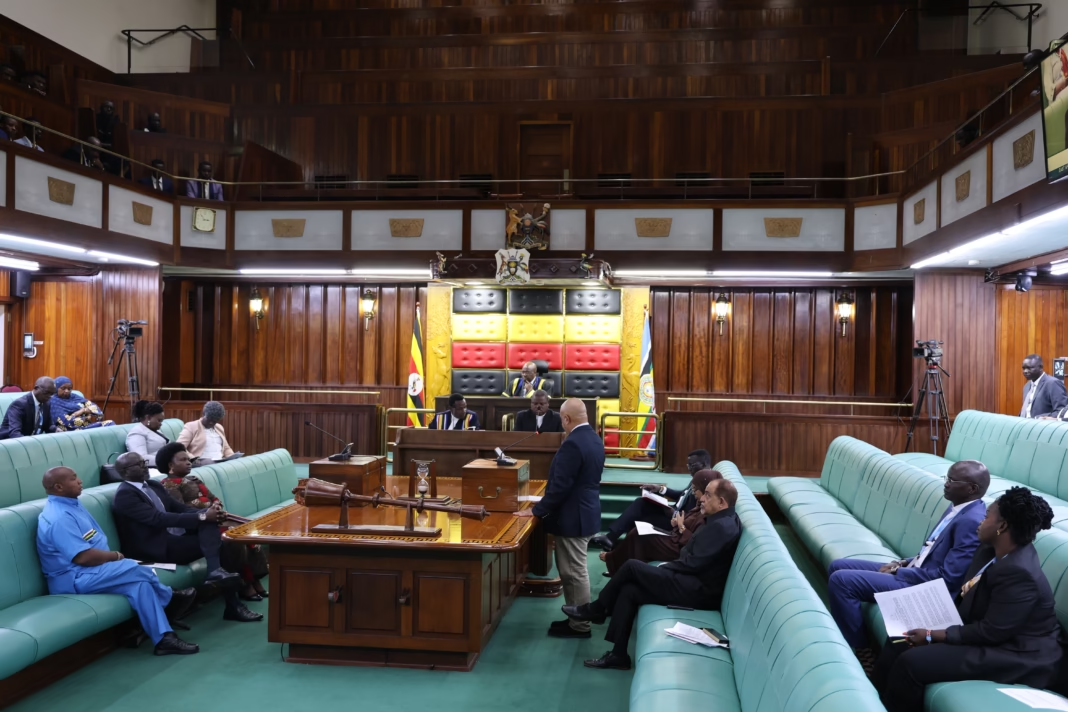
Presenting the findings in Kampala, EALA Women Caucus Chairperson Ann Itto said fear of mistreatment by customs and security officials remains widespread, undermining women’s safety and livelihoods. The report notes women frequently resort to unofficial routes due to a “fear of mistreatment by customs and other border officials,” exposing them to “harassment and incurring of heavy business losses.”
Incidents of “verbal, physical and sexual abuse” by border personnel are described as common, but reporting remains rare. The document adds that the absence of confidential hotlines, women’s desks or other complaint mechanisms leaves traders “vulnerable and without recourse.”
The oversight mission also documented persistent exploitation by middlemen who inflate fees or mislead women about customs requirements. According to Itto, these intermediaries take advantage of traders “due to lack of awareness and confidence, or lack of direct access to trade channels.” She said low literacy levels, limited digital skills and misinformation further compound the problem. “Many women are unaware that simplified clearance procedures for small consignments are free,” she said, “leading them to rely on agents despite the financial losses.”
Border infrastructure also came under scrutiny. Inspectors flagged a lack of childcare facilities, insufficient sanitary toilets and poor shelter at several posts. “These systemic failures force many women into unsafe informal trading pathways,” the report concludes.
During the same session, EALA MP Abdu Hasnu Makame urged the assembly to act, saying the challenges affect all informal traders crossing borders, not only women. “We should forward this recommendation to the council so that we can act on the recommendations,” he said.
Women comprise the bulk of small-scale traders
Statistics from the EAC Secretariat show that women account for a significant portion of cross-border trade. During a recent visit by the EAC Secretary General and the EALA Women Caucus to a border post, officials noted that women constitute about 60% of cross-border trade activity.
One advocacy effort a trade-facilitation forum organised by EABC together with the East African Women in Business Platform (EAWiBP) reiterated that women (together with youth) form the majority of small-scale cross-border traders and called on EAC governments to eliminate fees and charges that act as barriers to take-up of the formal trading scheme at official border posts.
Experts tracking informal cross-border trade (ICBT) in the region estimate that up to 80% of all informal traders in the EAC are women.
The EAC has established a Simplified Trade Regime (STR) that allows small consignments (valued at or below US$ 2,000) to clear customs with minimal paperwork.
Under previous EAC-GIZ initiatives, dozens of women cross-border traders from Uganda and South Sudan participated in training at border posts, where they learned how to use the STR and formal trade procedures, aiming to reduce the risks associated with informal trading.
However, low awareness of the STR, limited access to information, and poor border-point infrastructure continue to push many women toward informal and risky trade routes. As reported by Burundi Times during a 2025 visit to the Gatumba border between Burundi and the DRC: “non-tariff barriers and costly travel documents” remain major obstacles for women traders.
The evidence from the EALA report, and corroborating data from EAC and EABC-linked initiatives, underline the urgent need for reforms to protect women traders. Key measures recommended by women’s rights lobbyists and trade experts include, establishing confidential complaint mechanisms at border posts, such as women’s desks or hotlines, to allow traders to report abuse without fear of retaliation.
Investments in gender-responsive border infrastructure: sanitary facilities, childcare areas, shelter, safe waiting zones and secure storage for goods. Expanding awareness campaigns on STR and cross-border trade regulations, especially aimed at women and small-scale traders.
According to EALA, in a region where women make up the majority of informal cross-border commerce and yet remain vulnerable to abuse and exploitation, failure to address these barriers risks perpetuating inequality and undermines efforts to realise inclusive and sustainable regional economic integration under the EAC.