
Humanitarian organizations and United Nations officials have called for stronger protection of aid workers as attacks against humanitarian personnel continue to rise amid conflicts, shrinking humanitarian space and funding constraints.
The call was made Wednesday in Nairobi during a World Humanitarian Day event convened by World Vision International’s East Africa Regional Office in partnership with the U.N. Office for the Coordination of Humanitarian Affairs (OCHA) Regional Office for Southern and Eastern Africa and the Regional Inter-Agency Working Group.
The event, held under the theme “#NotATarget: Humanising Aid in an Era of Growing Risk,” brought together humanitarian agencies, donors, U.N. officials, nongovernmental organizations, academics and students to discuss the risks facing aid workers and the need to uphold international humanitarian law.
More than 1,000 humanitarian workers were killed globally between 2023 and 2025, according to U.N. figures. The toll is nearly three times the 377 aid workers killed during the previous three-year period.
The U.N. said at least 350 humanitarian personnel were killed in 2025. In 2026, at least 82 aid workers had been killed, while 97 were injured and 39 kidnapped, according to figures released around World Humanitarian Day.
Gaza remained the deadliest location for aid workers in 2025, with 186 humanitarian personnel killed, followed by Sudan with 71, according to OCHA.
Lilian Dodzo, World Vision’s regional leader, paid tribute to humanitarian workers who had been killed while carrying out their duties.
“I take this moment to pay tribute and honour those who paid the ultimate sacrifice in the line of duty,” Dodzo said.
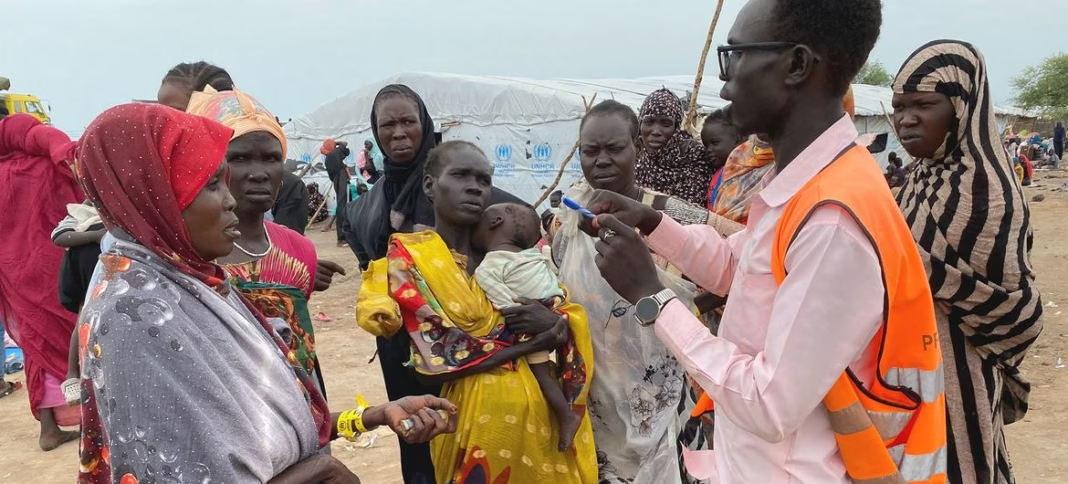
Participants also heard accounts from humanitarian workers operating in Sudan and South Sudan, where conflict, insecurity and access restrictions have complicated the delivery of assistance.
Rachel Mikanagu, director of the Regional Inter-Agency Working Group for East and Central Africa, said humanitarian organizations had a shared responsibility to protect personnel working in conflict-affected areas.
“As the humanitarian community, we have a shared responsibility to ensure that aid workers can carry out their life-saving work safely and without fear of violence,” Mikanagu said.
The discussions focused on protecting humanitarian personnel and civilians, strengthening humanitarian diplomacy and accountability, and adapting humanitarian operations to increasingly complex and resource-constrained environments.
Participants identified attacks against aid workers, shrinking humanitarian space, misinformation and disinformation, climate-related emergencies and reductions in humanitarian funding as major pressures on aid operations.
Carlos Geha, head of OCHA’s Regional Office for Southern and Eastern Africa, said humanitarian operations must maintain their core principles while adapting to changing conditions. Geha took up his Nairobi-based regional post in February 2026 after previously serving as head of OCHA’s office in Pakistan.
“The future of humanitarianism depends on our ability to stay true to our principles while adapting to new realities,” Geha said.
The U.N. has repeatedly called on states and parties to conflicts to comply with international humanitarian law and hold perpetrators accountable for attacks against humanitarian personnel.
U.N. humanitarian chief Tom Fletcher said in April that more than 1,010 humanitarian workers were killed between 2023 and 2025, including more than 560 in Gaza and the West Bank, 130 in Sudan, 60 in South Sudan, 25 in Ukraine and 25 in the Democratic Republic of Congo.
The Nairobi event concluded with calls for stronger accountability for attacks against aid workers and civilians, greater investment in local humanitarian organizations, improved use of data in humanitarian decision-making and closer engagement with affected communities.
World Humanitarian Day is observed annually on Aug. 19. It was established by the U.N. General Assembly in 2008 to commemorate the 2003 bombing of the U.N. headquarters in Baghdad, which killed 22 people, including the U.N. envoy to Iraq, Sergio Vieira de Mello.