
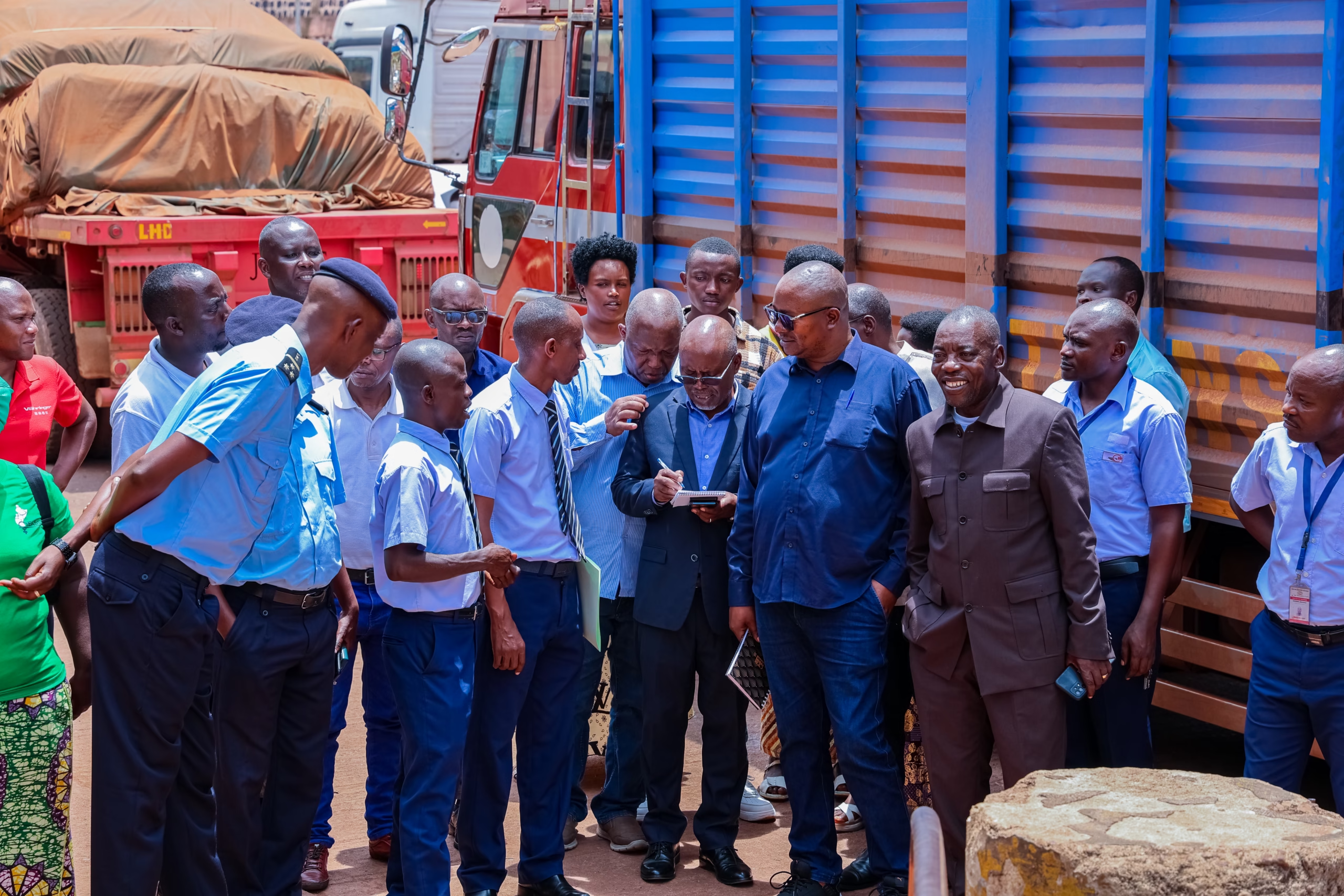
Lawmakers from the East African Legislative Assembly have raised concerns over early border closure, infrastructure shortfalls and procedural inconsistencies at the Kobero–Kabanga One Stop Border Post, warning that the challenges are constraining trade efficiency and undermining regional integration.
The concerns emerged during an oversight mission by EALA’s Committee on Communication, Trade and Investment on March 17–18 to assess progress in operationalizing the key crossing between Burundi and Tanzania.
EALA member Anastase Manirambona said limited operating hours — from 7 a.m. to 7 p.m. — remain a significant bottleneck for cross-border movement.
“We sometimes travel from Arusha via Kobero, but in most cases when you arrive at around 7 p.m., the border is closed,” he said. “So how will we reach the Vision 2040–60 if the border is closed this early?”
Other lawmakers noted that major crossings such as Namanga Border Post and Busia Border Post operate 24 hours, underscoring Kobero–Kabanga’s limited schedule as a constraint on regional logistics.
Saidi Kibeya, an EALA member from Burundi, said the restricted hours increase the cost of doing business and delay the movement of goods and people.
“We are here to learn and discuss the issues at Kobero–Kabanga so that we can report to Parliament and necessary measures can be taken to promote regional integration — especially to support free movement of goods, people and services,” Kibeya said. “This makes business costly and also more time is wasted. So why should Kobero–Kabanga not work 24 hours?”
Security and staffing constraints were cited as key barriers to round-the-clock operations. Kobero Police Chief Alfred Ntakarutimana said limited personnel and infrastructure gaps hinder extended hours.
“If we get eight officials and three groups who can work eight hours each, we can make the 24 hours,” he said. “There are no street lights between Kobero and Kabanga, and we also face security concerns.”
Ntakarutimana added that some travelers are denied entry based on security directives, including individuals from areas considered high-risk. He noted that Rwanda nationals are not allowed to enter Burundi via the land border, though they can travel by air.
At the operational level, officials reported steady revenue growth alongside persistent structural challenges. Jackson Kassa said the OSBP, launched in 2016, has recorded consistent gains on the Tanzanian side.
“In 2023, revenue was 12.5 billion Tanzanian shillings (about $4.8 million). In 2024, the target was 14 billion, but we collected 15 billion (about $5.8 million). In 2025, we collected 17 billion (about $6.5 million),” Kassa said. “This has been possible due to collaboration between Burundi and Tanzania, but there are still challenges.”
He cited smuggling through porous routes and the absence of cargo scanners on the Tanzanian side as ongoing risks, adding that authorities are working with security agencies in both countries to address them.
For Burundi, the OBR officials at the border declined to provide the annual revenue collection at the border.
Traders and officials also pointed to a lack of harmonized procedures between the two sides. A cross-border trader said goods in transit within the East African Community are sometimes taxed locally in Tanzania, increasing costs.
A Tanzanian customs official identified as Abdul said small-scale traders are treated differently across the border.
“We facilitate small traders — they almost pay nothing at our end — but Burundi still treats them like formal business people,” he said.
Officials cited a recent case in which a Tanzanian trader’s pickup truck carrying bananas was impounded and bananas were auctioned due to procedural discrepancies.
“The bananas were impounded and even the car a border official had to pay for it to be released. There is a lack of harmonized border procedures,” the official said.
EALA member Gabriel Ntisezerana described long delays at the crossing as counterproductive to the OSBP model.
“I always pass here to Arusha and sometimes it takes me about four hours waiting to cross the border. This is a big problem,” he said. “If I can spend more time, what’s the use of a one stop border post? Especially on the Burundian side, I am angry because officials arrive late.”
Local authorities highlighted infrastructure and service delivery gaps. Belyse Dukundane cited unreliable internet, electricity shortages and limited services at the border.
“We have a problem of internet, electricity and services. These are the challenges the border mainly faces,” she said, adding that tax awareness campaigns are needed to help traders better understand procedures.
Additional constraints include limited availability of yellow fever vaccination cards and centralized decision-making that delays operations.
“In Tanzania we can take a decision and later report to our bosses, but for Burundi all decisions are taken from Bujumbura,” one official said. “Officers have to call first before acting.”
The Kobero–Kabanga OSBP is a strategic trade gateway linking Burundi and Tanzania within the East African Community corridor. One Stop Border Posts are designed to streamline customs, immigration and inspection processes by co-locating officials from both countries in a single facility, reducing clearance times and logistics costs. However, unlike 24-hour crossings such as Namanga and Busia, Kobero–Kabanga’s limited hours and operational inefficiencies continue to weigh on trade flows and business competitiveness.


