
A BURUNDI TIMES SPECIAL INVESTIGATION
THE LOST MARKET | PART ONE
The empty site that became a symbol of delay
For more than a decade, one of Bujumbura’s most valuable commercial locations has represented both ambition and frustration.
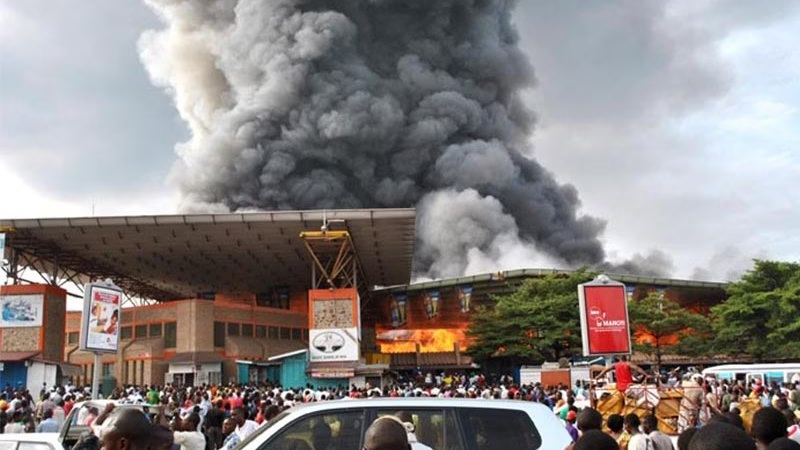
The site where thousands of traders once sold goods every day has remained at the centre of repeated reconstruction promises since the early morning of Jan. 27, 2013, when a fire destroyed the Central Market of Bujumbura.
The market was not simply a collection of shops.
It was one of the main engines of urban commerce, connecting wholesalers, retailers, transport operators and consumers in Burundi’s economic capital.
Its destruction disrupted thousands of businesses and changed the commercial landscape of the city. Traders were forced to relocate, with many moving their activities to other markets and commercial areas.
Thirteen years later, the site has entered another chapter.
The government and private investors are now advancing Buja City Plaza, a planned modern commercial complex that authorities say will replace the former market through a public-private partnership structure.
But after years of announcements, the project is facing the biggest test of all:
Can Burundi finally turn a long-promised reconstruction into a completed investment?
A market that carried more than commerce
Before the fire, the Central Market occupied a unique place in Burundi’s economy. For traders, it was a workplace. For consumers, it was a major shopping centre. For suppliers, it was a distribution point connecting goods from importers and wholesalers to businesses across the country.
The destruction therefore created consequences beyond the physical loss of infrastructure. Thousands of traders lost access to the commercial space where they earned their livelihoods. The economic impact continued long after the flames disappeared.
The former market site became a reminder of a broader challenge facing many developing cities: replacing damaged infrastructure while maintaining economic activity during periods of transition.
Following the fire, authorities repeatedly announced plans to restore the commercial centre. The objective appeared straightforward: replace the destroyed market with a modern facility capable of serving traders and supporting economic growth.
However, the process proved far more complicated. Over the years, different reconstruction proposals emerged, involving different concepts and potential investors. Some plans focused on rebuilding a market. Others moved toward a larger commercial real estate development model.
But despite several announcements, no replacement facility was completed. By early 2026, reporting by SOS Médias Burundi described the former market site as still awaiting effective reconstruction, despite previous commitments and preparatory activities.
From rebuilding a market to developing a commercial landmark
The latest approach represents a major shift. The project is no longer presented simply as a replacement market. It is being developed as Buja City Plaza, a modern commercial complex intended to combine retail space with wider urban redevelopment.
According to information published by the project developer, the development is expected to include commercial facilities, offices, hospitality and other urban functions.
The project is being promoted by Ubakanation Group and structured through a partnership involving the government and private investors. The government has created a project company, Ubaka Landmarks, responsible for the conception, financing, construction, operation and maintenance of the commercial complex.
The new PPP model
The biggest difference between the current initiative and previous attempts is the financing approach. Rather than depending only on direct government financing, the project is being developed through a public-private partnership. According to government documents, the PPP arrangement involves the state participating through the Banque d’Investissement pour les Jeunes (BIJE) and the private investment side through One Africa Investment Fund.
A government document reviewed by Burundi Times states that the PPP contract covers the design, financing, construction, operation, maintenance and eventual transfer of the commercial centre. The agreement foresees a 27-year period, including three years for construction and 24 years of commercial operation.
This structure is intended to combine public oversight with private capital. However, the success of such arrangements depends heavily on implementation.
The government’s latest commitments have raised new expectations among traders and businesses that have waited since 2013.
In February 2026, Burundi’s Cabinet examined the PPP agreement for Buja City Plaza, approving the framework with recommendations related to implementation monitoring and ensuring that construction costs correspond with project realities.
In April 2026, the presidency announced the appointment of state representatives to the board of Ubaka Landmarks, the company overseeing the project.
Those steps indicate that the project has moved beyond earlier conceptual stages and into a more formal institutional phase.
The investor confidence test
For Burundi’s economy, Buja City Plaza represents more than a single construction project. Large commercial developments are often viewed by investors as indicators of a country’s ability to execute complex projects. A successful project could demonstrate that Burundi can structure large public-private investments, attract private capital, manage long-term commercial assets and transform strategic urban spaces. But delays or financing difficulties could raise broader questions about project execution.
The challenge is therefore not only constructing a building. It is delivering a commercially viable asset.
The traders’ question: who benefits from the new market?
For many former traders, the reconstruction debate is ultimately about economic opportunity. The new development will need to answer practical questions:
Will previous traders have access to commercial spaces?
Will rental costs remain affordable?
How will smaller businesses fit into a modern commercial model?
A successful redevelopment will depend not only on investors and construction companies, but also on whether the project reconnects with the traders and consumers who made the original market economically important.
After thirteen years of waiting, Buja City Plaza has reached the stage where announcements must translate into measurable progress. The project now has a defined name, a project company, a PPP framework, government participation and identified private investment partners. The remaining challenge is execution. The question that has followed the site since 2013 remains unchanged