
Senior officials from Rwanda and the Democratic Republic of Congo have exchanged pointed accusations on social media, underscoring deepening tensions between the neighboring countries as regional and international peace efforts struggle to contain renewed violence in eastern Congo.
The latest exchange followed comments by Congolese government spokesperson Patrick Muyaya, who on Jan. 9 outlined Kinshasa’s position on political dialogue and ongoing mediation processes involving Rwanda and the armed M23 rebel group.
In a post on X, Muyaya said President Félix Tshisekedi had already agreed in principle to a political dialogue, adding that a roadmap had been jointly prepared by the Congolese presidency, the National Episcopal Conference of Congo (CENCO), the Church of Christ in Congo (ECC), and representatives of revival churches.
Muyaya emphasized, however, that any internal dialogue must be sequenced alongside existing international processes. He described talks in Washington as a dialogue with Rwanda, which he labeled “the father,” and negotiations in Doha as a dialogue with the M23 rebel group, referred to as “the son.”
“There is no legitimacy crisis in the DRC,” Muyaya wrote. “The crisis we are experiencing is of a security origin linked to Rwandan aggression.” He questioned whether political dialogue alone would be sufficient for Rwanda to halt what Kinshasa describes as destabilizing activities on Congolese territory, and insisted that any national dialogue would take place inside the country, not abroad.
Rwanda’s foreign affairs minister Olivier Nduhungirehe responded sharply, rejecting Kinshasa’s framing and accusing Congolese authorities of deflecting responsibility.
“When the father (Congolese government), the son (FDLR genocidaires), and the evil spirit (genocide ideology) attempt yet another ‘forum shopping’ in three years, as a delaying maneuver, we simply recall that salvation will first come from Kinshasa’s political will to apply the current peace processes in good faith,” the minister wrote on X.
The reference to the FDLR a Rwandan Hutu militia formed by remnants of forces linked to the 1994 genocide reflects Kigali’s longstanding justification for its security posture near or inside eastern Congo. Rwanda accuses the Congolese army of collaborating with the FDLR, an allegation Kinshasa denies.
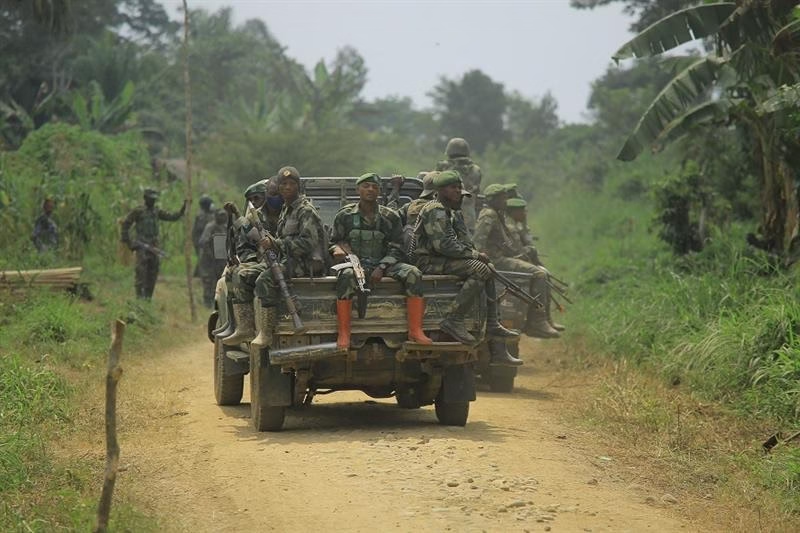
The war of words comes amid an entrenched conflict in eastern Congo, where fighting involving the M23 has displaced hundreds of thousands of civilians. The Congolese government and the United Nations have repeatedly accused Rwanda of backing the rebel group, a claim Rwanda denies.
Multiple mediation tracks are currently underway, including efforts led by Qatar, the United States, and regional organizations. Progress has been slow, with ceasefire agreements frequently collapsing and both sides accusing the other of bad faith.
Congolese officials argue that any political dialogue must complement, not replace, international peace processes addressing security threats and foreign involvement. “Any national political dialogue, which would be complementary to these processes, would then be welcome,” Muyaya said.
Analysts say the public exchange highlights the fragility of diplomatic engagement and the deep mistrust between the two governments, even as pressure grows from international partners for de-escalation.
For now, the dispute continues to play out both on the battlefield and online, reflecting a conflict where political rhetoric and military realities remain closely intertwined.


