
Burundi President Évariste Ndayishimiye has congratulated Zambian President Hakainde Hichilema on his re-election, describing the result as an opportunity for Zambia to pursue greater peace, unity and prosperity.
Ndayishimiye issued the message Tuesday in his capacity as both president of Burundi and chairperson of the African Union, following the Electoral Commission of Zambia’s declaration of Hichilema as the winner of the Aug. 13 presidential election.
“On behalf of the people and Government of Burundi, and of the entire African Union family, I convey my best wishes for continued success as he leads the Zambian people toward greater peace, unity, and prosperity — for the benefit of Zambia and our continent as a whole,” Ndayishimiye said in a message posted on his official X account.
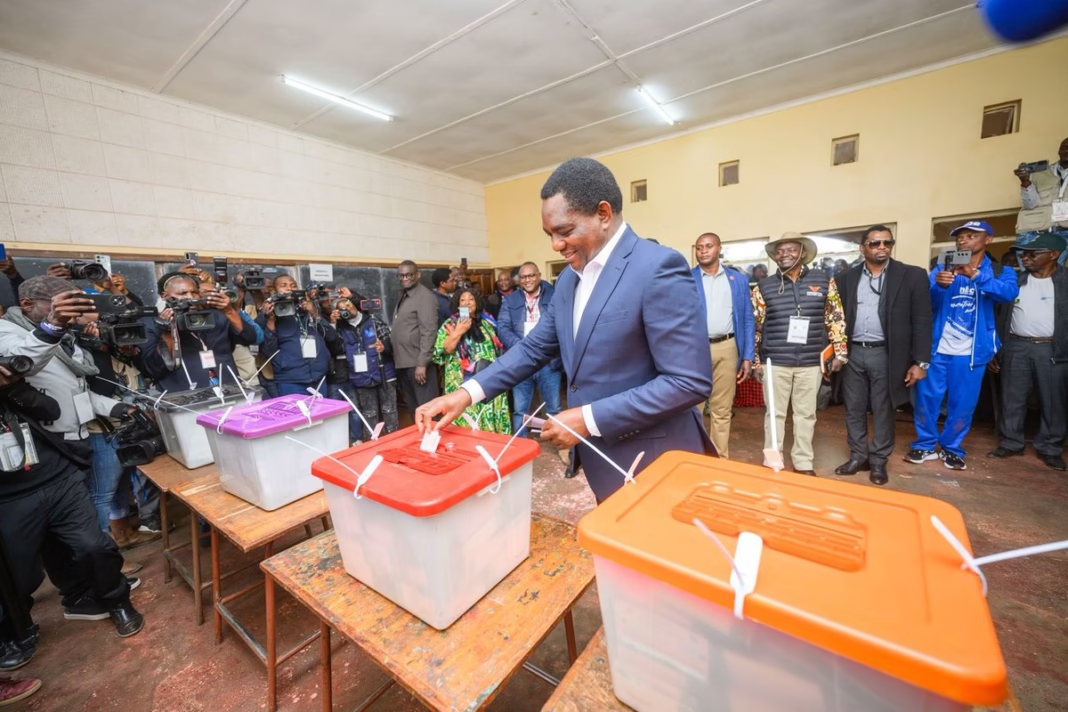
The commission declared Hichilema the winner after he secured 61.4% of the vote, or 2,965,326 votes, against 1,856,217 votes for his closest challenger, opposition leader Brian Mundubile. About 5 million votes were cast, according to the commission.
The result gives Hichilema, 64, a second five-year term after he first won the presidency in 2021, ending the long rule of Edgar Lungu’s Patriotic Front.
But while international observers described election day as largely peaceful and competitive, they raised concerns about the broader electoral environment, including restrictions on political freedoms, the use of state resources and unequal campaign conditions.
The European Union Election Observation Mission said the election was competitive, with 14 presidential candidates offering voters a choice, but concluded that restrictions on fundamental freedoms and advantages enjoyed by the incumbent created an uneven playing field.
“The broader electoral process took place in an environment that limited fundamental freedoms,” EU chief observer Michael McNamara said.
The EU mission said late changes to electoral laws created legal uncertainty and limited the time available for voters and stakeholders to understand the new rules. It also said constitutionally required laws governing political parties and political finance had not been enacted, weakening transparency and accountability.
The EU mission further reported that the campaign calendar introduced by the Electoral Commission of Zambia did not apply to the president and vice president, while restrictions affected other candidates’ ability to campaign and move freely.
It also said it directly observed the misuse of state resources at campaign events in eight provinces.
State-owned media was another concern. The EU mission said its monitoring found “heavily biased state-owned media coverage” in favor of the ruling party and reported increased self-censorship following changes to cyber laws.
Despite those concerns, the EU observers said election day itself was calm overall. The mission observed voting at 419 polling stations, as well as opening, counting and tabulation processes, and said polling staff efficiently facilitated voting while ballot counting was transparent in the stations it observed.
The African Union and Common Market for Eastern and Southern Africa also deployed a joint observation mission.
The AU-COMESA mission, led by former Ethiopian Prime Minister Hailemariam Dessalegn, comprised 93 short-term observers from 27 African countries. It observed voting at 740 polling stations across all 226 constituencies.
The mission noted Zambia’s history of peaceful transfers of power, including the changes of government through elections in 1991, 2011 and 2021. It also identified the cost of living, youth unemployment, poverty, political polarization and party alliances as important factors shaping the 2026 contest.
However, the AU-COMESA mission raised concerns over the timing of electoral reforms. It noted that the Electoral Processes Act was passed in May, only about three months before the election, leaving limited time for civic and voter education on the new rules.
The Southern African Development Community’s election observation mission also described election day as largely peaceful. It observed 277 polling stations across Zambia’s 10 provinces and reported a calm atmosphere at 275 of them.
The SADC mission, however, raised a specific concern over ballot secrecy after observing instances in which a voter’s national registration number was recorded against or on the ballot paper. It said any procedure that could allow a ballot to be traced to an identifiable voter was inconsistent with the constitutional principle of secrecy of the ballot.
SADC also called for reforms to the appointment of Electoral Commission of Zambia commissioners and urged the government and Parliament to enact legislation governing the registration, management, funding and accountability of political parties. It further recommended that electoral reforms be completed sufficiently ahead of future elections rather than during the election cycle.
The election was also briefly disrupted during the results-counting period. The Electoral Commission temporarily suspended counting after attacks on polling officials and the theft of ballot papers were reported. Several opposition figures were arrested, while Mundubile said police raided his home in what he described as an attack on his life.
The tensions did not prevent the electoral commission from completing the declaration of the presidential result.
Hichilema’s re-election comes as Zambia continues to grapple with the economic consequences of its 2020 sovereign debt crisis. During his first term, his government secured a restructuring of Zambia’s debt and pursued an economic reform program, while the country continued to face pressure from high living costs, unemployment, power shortages and poverty.
The president’s second term is also expected to focus heavily on Zambia’s copper industry. The country is seeking to significantly increase copper production as demand for critical minerals rises globally, while attracting new investment remains a central economic priority.
Ndayishimiye’s message places Burundi among the African governments publicly acknowledging Hichilema’s victory following the official declaration.
In his message, the Burundian president emphasized the broader continental dimension of the result, extending his congratulations not only on behalf of Burundi but also in his capacity as chairperson of the African Union.
Hichilema is now expected to begin a second term with pressure to translate the economic stabilization achieved during his first administration into broader improvements in living standards while addressing concerns raised over democratic space and the conduct of future electoral processes.