
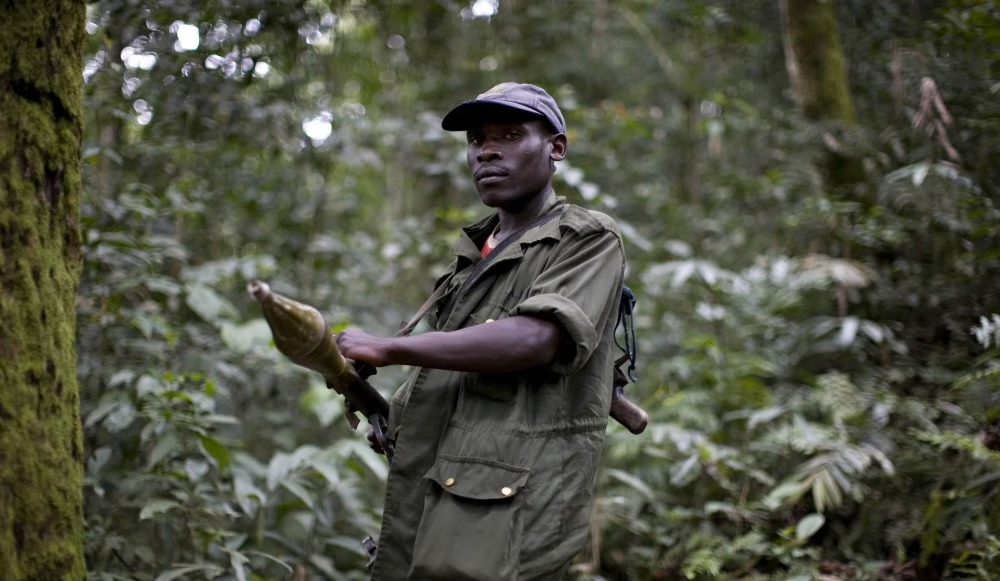

Democratic Republic of Congo President Félix Tshisekedi and Tanzanian President Samia Suluhu Hassan have called for the withdrawal of all unauthorized foreign forces from Congolese territory, putting renewed regional pressure on the military dimension of the conflict in eastern Congo.
The demand was made in a joint communiqué issued after Tshisekedi’s official visit to Zanzibar on Aug. 17-18. The two presidents said all relevant United Nations Security Council resolutions should be implemented, including provisions calling for an end to hostilities and the “unconditional” withdrawal of unauthorized foreign forces from the DRC.
The call comes as Kinshasa and Kigali work through a U.S.-backed peace framework aimed at ending the conflict in eastern Congo, where Rwanda backed AFC/M23 rebel movement controls substantial territory. Rwanda has faced international accusations of providing military support to the group.
Rwanda has denied backing M23 as a proxy force and says its “security measures” in eastern Congo are driven by threats from armed groups operating near its border, particularly the Democratic Forces for the Liberation of Rwanda, or FDLR.
The latest Tanzania-DRC statement also explicitly links the foreign-force issue to the FDLR.
The two presidents welcomed efforts to “neutralize” armed groups, specifically naming the FDLR, and called for its disarmament and dissolution. They also called for disarmament, demobilization, repatriation or reintegration of other non-state armed groups, along with accountability and transitional justice.
FDLR remains at the center of the dispute
The FDLR emerged from forces linked to the 1994 genocide against the Tutsi in Rwanda and has operated for decades from eastern Congo.
For Rwanda, the group’s continued presence is a core national-security concern. Kigali says FDLR fighters and allied groups have operated from Congolese territory and pose a threat to Rwanda.
Rwanda has also accused successive Congolese governments of working with the FDLR against M23 and other armed groups.
In a statement to the U.S. House Foreign Affairs Committee in January, Rwanda’s ambassador to Washington, Mathilde Mukantabana, said Kigali’s security coordination with AFC/M23 was linked to the threat posed by the FDLR. She said Rwanda would reduce those measures as Kinshasa fulfilled its obligations to neutralise and repatriate FDLR fighters under the Washington peace agreement.
Rwanda’s government has similarly argued that M23 is a Congolese movement representing grievances among Congolese Tutsi communities and has rejected accusations that Kigali is directing the rebellion. Kigali has said the presence of the FDLR and other armed groups near Rwanda’s border necessitates what it describes as a defensive posture.
That position has created a central obstacle in the peace process: Kinshasa is being pressed to dismantle the FDLR, while Kigali faces demands to withdraw its forces and end military support for M23.
The U.S.-brokered Washington agreement attempts to address both issues simultaneously.
Washington puts obligations on Kinshasa and Kigali
The latest regional declaration came days after the International Contact Group for the Great Lakes urged the DRC to move ahead with a plan to disarm and demobilize the FDLR.
The group, which includes the United States, Canada, several European countries and the European Union, said Aug. 13 that Kinshasa should develop an operational plan and realistic timetable for neutralizing the FDLR. It also warned that cooperation or joint operations involving the group would conflict with the DRC’s commitments under the peace process.
The DRC and Rwanda also met with the United States, Qatar and the African Union in Geneva on Aug. 12-13 under the Joint Security Coordination Mechanism established by the Washington agreement.
The meeting focused on strengthening monitoring and verification of the agreement’s implementation. Kinshasa also presented its FDLR demobilization plan.
That means the Tanzania-DRC call for foreign forces to leave Congo comes alongside renewed pressure on Kinshasa to deliver on the other side of the security equation — the dismantling of armed groups that Rwanda says threaten its territory.
U.S. has questioned how Rwanda’s withdrawal is carried out
Washington has also made clear that it is watching the implementation of Rwanda’s withdrawal commitments.
U.S. Secretary of State Marco Rubio said in June that the United States did not want Rwandan soldiers to leave Congolese territory only to reappear as M23 fighters under a different uniform.
“We don’t want to see Rwandan troops change uniform into M23 uniforms and claim that they’ve pulled out,” Rubio said. He said Rwanda had made some progress in pulling back troops but that Washington wanted faster implementation and would continue monitoring the process.
Read Burundi Times’ report on Rubio’s warning about Rwanda’s withdrawal
Rubio’s comments underscore the gap between a formal withdrawal and an independently verified reduction of Rwanda’s military role in eastern Congo.
Rwanda has disputed the characterization of its role, while U.S. officials and other international actors have continued to press Kigali over its relationship with M23.
Tanzania’s position carries regional weight
Tanzania is not a detached observer of the conflict.
Dar es Salaam previously contributed troops to the Southern African Development Community mission in eastern Congo, which fought alongside Congolese forces against armed groups before the regional force was withdrawn as diplomatic efforts intensified.
Tanzania has since remained an important political partner for Kinshasa and has backed regional efforts to address the conflict.
In Zanzibar, Tshisekedi and Samia also agreed to strengthen bilateral defense and security cooperation, including intelligence sharing and capacity building. They endorsed African Union mediation as well as the Washington and Doha peace processes and called for their coordinated implementation.
They also committed to closer coordination through the East African Community, the International Conference on the Great Lakes Region, SADC, the African Union and the United Nations.
The emphasis on multiple diplomatic tracks reflects the increasingly crowded effort to resolve the Congo conflict, with Washington, Doha and African-led initiatives operating alongside regional security mechanisms.
The immediate test is whether the security commitments can be implemented together: the FDLR must be dismantled, Rwanda’s military presence must be reduced and M23 must comply with the peace process.
For eastern Congo’s neighbors, the credibility of those commitments will depend less on the declarations made in diplomatic meetings than on what happens on the ground.
Burundi Times’ coverage of the FDLR disarmament test in the Rwanda-DRC peace process