
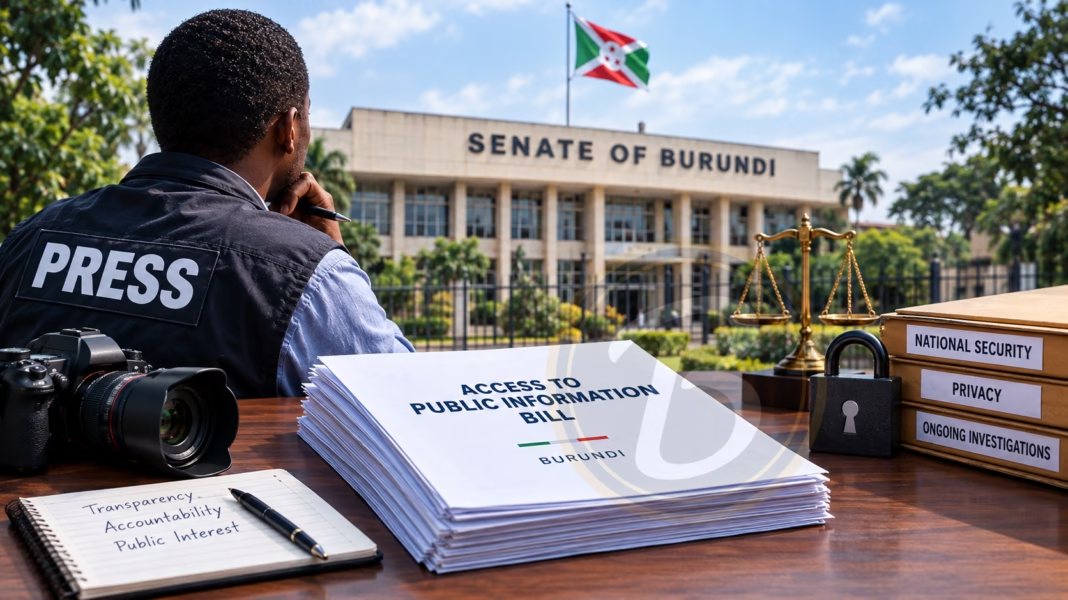

Burundi’s Senate unanimously adopted a bill on Tuesday establishing a legal right of access to public information, according to a post on the Senate’s official X account. But exceptions covering national security, privacy and ongoing judicial investigations could prove a major test of the law’s value to journalists and citizens.
The Senate said the vote came in a plenary session in Gitega chaired by Senate President Gervais Ndirakobuca. The bill sets out procedures for requesting information, requires covered bodies to publish certain information on their own initiative, and creates a National Commission on Access to Public Information to oversee implementation and hear appeals.
A Senate committee report dated Sept. 28, which recommended adoption subject to amendments, shows that some of the bill’s most consequential provisions concern what the public cannot obtain. The committee had reviewed both the government’s version and the National Assembly’s version, and adopted some of the Assembly’s amendments.
Who decides what is confidential?
Chapter IV of the bill (Articles 43 to 49) sets out the exceptions to the right of access. According to the report, the government told the committee that the chapter treats as confidential information relating “notably” to national security, another person’s private life or ongoing judicial investigations. The report does not reproduce the chapter’s text, so it is unclear whether that list is exhaustive.
That raises a basic question for independent journalism, who determines when information falls into one of those categories?
The government told the committee that an institution refusing access must give reasons, “including a clarification of the confidential nature of the information.” A requester who believes information was improperly withheld can first seek internal review and then appeal to the National Commission on Access to Public Information, the government said. The report does not cite article numbers for these steps. Chapter V (Articles 50 to 58) covers the commission and its procedures.
The report does not establish how narrowly “national security” is defined or what an institution must show before invoking it. That could matter in investigations involving security-sector spending, public procurement, policing or other decisions that carry both security implications and a strong public interest.
Privacy and corruption
The privacy exception could also complicate investigative reporting. Corruption inquiries often involve public officials, contractors and private companies, and a procurement file may contain both personal data and details of how public money was spent.
The key question is whether authorities would have to redact genuinely private information and release the rest, or whether personal data could justify withholding an entire document. The report does not say.
The same uncertainty applies to ongoing judicial investigations. The report lists them as a confidential category but does not say whether an open investigation automatically permits refusal or whether authorities must show that disclosure would prejudice it.
The report also shows how differently the state’s own investigators are treated. Senators asked how the bill would coexist with Article 7 of the 2006 anti-corruption law. As quoted in the report, that law allows anti-corruption officers acting under a written mandate from the Prosecutor General to inspect suspects’ bank accounts and demand documents, and the secret or confidential nature of records “cannot then be invoked” against them. The government said the two laws would coexist without difficulty because each has its own field, the new bill governs public access to information, while the 2006 law governs corruption investigations.
A right to information, with a price
Article 14 allows a requester to ask for a certified copy of a document in its usual or another form, a reproduction, a written transcription of audio or visual material, a typed or coded transcription, or an email where the document exists electronically.
Article 16 could limit those options. As described in the report, it says no circumstance obliges an institution to accommodate the requester’s preferences where the cost of access exceeds the “usually reasonable cost of access.” The institution must still tell the requester the actual costs.
Asked by senators what the maximum reasonable cost would be, the government acknowledged the bill “does not set a specific maximum amount.” Institutions are instead to set costs according to the nature of the document, and Article 31 requires tariffs to be displayed and publicly accessible. The government said the aim is that “fees do not become an obstacle to access.”
Asked why fees exist at all if disclosure is a duty essential to transparency, the government said they cover reproduction and processing costs and help prevent “abusive requests.”
For a newsroom seeking hundreds of pages of procurement, financial or administrative records, the lack of a statutory ceiling could matter.
Proactive disclosure
One of the bill’s strongest provisions is Article 39. It requires every public or private body covered by the law to publish the information it holds on its own initiative “within 30 calendar days of their creation or receipt.” If applied broadly, that could reduce journalists’ reliance on individual requests.
The oversight body
Article 50 creates the National Commission on Access to Public Information. The government told the committee the commission is “essential to guarantee independence and impartiality” because every service, including the ministry’s, is obliged to provide information to citizens.
The government also said the commission would be made up of state officials and private-sector representatives who meet periodically, a design it said would avoid excessive costs. The report does not say how members would be appointed or whether the commission’s decisions would bind institutions.
Amendments to watch
The committee proposed substantive amendments to two articles. The Senate’s post does not say whether the plenary adopted them as proposed.
Under a reworded Article 34, a requester who uses obtained information “for illegal, harmful or unlawful purposes” would face criminal penalties. The committee gave its reason as appropriate legal style, which suggests a rewording rather than a new sanction, but the original text is not in the report. The report does not define “harmful.”
Under a reworded Article 42, a public or private body would have to correct and update, without delay and at its own expense, personal information it holds on a requester that is outdated, inaccurate or incomplete, after verifying that the request is authentic. The committee said the body that produced the erroneous information should be responsible for fixing it.
What to watch
For journalists, the test will be whether the law delivers a meaningful right to information or one narrowed by broad exceptions. A bare invocation of “national security,” “private life” or “ongoing investigation” should not by itself settle the public-interest question. The report mentions neither a public-interest override nor a rule requiring partial disclosure.
What matters is whether authorities must justify a refusal, whether documents can be released in part and whether an independent body can overturn the decision. For a country adopting a transparency law, those details may matter more than the declaration of the right itself.
The Senate’s post did not say what happens next, including whether the bill returns to the National Assembly or goes to the president for promulgation.