
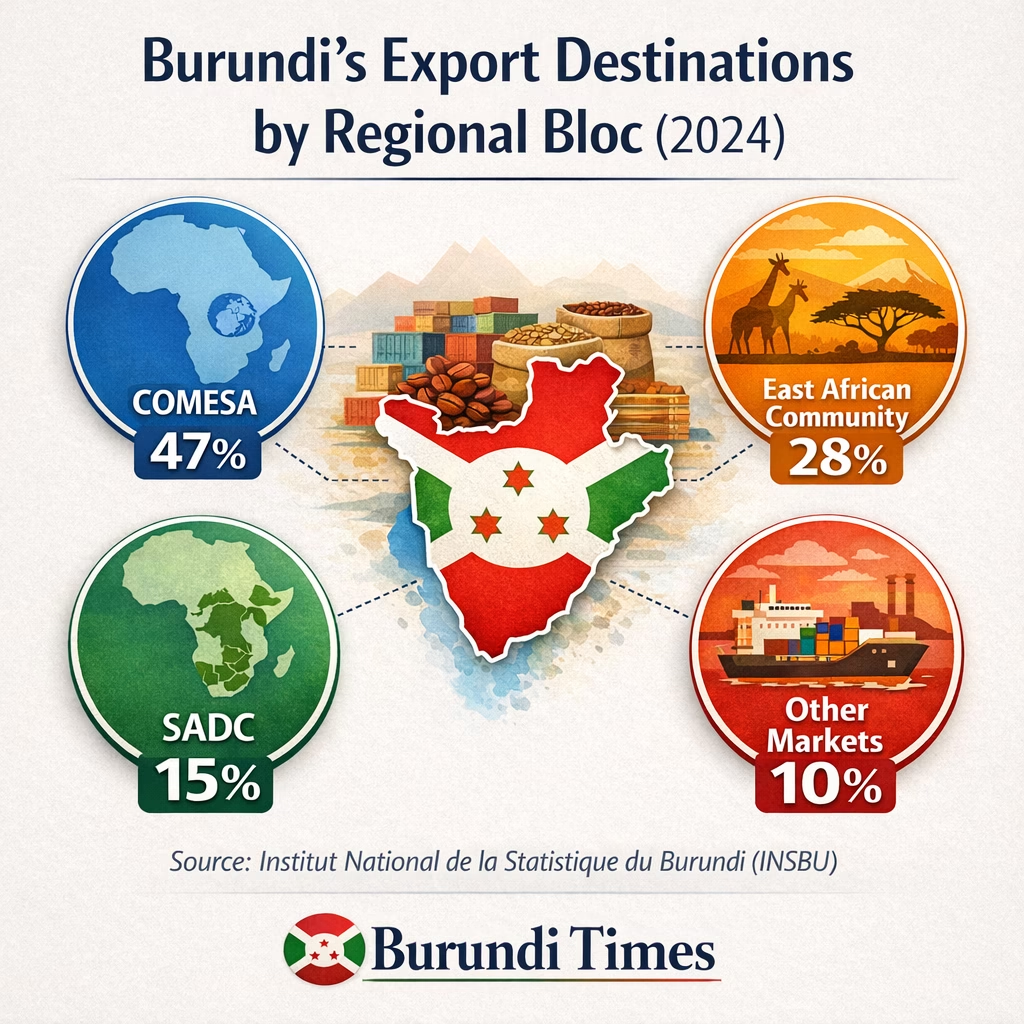
Burundi’s participation in the Common Market for Eastern and Southern Africa has significantly expanded its regional trade reach and strengthened cross-border commerce, according to the latest official statistics, with analysts saying the bloc remains one of the country’s most consequential economic partnerships.
Recent data from Institut National de la Statistique du Burundi show that regional markets dominate Burundi’s export geography. In the first quarter of 2024, about 47% of Burundi’s exports were destined for COMESA countries, making the bloc the country’s single largest export destination.
The figures highlight how regional integration frameworks are reshaping Burundi’s commercial orientation, particularly for a land-locked economy that depends heavily on neighboring markets for trade access.
Economists say such numbers reflect structural advantages linked to membership in Common Market for Eastern and Southern Africa, which operates a free-trade area allowing eligible goods to move tariff-free among participating states. That system reduces export costs and improves competitiveness for smaller economies.
During the launch of COMESA yellow card USSD application, Fabrice Bangemu said that the COMESA yellow card scheme is essential in facilitating transport and transiting for drivers and goods in Eastern and Southern Africa.
“This innovative application is a key step towards transforming cross-border transport projects, enabling simplified documentation management and reduced transit times,” he said.
Mobility and business climate
For Burundi’s small traders and transporters, COMESA’s regional integration is not just policy it is reshaping daily commerce and transport.
“Before the simplified customs procedures, every border crossing could take hours or even a full day. Now, with the paperwork streamlined and insurance standardized, I can deliver goods faster, spend less on bribes, and even take more trips in a week. COMESA has truly changed how we do business on the road,” said Jean-Baptiste Niyongabo, a truck driver in Bujumbura.
“The RECOS simplified trade regime has been a lifeline for my small business. Crossing into the DRC to sell industrial products used to be a nightmare long queues, complicated forms, and high fees. Now, with the approved forms and reduced customs duties, I can get my goods to market in half the time,” said Aline Nkurunziza, small-scale trader at Gatumba border.
Official COMESA data indicate Burundi’s exports to the bloc rose from about $69 million in 2022 to roughly $77 million in 2023, an increase of about 12%, while imports from COMESA partners declined from about $212 million to $180 million over the same period. Analysts interpret that shift as a sign of improving regional trade performance, even though Burundi still runs an overall global trade deficit.
Burundi’s export basket remains concentrated in primary commodities. According to national statistics, the country’s top export earners in 2024 were:
- gold — about 93.2 billion BIF
- coffee — about 77.9 billion BIF
- tea — about 42 billion BIF
Total exports reached approximately 506.1 billion BIF in 2024, while the trade deficit stood at roughly 2,593.9 billion BIF, underscoring the structural imbalance between imports and exports.
Analysts say regional markets help stabilize export earnings when global commodity prices fluctuate, providing more predictable demand conditions.
Trade specialists say integration benefits extend beyond tariff reductions. COMESA-supported initiatives including customs harmonization, regional transit guarantees and transport corridor development are designed to lower logistics costs and speed up cross-border shipments.
Projects backed by institutions such as the African Development Bank and other partners aim to reduce transit delays that historically raise trade costs for inland states.
In October 2025, for example, officials from Burundi and the Democratic Republic of Congo coordinated plans to reopen key border crossings to facilitate small-scale trade. COMESA’s trade director described the move as “a significant milestone with broad economic, social, political and psychological benefits” for border communities.
Policy frameworks tied to COMESA membership also improve the movement of goods and business travelers. Simplified customs documentation, standardized procedures and regional trade facilitation systems are intended to reduce administrative barriers for exporters and traders.
Experts say these measures are especially important for small and medium-sized enterprises, which often lack the resources to navigate complex border requirements. Harmonized rules across multiple countries help reduce regulatory uncertainty and expand potential markets.
For Burundi, whose geography limits direct access to seaports, regional blocs function as economic lifelines. Analysts note that diversified regional markets can cushion the country against shocks affecting any single trading partner and strengthen supply-chain resilience.
Development economists, including those at the World Bank, have long emphasized that regional trade integration is particularly valuable for smaller economies because shared markets expand demand beyond domestic consumption capacity.
While structural challenges remain including infrastructure gaps, limited industrial capacity and non-tariff barriers recent official data indicate COMESA continues to play a central role in Burundi’s external commerce.
With nearly half of exports directed toward the bloc, rising regional sales and ongoing trade facilitation initiatives, policymakers increasingly view COMESA not only as a diplomatic forum but as a core engine of Burundi’s economic growth strategy.
Analysts say the country’s future trade trajectory will depend largely on how effectively it leverages regional value chains and investment opportunities within the expanding COMESA market, despite the security challenges Burundi is facing with its neighbouring countries.
By Moses Havyarimana


