
The International Crisis Group has warned that escalating tensions between Burundi and Rwanda, fueled by the worsening conflict in eastern Democratic Republic of Congo, could trigger a “fully blown inter-state confrontation” unless urgent diplomatic measures are taken.
The warning appears in the organization’s 2026 peace and security priorities for Africa, which identifies the Burundi-Rwanda rivalry as one of the continent’s most volatile flashpoints. Crisis Group said deteriorating relations between the two neighbors, combined with the growing complexity of armed group activity in eastern Congo, have heightened the risk of direct military conflict.
“Escalating hostilities tied to eastern Congo’s conflict dynamics risk drawing Burundi and Rwanda into a wider regional war,” the group said, urging regional actors and international mediators to intensify diplomatic engagement and conflict-prevention initiatives.
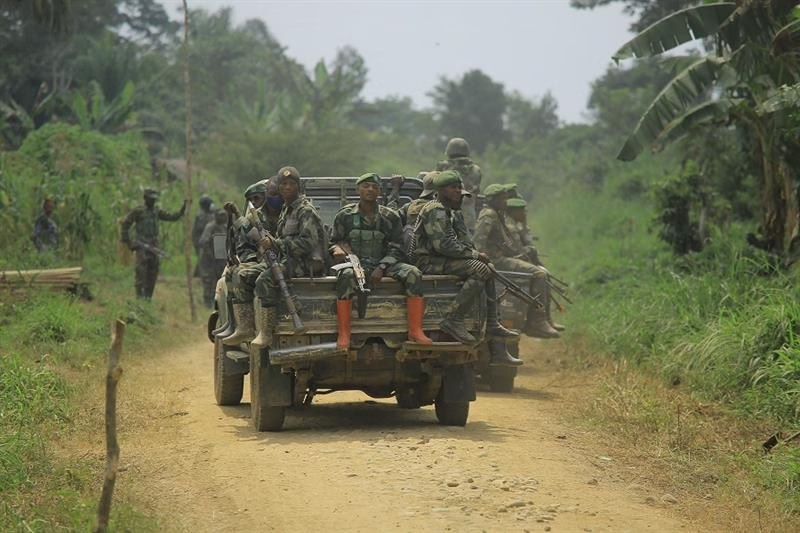
The tensions are closely linked to the resurgence of the March 23 Movement, or M23, a rebel group that has seized strategic territory in eastern Congo and displaced hundreds of thousands of civilians. Congo and several international observers have long accused Rwanda of supporting the rebel group.
Recently there have been a shift in Rwanda’s public position. Rwandan authorities acknowledged “security coordination” with the M23 rebel movement, describing the relationship as a defensive measure against what Rwanda calls security threats from armed groups operating in eastern Congo.
Rwandan officials say the coordination was intended to counter “genocidal forces” believed to pose a danger to Rwanda’s national security.
Burundi has repeatedly expressed concern about Rwanda’s involvement in eastern Congo, arguing that armed group activity near its western border threatens regional stability. Burundian officials have called for stronger regional oversight and diplomatic intervention to prevent further escalation.
Rwanda has defended its security posture, maintaining that its actions are aimed at protecting its territory and preventing cross-border attacks by hostile militias. Rwandan officials have also called for broader regional cooperation to address armed groups operating across eastern Congo.
Diplomatic relations between Burundi and Rwanda remain strained, with mutual accusations of supporting insurgent groups contributing to deep mistrust between the governments. Regional organizations, including the African Union and the East African Community, have urged both countries to pursue dialogue and de-escalation.
According to reporting by Burundi Times, relations between the neighboring countries have deteriorated significantly in recent years following Burundi’s accusations that Rwanda supports the Burundian rebel group RED-Tabara. Burundi subsequently closed its land border with Rwanda, citing security concerns, a decision that continues to affect trade and cross-border movement.
The broader eastern Congo conflict remains one of Africa’s most severe humanitarian crises, displacing millions and drawing repeated international calls for ceasefires and negotiated settlements.
Analysts warn that the involvement of multiple regional actors and proxy armed groups raises the possibility of accidental military confrontation between neighboring states.
The African Union has urged all armed actors to withdraw from contested territories and recommit to peace agreements, warning that continued escalation threatens stability across the Great Lakes region. Diplomatic initiatives have produced intermittent ceasefires, but fighting and political tensions persist.
Security experts say that without sustained dialogue and confidence-building measures, the dispute between Burundi and Rwanda could rapidly escalate beyond proxy conflict dynamics.
“The danger is that unresolved proxy wars and entrenched mistrust could quickly spiral into direct confrontation,” Crisis Group said, emphasizing the urgent need for preventive diplomacy.