
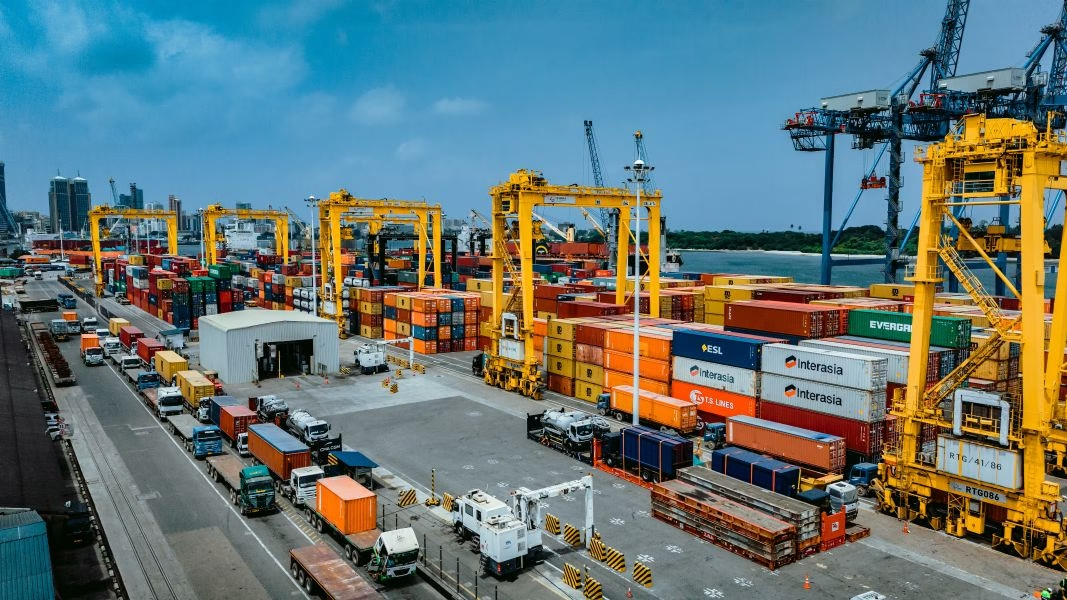

Trade across the East African Community rose 37% to $52.3 billion in the second quarter of 2026, new regional statistics show — but the surge leaned heavily on mineral exports and a near-doubling of trade with China, underscoring the bloc’s continued dependence on commodities and markets outside the Community.
Exports climbed 41.3% to $26.3 billion in the April-June period, while imports rose 32.9% to $26 billion. That left the EAC with a trade surplus of roughly $300 million, a sharp turnaround from the $945.3 million deficit recorded a year earlier — though the shift came from exports growing faster than imports, not from any major gap opening up between the two.
Copper and precious metals accounted for 61.9% of all EAC exports during the quarter, up from 58.7% a year earlier. Coffee, tea and spices remained the region’s key agricultural exports, while petroleum products, machinery, transport equipment and industrial supplies led imports.
China emerges as the biggest driver
China was the EAC’s single largest export destination during the quarter. Exports to the country nearly doubled, from $5.7 billion in the second quarter of 2025 to $10.7 billion this year, a rise the EAC attributed largely to mineral commodities and other raw materials. Imports from China grew too, from $4.7 billion to $7.1 billion.
That puts China at the center of the region’s expanding external trade, both as the top buyer of EAC commodities and as a leading supplier of manufactured and industrial goods. The UAE and South Africa were also major export destinations, while India, the UAE, Saudi Arabia, the United States and Japan were top import sources.
The concentration in minerals sits awkwardly alongside the EAC’s own development goals: its Vision 2050 agenda names industrialisation, value addition and diversification as priorities.
According to verified data from national central banks and China’s own customs authority, the clearest quantified drivers are copper and cobalt from the Democratic Republic of Congo. The DRC exported around 955,000 metric tons of copper in the first quarter of 2026, down from 1.09 million tons a year earlier, with output led by Ivanhoe, CMOC, Glencore and Sicomines, while cobalt exports rebounded to 48,800 tons in the same quarter following the end of a months-long export ban.
Kinshasa has since tightened supply at the source, setting 2026-2027 cobalt export quotas at 96,600 tonnes, roughly half of 2024 volumes, with initial shipments under the new system expected to reach China, the primary destination. China’s own customs data bear out the scale of that reliance in June 2026 alone, China imported 154,839.76 metric tons of copper cathode from the DRC, up 20.39% month-on-month and 30.91% year-on-year, more than four times the volume it imported from its next-largest supplier, Russia, at 35,738.03 tons.
Gold from Tanzania and Uganda adds a second, larger dollar figure to the region’s export story, though it moves mainly through global bullion markets rather than direct bilateral trade with China. Tanzania’s gold exports rose 36.4% to $5,522.9 million in the year ending June 2026, according to the Bank of Tanzania, while Uganda’s gold exports surged 75.8% to $5.8 billion in 2025, up from $3.3 billion in 2024, according to the Bank of Uganda.
Uganda’s link to China runs more directly through production than trade flows, a delegation of Chinese investors toured the Wagagai Gold Mines, Uganda’s biggest, in April 2026, a facility expected to produce about 1.2 tonnes of refined gold annually. Copper and cobalt remain the two minerals with a documented and strengthening trade relationship with China specifically; gold’s contribution to EAC exports is real and substantial, but far less traceable to China as a direct destination.
Intra-EAC trade grows, but shrinks as a share of the total
Trade among EAC Partner States also rose, with intra-EAC exports up 33.2% to $3.2 billion. But because trade with outside markets grew even faster, intra-EAC exports fell as a share of the total, to 12.1% of total EAC exports, down from 12.8% a year earlier.
That’s a notable gap for a bloc whose integration agenda built around its Common Market and Customs Union frameworks is meant to expand trade among members, not just with the rest of the world.
EAC officials have long acknowledged the shortfall. In February, then-Secretary General Veronica Nduva noted that intra-EAC trade had grown from $6.42 billion in 2016 to $15.25 billion in 2024, but still amounted to only about one-eighth of total exports. The bloc has set a target of raising intra-regional trade to 50% of the total by 2030.
Current Secretary General Stephen P. Mbundi said in July that hitting that target means tackling more than tariffs. “We have made significant progress in removing tariff barriers. Our priority now is to eliminate the administrative and regulatory obstacles that continue to increase the cost and time of doing business across our region,” he said.
African markets pick up steam
China wasn’t the only bright spot. EAC exports to African countries rose 44.3% to $7.2 billion, or 27.5% of total regional exports. Exports to SADC countries grew 50.8% to $5.1 billion, and exports to COMESA countries rose 48.3% to $3.1 billion — growth that comes as the bloc looks to deepen both intra-regional and continental trade ties.
The EAC’s internal market currently spans Burundi, the Democratic Republic of Congo, Kenya, Rwanda, Somalia, South Sudan, Tanzania and Uganda; Somalia joined as a full member in March 2024, bringing the bloc to eight states.
Inflation cools, unevenly
The trade expansion came alongside a marked slowdown in regional inflation. The EAC Harmonised Consumer Price Index showed annual headline inflation falling from 11.1% in April to 10.7% in May and 7.8% in June, well below the 22.7% recorded a year earlier.
The headline number masks some pockets of pressure, though. Food inflation actually rose, to 10.1% in June from 9.5% in May, and energy, fuel and utilities inflation stood at 11.1%. Core inflation, which strips out volatile items climbed from 6.2% in April to 7% in June.
Inflation also varied widely by country. In June, annual headline inflation stood at 13% in Rwanda and South Sudan, 8% in Burundi, 6.5% in Kenya, 4% in Tanzania and 3.7% in Uganda.
Credit flows to trade and construction — not manufacturing
Lending patterns tell a similar story to the trade data. Year-on-year credit to wholesale and retail trade grew 29.1%, agriculture 25.6% and construction 22.9%. Real estate lending rose 6.2%. Manufacturing credit, by contrast, grew just 0.9%, a striking gap given the EAC’s stated push to expand industrial production and value addition.
Households held the largest stock of outstanding loans, at $17.6 billion, followed by wholesale and retail trade at $11.6 billion. Broad money supply rose 15.3% to $107.7 billion, and private-sector credit grew 15% to $75.9 billion.
Speaking at an August trade and investment forum, Mbundi said the region needs stronger regional value chains, more investment and expanded manufacturing to grow intra-EAC trade. “Expanding intra-EAC trade remains one of the Community’s foremost priorities,” he said.

