

Ethiopia said Monday that any discussion of the Blue Nile must account for the fact that the river originates in its highlands, a day after the African Union’s chairperson urged cooperation over the continent’s shared water resources amid a long-running dispute between Egypt and Ethiopia over the Nile.
In a press statement, Ethiopia’s Foreign Ministry said the Abay River, as the Blue Nile is known in Ethiopia, “contributes about 85 percent of the Nile River’s total flow.” It said “any discussion concerning the utilization and management of the Abay River should be informed by these fundamental realities.”
The statement did not name Egypt or any other country.
The ministry also addressed the Red Sea, saying Ethiopia is “both geographically and historically connected” to the waterway and that its nearest border lies “barely 30 miles from the coast.” Any serious discussion of regional maritime affairs and security, it said, “must account for Ethiopia’s legitimate interests and its enduring connection to the Red Sea.”
Ethiopia has been landlocked since Eritrea gained independence in 1993. Prime Minister Abiy Ahmed has pressed publicly in recent years for sovereign access to the sea, a stance that has strained relations with Eritrea.
“Actions taken through proxies or acts of aggression will not change the facts on the ground,” the ministry said. It said Ethiopia “stands ready to defend its sovereignty, territorial integrity, and core national interests” and urged regional actors to address shared challenges through “constructive dialogue, partnership, and adherence to the principles of good neighborliness rather than confrontation and zero-sum approaches.”
On Sunday, African Union Chairperson Évariste Ndayishimiye, Burundi’s president, addressed the eighth AU Mid-Year Coordination Meeting in New Alamein, Egypt.
“Shared water resources must be managed through wisdom, solidarity and cooperation, in the interest of African peoples and sustainable development,” Ndayishimiye said, according to the AU’s readout of his remarks.
He listed shared water among the obstacles to African integration, along with weak productive capacity, infrastructure gaps, inadequate financing and persistent insecurity. The readout did not mention Egypt or Ethiopia by name.
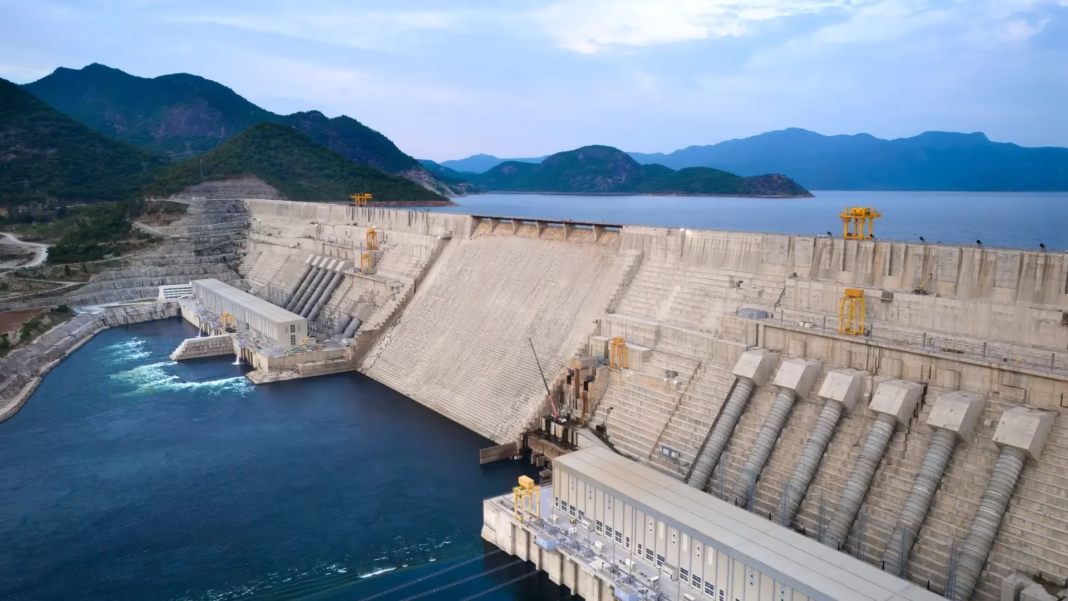
The two countries have been at odds for more than a decade over Ethiopia’s Grand Ethiopian Renaissance Dam on the Blue Nile. Construction began in 2011, and Ethiopia inaugurated the dam on Sept. 9, 2025. The dam has an installed capacity of 5,150 megawatts, down from a previously planned 6,450 megawatts, and a reservoir that holds 74 billion cubic meters of water. Ethiopia says the project is essential to its development and electrification.
Egypt, which gets about 97% of its water from the Nile, has said the dam threatens its water security. Egypt and Sudan say they want a legally binding agreement on filling and operating the dam, while Ethiopia says any pact should be advisory. Negotiations, including U.S.-sponsored talks and African Union-led efforts, have produced no deal.
Egyptian President Abdel Fattah el-Sisi, speaking at the opening session of the coordination meeting, said disputes over borders and shared natural resources should be addressed through dialogue and international law, according to a transcript released by the Egyptian presidency. He stressed sovereignty, territorial integrity and good-neighborly relations.
Ndayishimiye met el-Sisi on Saturday on the sidelines of the inaugural Alamein Africa forum. The two discussed bilateral relations and developments on the Nile issue, the Egyptian presidency said. It said el-Sisi warned against unilateral measures affecting the water interests of Nile Basin countries and reaffirmed Egypt’s rejection of “using the Nile water issue to achieve political gains.”
At the coordination meeting, Ndayishimiye also said Africa cannot rely on a continental free trade area alone and must produce, transform and add value to its resources within the continent. He cited roads, railways, energy networks, ports and digital infrastructure as essential to moving people, goods and services.
He welcomed the work of an AU-led platform on early warning and conflict prevention and called for “a decisive transition from early warning to early action.”
At Saturday’s forum, Ndayishimiye proposed an African Investment and Implementation Dashboard to track projects, financing, responsibilities, timelines and results.