
East African private sector leaders on Friday urged partner states to demonstrate stronger political will to eliminate non-tariff barriers and accelerate intra-regional trade, as business executives and regional officials convened for the EABC CEOs–EAC Secretary General meeting in Bujumbura.
Representatives from Burundi’s private sector including MIRA Steel and Roofings, FOMI, Seed Trade Company and BANCOBU pressed for faster resolution of trade bottlenecks that continue to inflate business costs across the bloc.
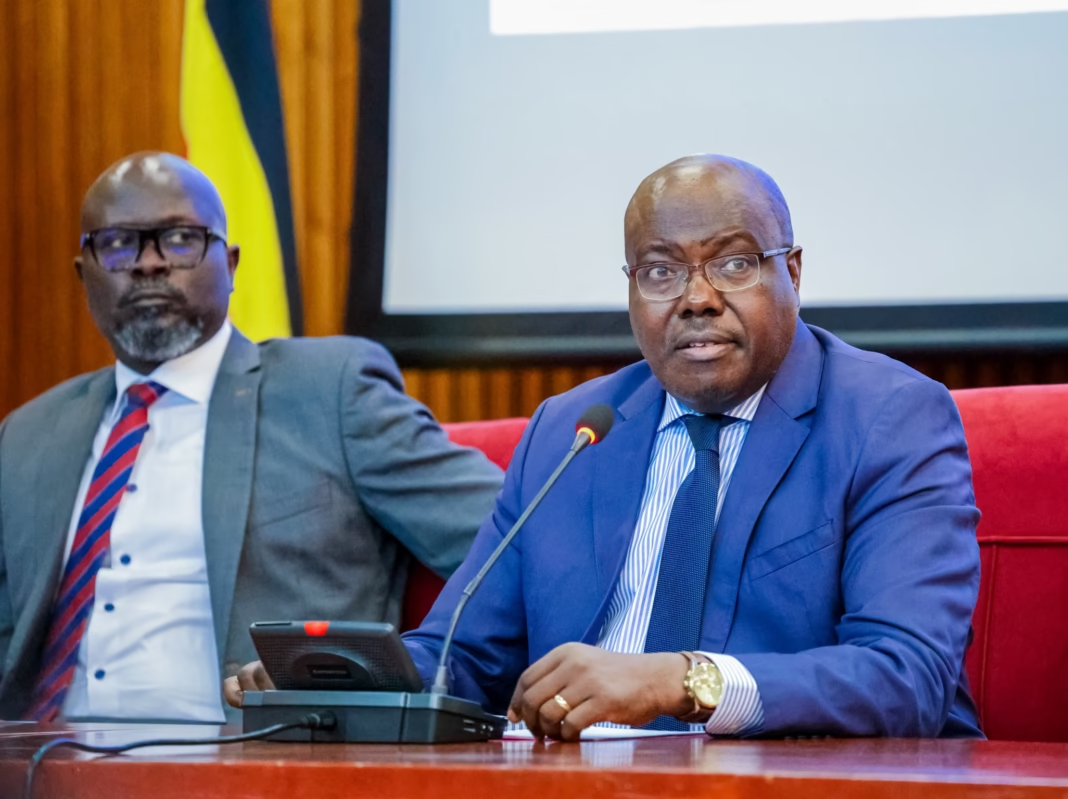
Burundi’s minister of Foreign Affairs, Regional Integration and Development Edouard Bizimana, told participants that the government is taking steps to tackle delays and non-uniform procedures at the Kobero-Kabanga border between Burundi and Tanzania, one of the region’s most problematic crossing points.
“We will take into account the issues… there is something that is being done, that will be done soon, to help our business people,” Bizimana said, citing gaps in infrastructure, logistics, and the inconsistent application of the Common External Tariff as constraints undermining regional competitiveness. He said the EAC’s customs union, common market and progress toward a monetary union provide a strong foundation, but added that partner states must scale up joint infrastructure investments to unlock trade potential.
The EAC Secretary General Veronica Nduva said that intra-EAC trade accounts for just 15 percent of the region’s total commerce a level she described as low despite gradual improvements. She identified delays at the Burundi–Tanzania border, corruption and non-uniform standards as key challenges, and called for an upgrade of the Kobero-Kabanga border post.
“Why do we have eight countries coming together? It is simple. It was for the free movement of goods, services and people,” Nduva said. She reported that the EAC has resolved 274 non-tariff barriers since 2007 and achieved a 75 percent reduction in clearance time under the single customs territory, lowering business costs.
The EAC SG also pointed to the East Africa Payment and Settlement System, which allows efficient local-currency transactions, and a market access program in Burundi supporting value-added exports including coffee, avocado, tea and specialty oils.
“The private sector needs to work closely with the available mechanisms in order to eliminate NTBs. They shouldn’t wait for gatherings like this but when they run into one our contacts are public we are available to guide them and ease the time and cost of doing business in the region,” said Monica Head of Internal Trade at East African Community.
EABC’s CEO Adrian Njau said regional trade between April and June 2025 rose sharply, with total EAC trade increasing by 28.4 percent to $38.2 billion compared to the same quarter last year.
Exports surged 40.5 percent to $18.8 billion, while imports grew 18.8 percent to $19.6 billion, narrowing the region’s trade deficit from $3.2 billion to $0.9 billion. Intra-EAC trade climbed 24.5 percent to $4.6 billion during the quarter, but its share of the region’s overall trade remained stagnant at around 12 percent.
“This low share of intra-EAC trade… underscores the urgent need for a stronger public and private dialogue to find workable solutions on how to bolster our intra-EAC trade,” Njau said. He added that scaling up reforms is essential if the region is to meet its target of raising intra-EAC trade to 40 percent by 2030.
Burundi Chamber of Commerce (CFCIB) chairman Olivier Suguru said the bloc’s ability to deepen integration hinges on political commitment from partner states. He argued that removing NTBs, harmonizing trade policies and fast-tracking EAC monetary commitments remain central to improving the business environment, and added that adopting a single regional tourism visa would support economic recovery.
Executives from SAVANOR, one of Burundi’s largest manufacturers with more than 2,000 employees, called for reforms in the national education system to address skills gaps and better align training with the needs of the industrial sector.
The outcome of the meeting will inform the EABC’s regional priorities for 2026, with business leaders emphasizing that sustained cooperation between governments and private sector actors remains key to lowering trade costs and unlocking East Africa’s economic potential.
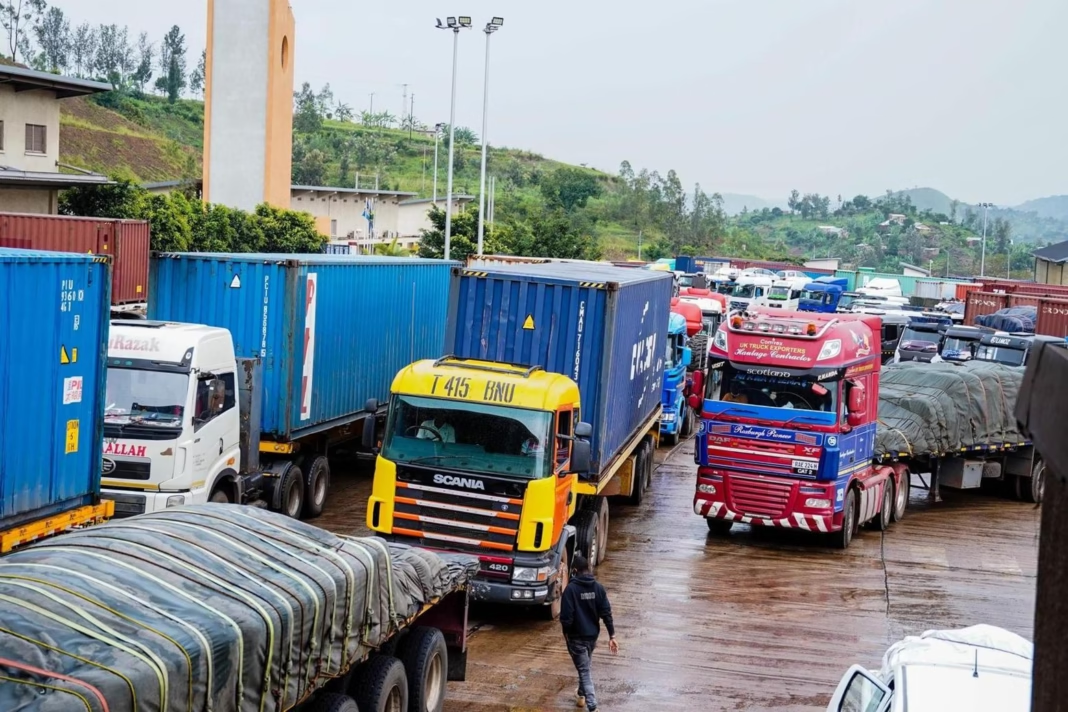
The ongoing closure of the land border between Burundi and Rwanda has significantly disrupted bilateral trade. Gitega has stated it will only reopen the crossing after Kigali extradites members of the RED TABARA rebel group, a demand that has stalled markets and cross-border commerce. This suspension of trade flows deprives local businesses of key trading routes, drives up logistics costs, and undermines the economic integration goals of the East African Community.