
June 3, 2025 | Arusha, Tanzania
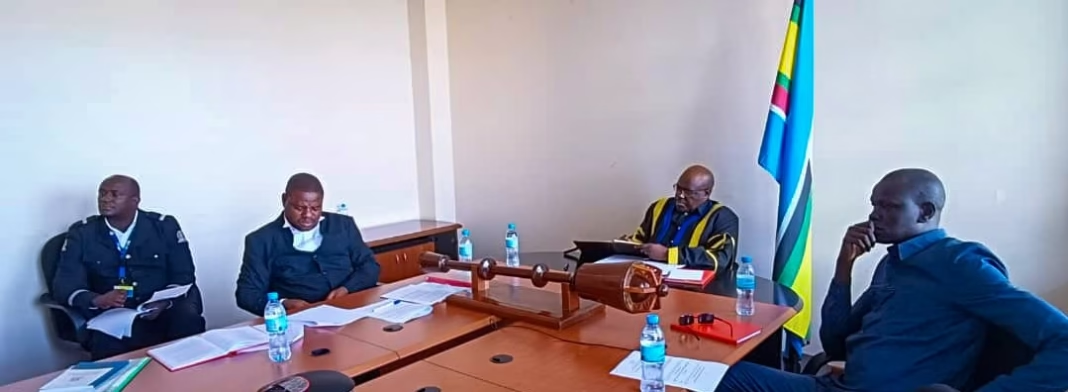
The East African Legislative Assembly (EALA) reconvened virtually on Tuesday, reversing its April 29 decision to halt budgetary proceedings due to financial constraints. This move comes as the East African Community (EAC) grapples with significant funding shortfalls stemming from delayed and incomplete contributions by member states.
In its 57th Extraordinary Meeting on May 29, the EAC Council of Ministers authorized the Assembly to hold virtual sessions under Rule 10(5a) of its Rules of Procedure. To facilitate this, the Council allocated $660,690, sourced through internal borrowing from EAC organs and institutions, enabling EALA to proceed with the scrutiny and approval of the EAC Supplementary Budget for the fiscal year 2024/2025 and the Draft Estimates for 2025/2026.
The motion to vacate the earlier suspension was introduced by Hon. Jacqueline Amongin and seconded by Hon. Dr. Abdullah Makame. Subsequently, the Assembly received key legislative proposals, including the EAC Supplementary Appropriation Bill, 2025, and the EAC Supplementary Appropriation (No. 2) Bill, 2025, both referred to the General-Purpose Committee for further deliberation.
The EAC’s financial challenges are underscored by a significant shortfall in member state contributions. As of November 8, 2024, the bloc faced outstanding remittances totaling approximately $76.2 million. Notably, the Democratic Republic of Congo owed $20.7 million, Burundi $17 million, and South Sudan $15.6 million. In contrast, Kenya had fulfilled its financial obligations, while Uganda, Tanzania, and Rwanda had relatively minor arrears.
The funding crisis has had tangible impacts on the EAC’s operations. The East African Court of Justice and EALA previously suspended activities due to financial constraints. EAC Secretary-General Veronica Nduva earlier this year emphasized the urgency of addressing these issues, stating, “The financial shortfall hampers our ability to implement essential programmes and projects that promote peace and security and address pressing challenges.”
Efforts to establish sanctions for non-compliant member states have been ongoing since 2020. However, progress has been slow, with the Council of Ministers yet to finalize a schedule of sanctions. MP George Stephen Odongo from Uganda highlighted the need for decisive action, suggesting the activation of treaty provisions to suspend members failing to meet their financial commitments.
As EALA resumes its functions, the broader financial instability within the EAC remains a pressing concern. The Assembly’s ability to carry out its legislative duties hinges on the timely and full contributions from all member states. Without a sustainable funding model and enforcement mechanisms, the EAC’s objectives risk continued disruption.