
Burundi has exported a convoy of 15 trucks carrying a mix of gemstones and strategic minerals, in what officials describe as part of an ongoing effort to expand the country’s export base and formalize artisanal mining.
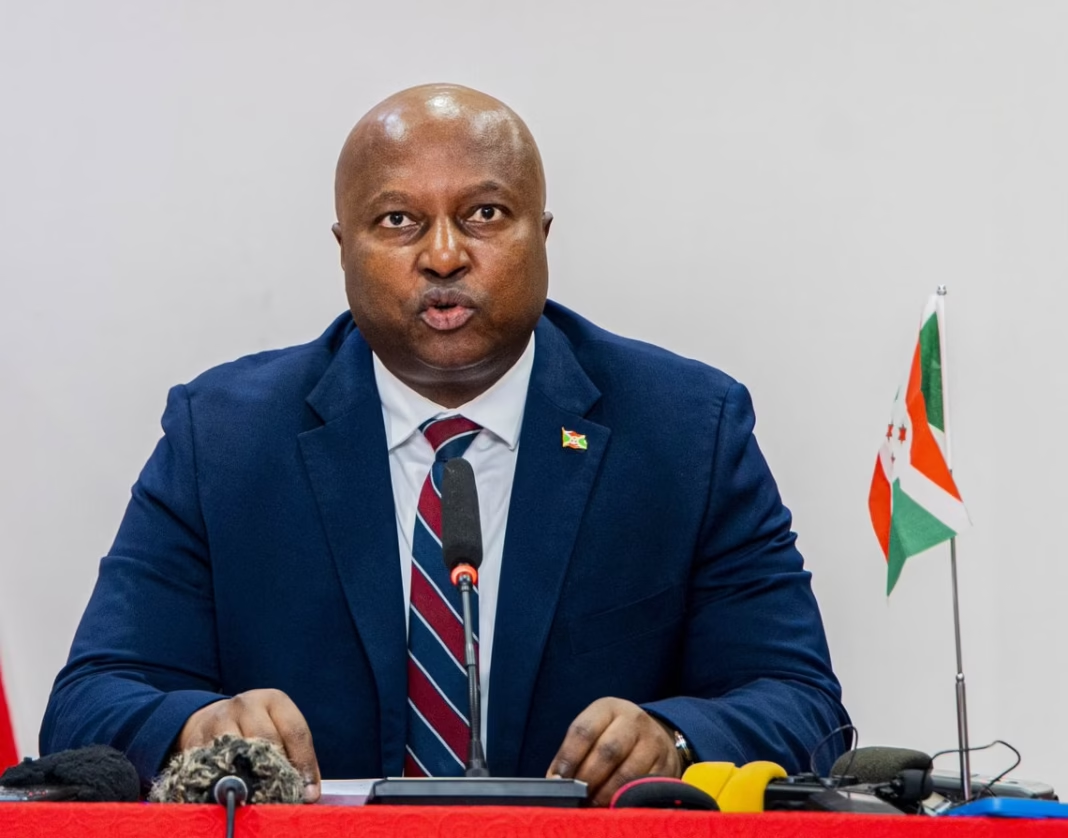
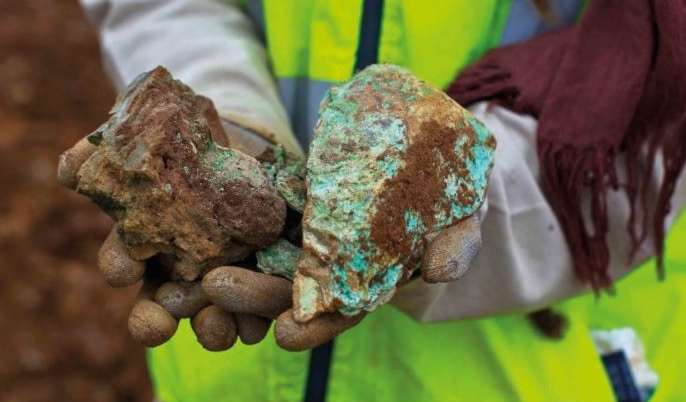
The shipment was launched at an industrial site in the capital by Mines and Energy Minister Hassan Kibeya. The cargo represents roughly two weeks of production and includes amethyst and green quartz (104 tons each), lithium (78 tons), and beryllium (26 tons), alongside smaller quantities of rare earths, jasper and agate.
Kibeya said the minerals were largely extracted by youth organized into cooperatives and supported by the state. “This production comes mainly from young people organized into cooperatives, with government support,” he said, adding that the initiative is intended “to increase mineral production and contribute to the country’s development.”
Limited but notable scale
The shipment underscores both the potential and the constraints of Burundi’s mining sector. While the diversity of minerals—particularly lithium and rare earth elements—aligns with growing global demand tied to energy transition technologies, the overall scale remains modest.
Burundi’s total exports have historically been low in absolute terms, typically just over $200 million annually. Coffee and tea dominate export revenues, often accounting for the majority of foreign exchange earnings. Against that backdrop, periodic mineral shipments such as this one are unlikely, in the short term, to significantly alter the country’s external balance.
However, they may signal gradual diversification if production becomes more consistent.
The government’s approach centers on structuring a largely informal sector. Artisanal mining has long existed in Burundi but has been characterized by low productivity, limited oversight and safety risks.
Authorities are attempting to address these constraints through cooperative models and targeted support. The state-backed youth program PAEEJ is providing equipment, materials and training to participating miners.
According to program official Itangishaka NIV Dany, the support includes “protective equipment, necessary materials, as well as appropriate mentoring,” with trained miners also passing on skills to peers in the field. This peer-based training model is intended to improve both productivity and safety standards.
External partnerships and technology gap
The export operation coincided with visits by investors from China, reflecting Burundi’s reliance on external partners for technical capacity in mining.
Officials say these partners are assessing sites and supporting the introduction of modern extraction techniques, as well as advising on mineral processing. The latter remains a critical gap: Burundi currently exports raw or minimally processed minerals, limiting value capture.
Developing local processing capacity would require significant capital investment, infrastructure and regulatory clarity—factors that have historically constrained the sector.
Policy signals and economic implications
The government has encouraged citizens to report mineral deposits and urged youth participation in mining, indicating an expansion strategy that combines resource identification with labor mobilization.
Kibeya said the broader objective is “to stimulate economic growth and improve the living conditions of the population,” framing mining as both an economic and social policy tool.
From an analytical perspective, the initiative reflects three overlapping policy goals:
- Export diversification: Reducing reliance on coffee and tea
- Employment generation: Absorbing youth labor into structured activities
- Resource formalization: Bringing informal extraction into regulated channels
The effectiveness of this approach will depend on consistency of output, transparency in licensing and exports, and the ability to attract sustained investment.
Outlook
The 15-truck export illustrates incremental movement rather than structural transformation. For mining to materially affect Burundi’s export revenues, production would need to scale significantly, logistics chains would need to stabilize, and value addition would have to increase.
In the near term, such shipments are likely to remain supplementary to agricultural exports. Over the longer term, their significance will hinge on whether Burundi can transition from episodic mineral exports to a more predictable and regulated mining economy.