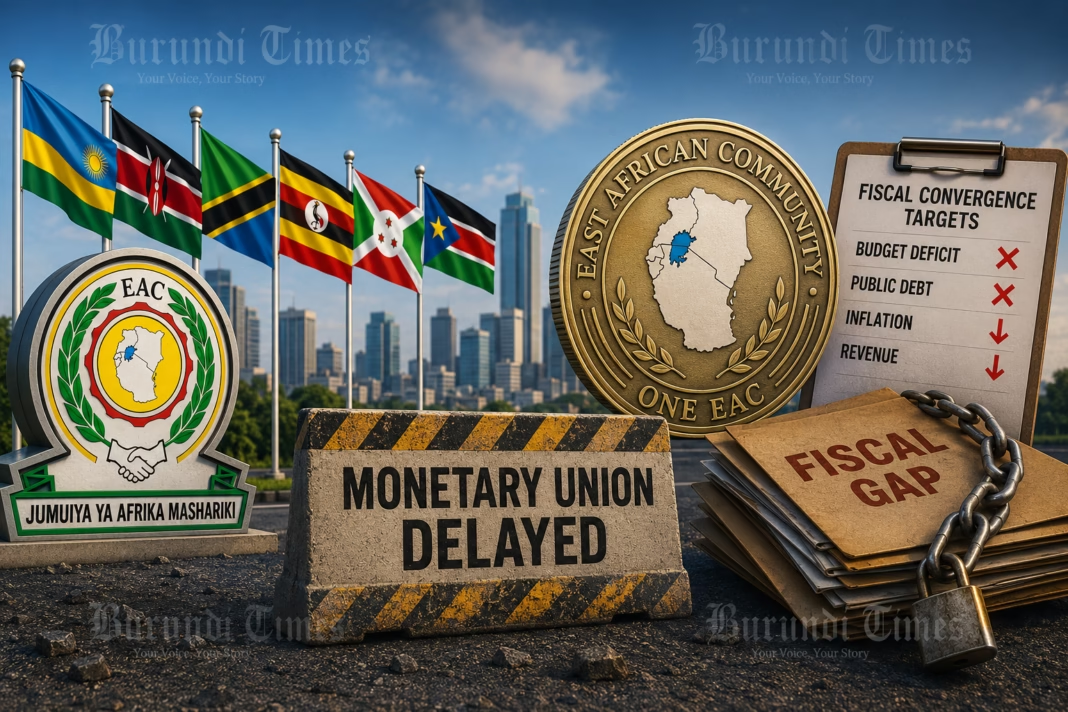


Trade integration and customs policy enforcement remain key challenges for the East African Community (East African Community), as ministers review progress on tariff harmonisation, the Common External Tariff (CET), and persistent non-tariff barriers affecting intra-regional trade.
Meeting under the Sectoral Council on Finance and Economic Affairs, officials are examining core customs measures, including CET implementation, rules of origin, and excise duty alignment across Partner States.
According to the official meeting brief, the Council will review “the application of the revised EAC Common External Tariff and Partner States’ submissions for FY 2026/27,” alongside “review of the EAC Rules of Origin.”
The discussions come amid continued efforts to strengthen the EAC Customs Union, one of the key pillars of regional integration under the EAC Treaty, alongside the Common Market and Monetary Union. The Customs Union is intended to ensure free movement of goods within the region and the application of a common external tariff.
However, officials acknowledge that enforcement gaps remain a major challenge.
The meeting brief also highlights ongoing policy reviews aimed at strengthening regional manufacturing, including a study on glass and ceramic tiles, designed to support value addition and reduce dependence on extra-EAC imports.
In addressing trade distortions, the Council noted efforts on “progress in aligning national definitions of ‘import’ with the EAC framework and removing measures that contravene Articles 10 and 15 of the Protocol on the Establishment of the EAC Customs Union.”
The Customs Union Protocol, a legally binding framework under the EAC Treaty, requires Partner States to eliminate internal tariffs and non-tariff barriers, while maintaining a unified external tariff regime. It also prohibits trade restrictions that create discriminatory or equivalent charges within the bloc.
Despite these commitments, implementation remains uneven. The Council further highlighted issues linked to “fees, levies and charges of equivalent effect,” which continue to vary across Partner States and undermine trade facilitation.
These inconsistencies persist even as the region advances broader integration goals under the East African Monetary Union (EAMU) roadmap, which depends on strong customs and fiscal convergence.
Trade experts note that while CET policies are largely agreed at regional level, enforcement differences at national level continue to limit the effectiveness of the Customs Union in practice.
The meeting is expected to produce recommendations on customs enforcement, tariff alignment, and removal of non-tariff barriers as part of efforts to deepen regional trade integration.