

Five Burundian opposition political parties have jointly questioned the country’s preparations for the 2027 presidential election, warning that the process risks deepening political tensions if concerns over inclusivity and consensus are not addressed.
In a statement dated May 8 and signed in Bujumbura, the parties National Congress for Liberty (CNL), Union for National Progress (UPRONA), Council of Patriots for Democracy (CODEBU), SAHWANYA-FRODEBU and Convention for Democracy and Prosperity (CDP) said they were reacting to recent announcements by the Independent National Electoral Commission (CENI) regarding the electoral timetable and preparations for the next presidential vote.
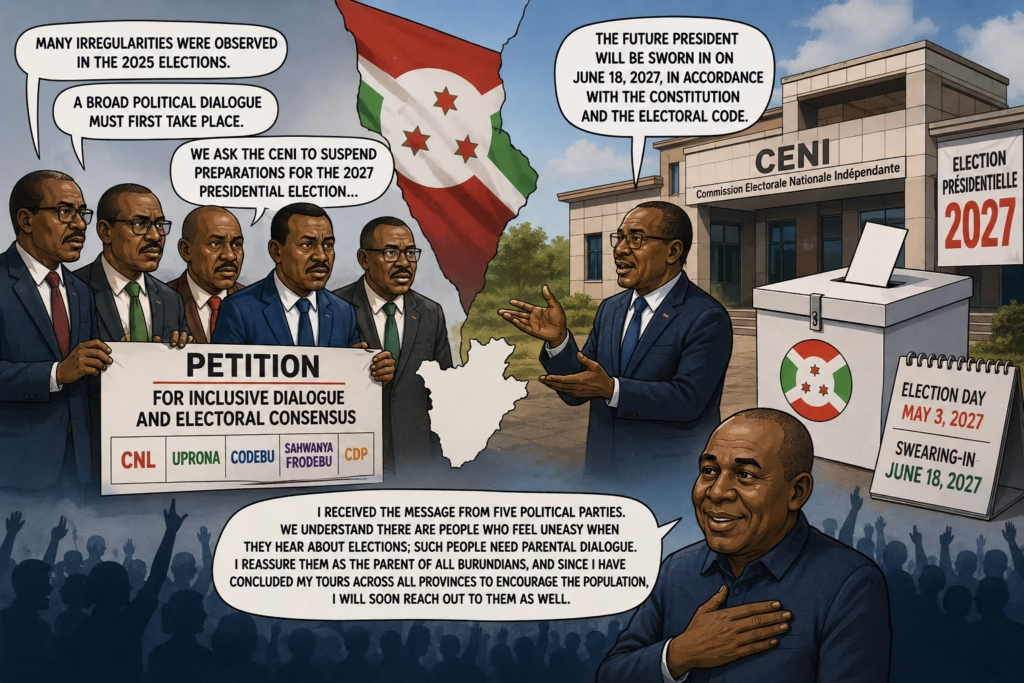
“After the 2025 legislative and communal elections, many irregularities were observed before, during and after the vote,” the parties said, adding that grievances linked to the elections “have never received satisfactory answers.”
The opposition accused the electoral commission of moving ahead with preparations for the 2027 presidential election “in a unilateral manner” despite what it described as an unresolved political and security climate.
“We believe electoral issues should not be limited to technical organization alone,” the statement said. “A broad political dialogue aimed at restoring trust among Burundians must first take place.”
The parties urged the electoral commission to suspend the process pending national consultations.
“We ask the CENI to suspend preparations for the 2027 presidential election until all stakeholders agree on the management of the electoral process and on a political environment capable of reassuring the population,” the joint statement read.
The declaration came hours after the Independent National Electoral Commission (CENI) held a meeting with electoral partners in Bujumbura on preparations for the 2027 presidential election.
Reacting to the opposition statement, Burundi’s President Évariste Ndayishimiye sought to ease tensions in a message published on X.
“I received the message from five political parties,” Ndayishimiye wrote.
“We understand there are people who feel uneasy when they hear about elections; such people need parental dialogue,” he added.
“I reassure them as the parent of all Burundians, and since I have concluded my tours across all provinces to encourage the population, I will soon reach out to them as well.”
The exchange marks one of the first major public disagreements between opposition parties and electoral authorities ahead of Burundi’s 2027 presidential election.
Burundi’s previous elections have repeatedly been disputed by opposition groups, with critics raising concerns over political space, electoral transparency and the treatment of opposition members in past electoral cycles.
During the meeting, CENI president Prosper Ntahorwamiye said the presidential election would be held on May 3, 2027, with the inauguration of the elected president scheduled for June 18, 2027.
“The future President of the Republic will be sworn in on June 18, 2027, in accordance with the Constitution and the Electoral Code,” Ntahorwamiye said during the meeting.
He also disclosed that the projected electoral budget stands at 115.8 billion Burundian francs, while only 3.8 billion francs had been secured as of February 2026.
“The budget still to be mobilized is more than 112 billion Burundian francs,” he said.
According to CENI, partial voter registration will target citizens turning 18 before the 2027 election, repatriated Burundians and citizens who were not registered during the 2024 enrollment exercise.
Ntahorwamiye called on political actors to avoid inflammatory rhetoric during the electoral process, stressing that “the success of the 2027 electoral process will depend on the effective involvement of all partners.”