
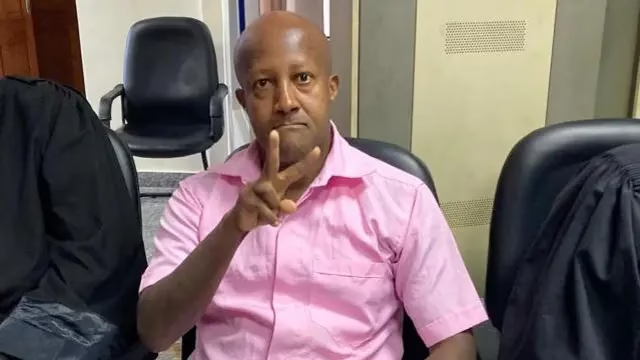

Rwandan authorities on Thursday announced the death of controversial commentator and former university lecturer Aimable Karasira, who died shortly after completing a five-year prison sentence and just hours before he was due to be released.
According to Rwanda Correctional Service (RCS), Karasira died at Nyarugenge Hospital in Kigali following what officials described as a suspected overdose of prescribed medication.
RCS spokesperson Chief Superintendent Hillary Sengabo told Rwanda’s state-affiliated newspaper The New Times that Karasira had already signed release papers on Wednesday afternoon after completing his sentence at Nyarugenge Correctional Facility.
“He signed his release papers yesterday afternoon,” Sengabo said, adding that Karasira allegedly consumed a large quantity of medication prescribed for a pre-existing medical condition while awaiting collection by relatives. Prison officers and inmates reportedly attempted to intervene before he was transferred to a prison clinic and later to Nyarugenge District Hospital, where he died around midnight.
Authorities said investigations and medical examinations were ongoing to establish the exact cause of death.
Karasira, a former lecturer at the University of Rwanda, became one of Rwanda’s most closely watched dissident voices after publishing political commentary on YouTube, where he criticized the government and spoke publicly about the deaths of family members during and after the 1994 genocide.
He was arrested in May 2021 and later charged with genocide denial, inciting divisionism, spreading false information, and financial crimes linked to funds found at his residence.
In September 2025, a Rwandan court sentenced him to five years in prison on charges linked to “divisionism,” though prosecutors appealed the ruling and sought a significantly longer sentence of 30 years.
International human rights organizations, including Human Rights Watch and the Committee to Protect Journalists, had repeatedly raised concerns about his detention, treatment in custody, and the broader state of free expression in Rwanda.
Human Rights Watch said earlier this year that Karasira reported being tortured while detained and argued that Rwanda’s laws against “genocide ideology” and “divisionism” are often used to silence dissenting voices.
Karasira’s death is likely to reignite scrutiny of Rwanda’s treatment of critics and political dissidents, particularly given comparisons already drawn by rights groups to the 2020 death in police custody of gospel singer Kizito Mihigo. Mihigo, once celebrated for reconciliation-themed music, died under disputed circumstances after being rearrested while allegedly attempting to flee the country.
The Rwandan government has consistently defended its genocide-related legislation as necessary to prevent hate speech and ethnic extremism in the aftermath of the Rwandan genocide.
As of Thursday evening, no statement had been issued publicly by Karasira’s family or legal representatives.