
Declining foreign aid and rising debt servicing costs are squeezing government finances across East Africa, forcing difficult policy choices as global economic conditions deteriorate, the International Monetary Fund said.
In its April 2026 Regional Economic Outlook, the IMF warned that countries including Burundi, Rwanda, Uganda, Kenya, Tanzania, South Sudan, Somalia and the Democratic Republic of the Congo face tightening fiscal constraints as external financing becomes less reliable.
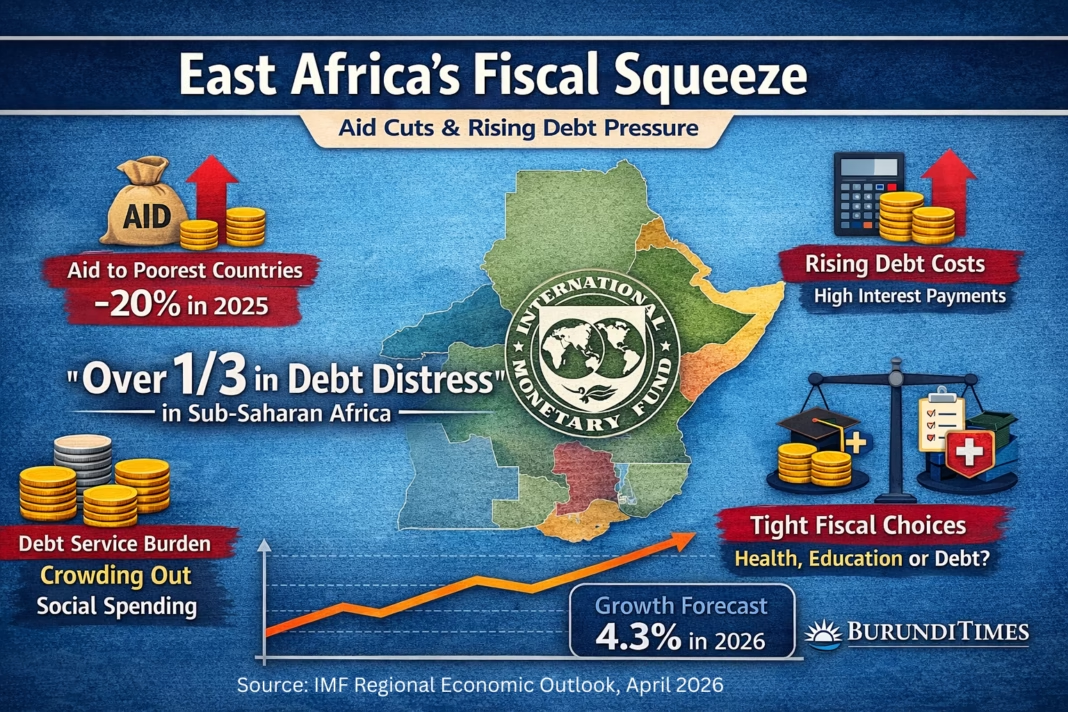
The IMF highlights a sharp reduction in foreign aid flows, particularly affecting low-income and fragile states that rely heavily on external support.
“Aid has been a critical resource for many,” the report notes, warning that the recent decline represents a major shock for vulnerable economies.
The Fund adds that “this shock is different,” as cuts are occurring amid already strained public finances and rising global uncertainty.
Debt servicing crowds out development spending
At the same time, rising borrowing costs are increasing the share of government revenues devoted to debt servicing.
The IMF estimates that more than one-third of countries in sub-Saharan Africa are at high risk of, or already in, debt distress, with interest payments consuming a growing portion of fiscal resources.
This trend risks crowding out spending on essential services such as health, education and infrastructure.
“The debt service burden is also elevated, which risks crowding out priority development expenditures,” the IMF said.
With aid declining and debt costs rising, governments across East Africa are facing difficult fiscal trade-offs.
“Countries should reprioritize spending toward the most cost-effective social support… and strengthen expenditure controls,” the IMF advised.
Oil-importing countries including Kenya, Rwanda and Uganda are particularly exposed to rising fuel and food prices, further straining budgets and external balances.
The IMF warns that many countries have limited fiscal space to respond to new shocks, particularly those already facing high debt levels and weak revenue bases.
“Most of these countries don’t have that luxury,” IMF Africa Department Director Abebe Aemro Selassie said, referring to the ability to deploy large-scale fiscal support.
Call for reforms and domestic resource mobilization
To address the growing fiscal squeeze, the IMF urges governments to strengthen domestic revenue collection and improve spending efficiency.
“Domestic revenue mobilization remains central to a sound medium-term fiscal strategy,” the report said.
The Fund also calls for structural reforms to boost private-sector growth and reduce dependence on external financing.
The fiscal pressures come as the regional economic outlook weakens due to global shocks, including rising energy prices and disrupted trade flows linked to the Middle East conflict.
Sub-Saharan Africa’s growth is projected at 4.3 percent in 2026, with inflation expected to rise, further complicating policy decisions.
The IMF says the current environment marks a turning point for economic management in East Africa.
With external support declining, governments will need to rely increasingly on domestic policy measures to maintain stability and protect vulnerable populations.