

For many families, safety is something they assume—until it is suddenly taken away.
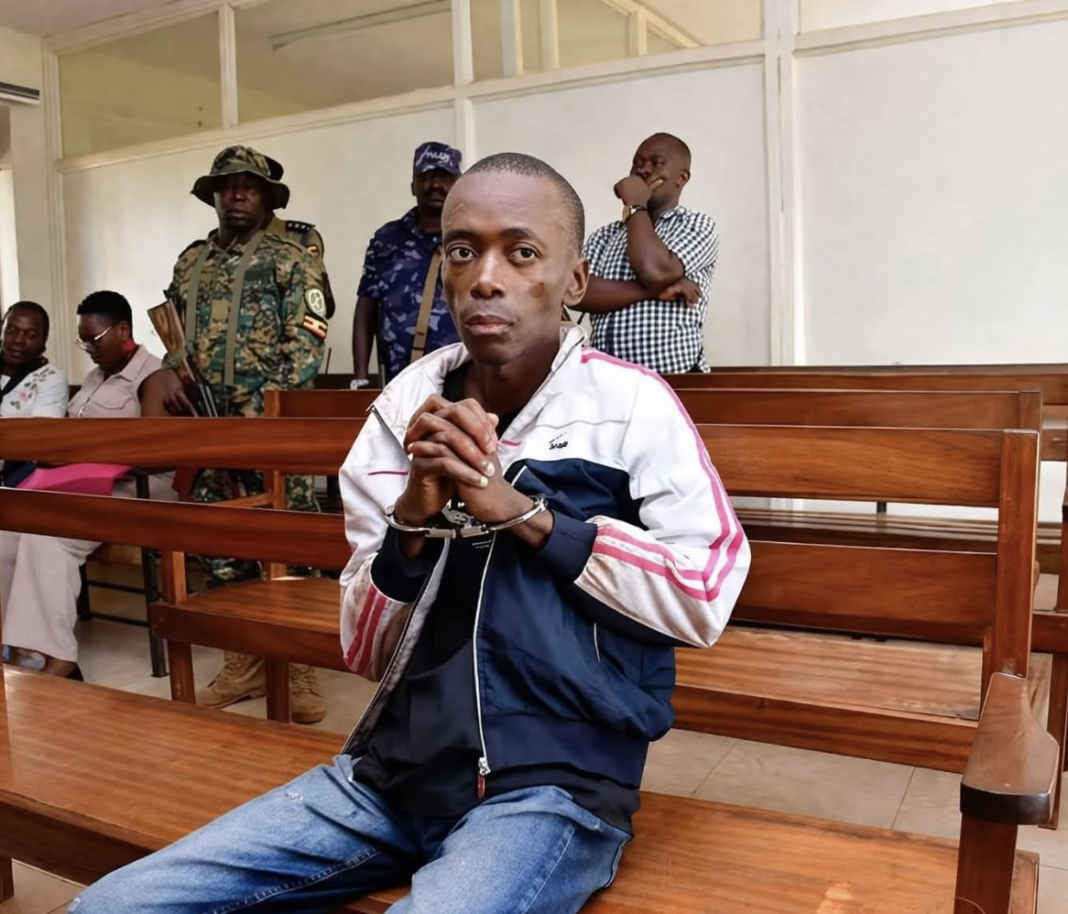
On April 2, 2026, a man entered the Ggaba Early Childhood Development Centre in Kampala disguised as a parent seeking to enroll a child. He allegedly stabbed four toddlers to death, later confessing that he believed killing children as human sacrifices would make him wealthy. The suspect, Christopher Okello Onyum, 38, a dual Ugandan-American citizen, was swiftly committed to the High Court on four counts of murder. The four children killed were Rayan Eteku, Keisha Agenoroth, Ignatius Sseruyange, and Rayan Odeke. A fifth child was injured.
This was not random. It was calculated.
Investigators believe the attack was carefully planned days in advance. On March 31, Okello reportedly rented a Toyota RAV4 as part of his preparation. The following day, he allegedly drove across Kampala—through Ntinda, Nakawa, Kibuli, Kabalagala, and Bunga—mapping out his route to the daycare centre. At the facility, he posed as a prospective parent, gathering information and studying the environment. He told a caretaker the child he sought to enroll “did not talk much and struggled to mix with others,” and asked about fees before leaving—only to return the following day to carry out the attack.
That methodical planning is what makes this case so deeply disturbing. This was not a moment of madness. The Director of Public Prosecutions told court that Okello “believed in wealth by human sacrifice and was able to explain the reason for killing the children as fortune hunting or enrichment.” A psychiatric report issued just three months before the attack, in December 2025, had certified him as mentally fit, with coherent speech, logical thinking, and no perceptual disturbances. The court later ruled he was fit to stand trial.
The attack struck at a place where children are supposed to be most protected—a classroom. There were 14 pupils present.
In neighborhoods across Kampala, fear has replaced normalcy. Parents are more alert, movements are more controlled, and trust—once easily given—has become fragile. The tragedy has not only taken lives; it has disrupted the most fundamental assumption families make: that when a child is left at school, they are safe.
A Pattern Uganda Cannot Afford to Ignore
The Ggaba killings did not occur in a vacuum. According to official sources, police recorded at least 78 cases of ritual killings in Uganda in 2024, up from 62 in 2023 and 49 in 2022—with children making up a significant proportion of victims. Rights groups warn that reported cases are likely just the tip of the iceberg, as many go unreported due to fear of reprisals. In his 2025 Christmas message, the Kabaka of Buganda, Ronald Muwenda Mutebi II, warned that “we thought these crimes had ended, but they have resurfaced again,” describing children going missing and later being found murdered, with body parts removed.
What makes the Ggaba killings particularly disturbing is the setting. Unlike previous cases often reported in remote or rural areas, this attack occurred in a daycare centre within a busy urban suburb of Kampala. The belief in wealth through ritual sacrifice—long dismissed as a problem confined to the countryside—has now entered the city’s most vulnerable spaces: its schools.
Uganda outlawed ritual sacrifice under the Prevention and Prohibition of Human Sacrifice Act, but rights groups say enforcement gaps remain and many cases go unreported. Low conviction rates—often below 10%—mean that the law exists largely on paper for those who would exploit the most vulnerable.
The Gaps That Let This Happen
As authorities investigate, difficult but necessary questions must be asked. Reports suggest the suspect gained access to the premises by posing as a parent—raising urgent questions about visitor management, staff training, and emergency preparedness in early childhood centres. Daycare centres are expanding rapidly across urban Uganda, yet regulation, inspection, and enforcement remain inconsistent, with many facilities operating with minimal oversight, leaving critical safety decisions to proprietors.
The day after the killings, the State Minister for Higher Education visited the school and ordered its immediate closure. Presidential condolences came with a financial gesture—Shs 10 million from the Head of State’s office for each bereaved family. These responses, while meaningful, cannot substitute for structural reform.
Justice in the Courtroom—and Its Limits
The judicial response has been unusually swift. President Museveni directed the Judiciary to fast-track the case using Uganda’s newly operational mobile court system, allowing proceedings to take place closer to where the crime occurred, so the community could witness justice being served. The case became the first recent civilian criminal matter to be heard through a community-based mobile High Court session, held at Ggaba Community Church grounds—about 100 metres from the daycare centre where the killings occurred.
But even this landmark step drew scrutiny. The Uganda Law Society sued the government, challenging the legality of the public community trial, arguing that the mobile court session violated constitutional guarantees of a fair trial. The tension between the public’s demand for visible justice and the accused’s right to due process reflects the deeper fault lines this case has exposed. A community’s grief, however raw and legitimate, cannot be allowed to override the principles that make justice credible.
Silence as Complicity
Beyond fear and anger lies a critical opportunity—and a harder truth. Protecting children cannot depend solely on the courts or the police. It must begin at the community level, in the conversations we are willing to have and the signs we are willing to report.
World Vision’s work in Uganda has shown that localized child protection systems—community alert networks, outreach to traditional healers, and grassroots education programs—can reduce incidents dramatically in the areas they reach. But these efforts remain small in scale. Without national investment and political will, they cannot fill the void left by weak institutional safeguards.
The deaths of Rayan, Keisha, Ignatius, and Rayan are not just statistics. They are children with names, with families, with futures that were taken from them in a classroom that was supposed to be safe. Their deaths are a painful reminder of what happens when systems fail, when warning signs go unaddressed, and when communities mistake silence for peace.
As the trial continues, one truth remains clear: preventing such tragedies requires awareness, responsibility, and collective action—not just in response to headlines, but before the next headline is written.
Because when it comes to protecting children, silence is not neutral. It is dangerous.
Note: Christopher Okello Onyum has pleaded not guilty to all four counts of murder. The trial is ongoing. All allegations remain subject to the court’s judgment.