
Analysis | Africa’s World Cup Promise Keeps Ending at the Same Place
For nearly two decades, African football has been waiting for the next breakthrough.
Since Ghana reached the quarterfinals in 2010 and Morocco made history by reaching the semifinals in 2022, expectations have risen dramatically. More African players now feature for Europe’s elite clubs than ever before. Coaching standards have improved. Domestic federations have invested more heavily in youth development.
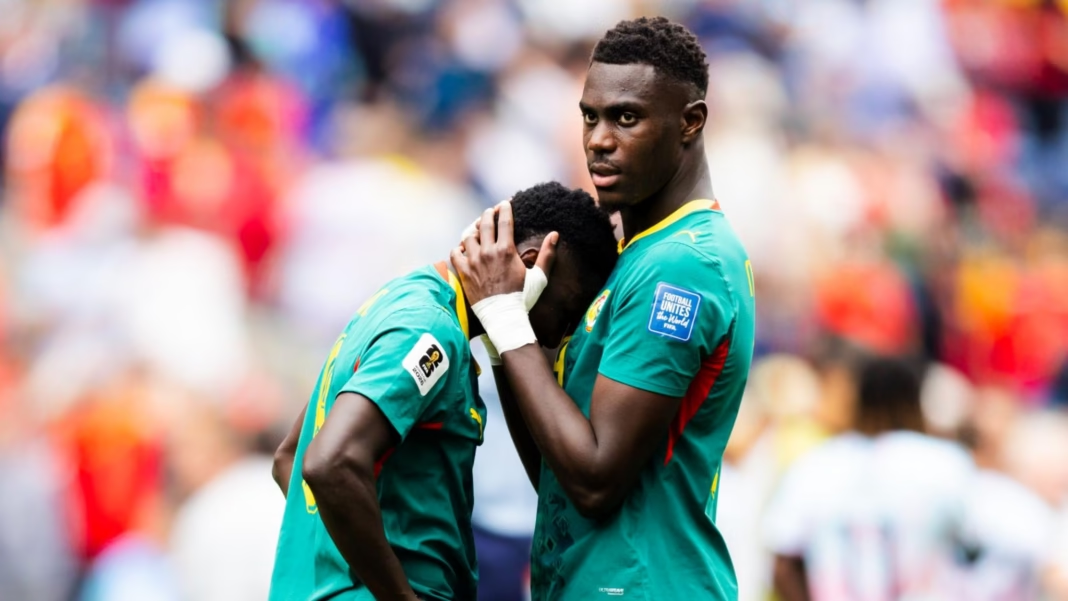
Yet as the 2026 World Cup knockout rounds unfold, the continent is again watching its representatives disappear one by one.
Algeria’s elimination by Switzerland may not have been the biggest upset of the tournament, but it perfectly captured a recurring African story.
The Desert Foxes controlled long periods of possession, created promising opportunities and carried genuine attacking threat through captain Riyad Mahrez. But Switzerland required only two moments of clinical precision to punish defensive lapses, exposing the difference between competing well and winning at football’s highest level.
Algeria coach Vladimir Petković admitted afterward that his side “were punished heavily for mistakes,” a concise summary not only of Algeria’s campaign but of several African exits.
The same pattern has repeated throughout the tournament.
Senegal appeared destined for the Round of 16 before surrendering a two-goal advantage against Belgium in one of the competition’s most dramatic collapses. Internal disagreements within the squad surfaced immediately after the defeat, raising uncomfortable questions about leadership and cohesion beyond the pitch.
DR Congo pushed England until the closing stages before falling 2-1.
South Africa lost by a single goal.
Ivory Coast were competitive against Norway but failed to convert chances.
None of these defeats suggested a gulf in talent. Instead, they exposed something more frustrating: the inability to manage decisive moments.
That has become Africa’s greatest challenge.
European and South American teams often survive tournaments not because they dominate every match, but because they punish mistakes with ruthless efficiency while making very few of their own. African teams continue to play with flair, pace and athleticism, yet they frequently lose games in moments rather than over 90 minutes. The statistics may show narrow defeats, but tournament football is rarely about statistics.
It is about concentration after scoring. It is about defending set pieces. It is about finishing the one clear opportunity that arrives in the 85th minute. Those details continue to separate contenders from participants. Ironically, Morocco’s remarkable run four years ago showed exactly what is possible when an African side combines technical quality with tactical discipline and emotional control.
That campaign should have been the blueprint rather than the exception. Instead, Morocco still stands largely alone. Another issue lies beyond tactics. Many African national teams continue to assemble only days before major tournaments, while coaching changes, administrative disputes and uncertain preparations remain common across the continent.
By comparison, Europe’s leading nations benefit from long-term planning, consistent technical structures and stable football federations. Talent has never been Africa’s problem. Infrastructure, continuity and game management remain the bigger obstacles.
There are still reasons for optimism.
Egypt and Ghana remain alive in the competition, while Cape Verde the tournament debutants have already become one of the stories of the World Cup through fearless performances that have challenged traditional hierarchies. Whatever their final results, they have shown that African football continues to evolve.
But Algeria’s exit also closes another chapter. Mahrez confirmed after the defeat that the match would be his final appearance for the national team, bringing the curtain down on one of Algeria’s finest international careers. His departure symbolizes something larger.
A generation that promised to establish Africa among football’s elite is gradually giving way to another still searching for consistency. The continent no longer struggles to produce world class players.
Its challenge now is producing world-class tournament teams. Until African sides consistently master the smallest moments on football’s biggest stage, the familiar cycle will continue: flashes of brilliance, widespread admiration and another early flight home.