
East African countries risk missing the ambitious goals of the Kampala Comprehensive Africa Agriculture Development Programme (CAADP) Declaration unless governments substantially increase investment in agriculture and improve public spending, a regional assessment has warned.
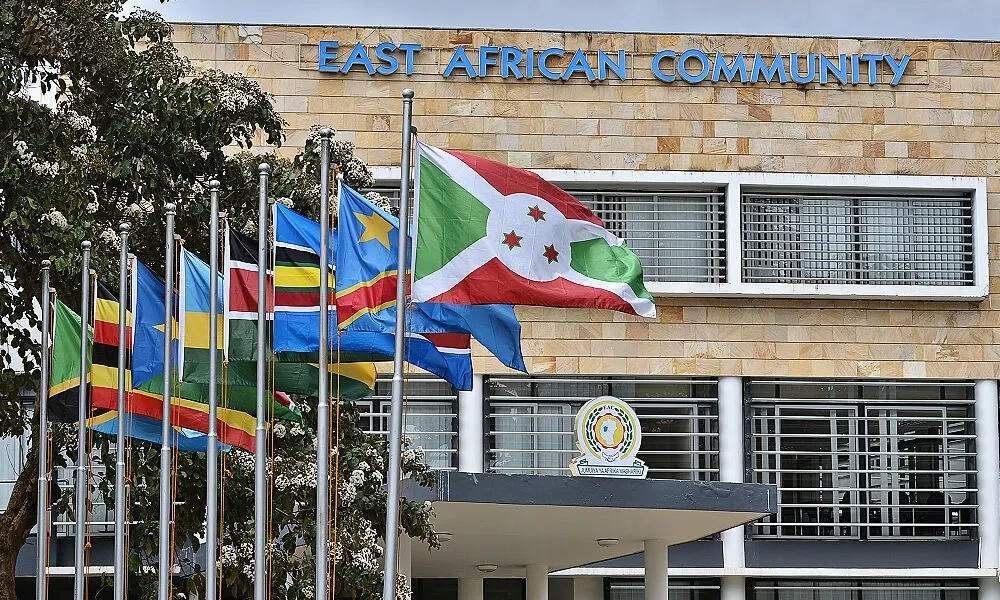
The warning comes as the East African Community (EAC) begins implementing the Regional Agri-food Systems Investment Plan (RASIP) 2026-2035, the bloc’s blueprint for transforming agriculture into a driver of food security, trade, jobs and economic growth.
An assessment presented during a regional webinar by the EAC-CAADP Non-State Actors Group found that while political commitment remains strong, implementation is being undermined by inadequate financing, debt pressures and weak budget execution.
“The region has moved beyond a deficit of political commitment. The constraint is readiness to implement — the capacity to finance, execute, coordinate and sustain agrifood systems transformation,” the report says.
Although African Union member states committed under the Malabo and Kampala declarations to allocate at least 10% of public expenditure to agriculture, only Burundi currently exceeds that threshold among the seven EAC partner states assessed.
Burundi allocates about 13% of its national budget to agriculture. Rwanda allocates approximately 4.5% but is regarded as having the region’s strongest investment strategy, with spending targeting irrigation, seed systems, livestock genetics and climate-smart agriculture.
Kenya allocates only 1.3% of its national budget to agriculture despite increasing sector funding by 34.5% from the previous year. South Sudan could not be assessed because no verifiable agriculture budget allocation was publicly available.
The report argues that headline budget allocations alone do not accurately measure readiness to transform agriculture. It assesses countries against six indicators, including investment adequacy, quality of expenditure, domestic financing, budget execution, institutional accountability and alignment with national agricultural investment plans.
“Budget shares alone cannot establish implementation readiness,” the report notes, arguing that modern food systems are financed across multiple government ministries, including through transport, climate resilience, nutrition and trade investments.
Presenting highlights of the EAC’s Fifth Biennial Review Report, David Wafula, coordinator for agriculture and food security at the EAC Secretariat, said the bloc had made progress under the Malabo Declaration but continued to lag in agricultural investment financing, ending hunger and expanding intra-African agricultural trade.
He said meeting Kampala targets, including increasing agrifood output by 45% and eliminating hunger, would require significantly greater public and private investment.
“Success requires a multisectoral approach that coordinates investments in agrifood systems,” Wafula said, adding that uneven implementation capacity among partner states remains a major concern.
The financing challenge is evident within the EAC itself. For the 2026-27 financial year, the community’s productive sectors budget increased from $3.44 million to $4.13 million, but 89.17% of the funding comes from development partners. Partner states contribute only 10.83%. The EAC’s total budget stands at $110.86 million.
The assessment also highlights pressure from debt servicing, security spending and fiscal consolidation. Kenya’s agriculture budget is constrained by debt repayment obligations, while the Democratic Republic of Congo and South Sudan divert significant resources towards security. Uganda faces debt and infrastructure pressures, while Tanzania’s agriculture budget has been affected by expenditure rationalisation.
These competing demands are crowding out long-term investment in agricultural research, extension services, irrigation, mechanisation and climate resilience. The report also warns against relying on politically attractive input subsidies at the expense of structural investments needed for sustained growth.
Speaking during the opening session, Agnes Kirabo, chairperson of CAADP and regional coordinator of the Food Rights Alliance, urged stakeholders to translate policy commitments into tangible actions that improve people’s lives across Africa.
Kirabo noted that Africa has a predominantly young population, with 76% of its people younger than 35, describing this demographic as a major asset for the continent’s development.
However, she stressed that responsibility for driving change should not rest solely on young people.
“Those of us who are above 35 years old should not leave this work to the under-35s. We all have a role to play in transforming the lives of our people,” she said.
Participants called for stronger oversight of agricultural spending by governments, parliaments and civil society organisations. East African Legislative Assembly (EALA) member Françoise Uwumukiza said parliamentarians have a critical role in ensuring national agricultural investment plans align with RASIP and that governments are held accountable.
The EAC-CAADP Non-State Actors Group recommended a harmonised regional Kampala Readiness Scorecard, quarterly monitoring of budget releases and expenditure, publication of financing gaps in national agricultural investment plans, and common standards for tracking agrifood expenditure.
Closing the webinar, Chikondi Chabvuta, continental chairperson of the CAADP Non-State Actors Group, urged governments to shift from commitments to financing implementation.
“Move from promises to financed implementation: every commitment should carry a costed financing pathway,” she said.
For East Africa, where agriculture remains a major employer and backbone of rural economies, the challenge is no longer agreeing on what needs to be done, but whether governments can mobilise resources, strengthen institutions and sustain political will to turn regional declarations into measurable improvements in food production, nutrition, trade and livelihoods.