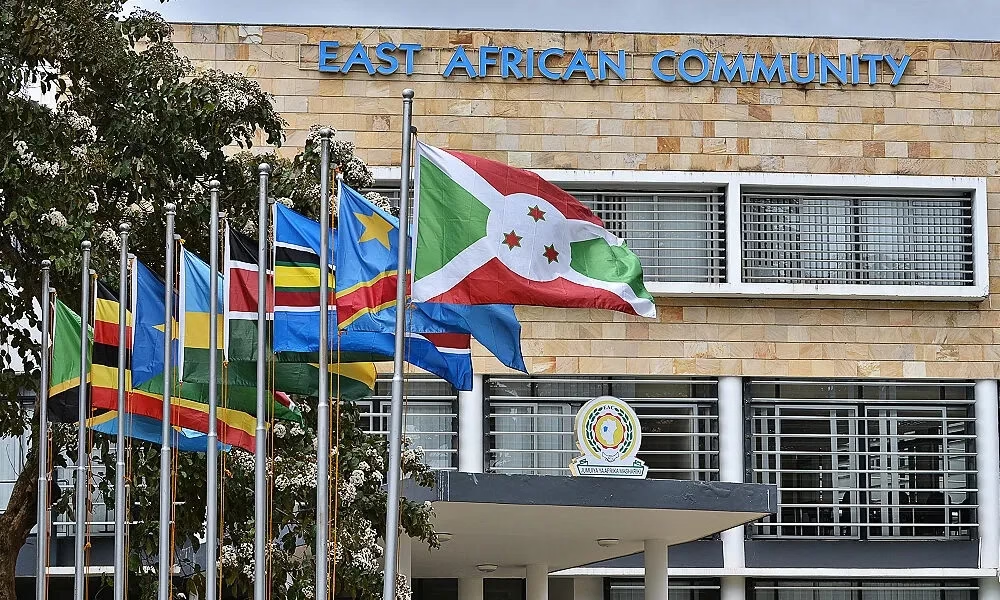
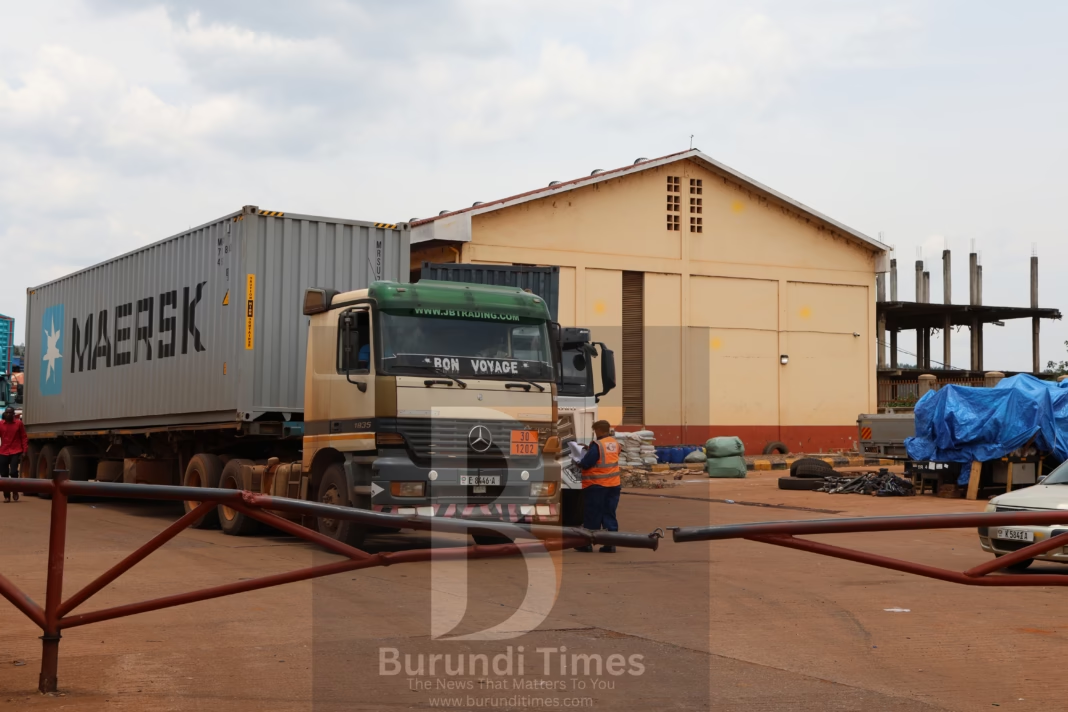

East African businesses are calling for faster action to remove trade barriers, improve border efficiency and connect payment systems as companies seek to take greater advantage of the region’s expanding market.
Intra-EAC trade rose 28% in 2025 to $19.3 billion from $15.2 billion a year earlier, according to the East African Community. But intra-regional trade remains about 15% of the bloc’s total trade, while the EAC has estimated that 30% to 50% of its regional trade potential remains unrealized.
Speaking at a CEOs–Trade & Investment round-table in Nairobi on Tuesday, business leaders said non-tariff barriers, border delays, high logistics costs, regulatory differences and difficulties with cross-border payments continue to raise the cost of doing business.
Ahmed Farah, executive director of the East African Business Council, said the region’s market offered significant opportunities for Kenyan businesses.
“The East African Community is not just a neighbouring market — it is Kenya’s next growth frontier,” Farah said.
He called for the removal of non-tariff barriers, harmonization of standards, lower logistics costs and consistent implementation of EAC commitments.
Ashif Kassam, executive chairman of RSM Eastern Africa, said the region’s challenge was increasingly about implementation.
He identified non-tariff barriers, border delays, high logistics and electricity costs, fragmented regulations, non-integrated digital systems, cross-border payment difficulties and policy uncertainty among the main constraints on investment and regional trade.
Costs beyond tariffs
For companies moving goods across borders, delays can translate directly into higher costs.
Duncan Onyango, CEO of Trade Catalyst Africa, said businesses must consider whether they can finance production, fulfil orders, receive payment and remain profitable.
“The key questions for businesses are: Can I finance it? Can I fulfil the order? Will I get paid? And can I make a profit?” Onyango said.
He said infrastructure improvements alone would not resolve the region’s trade problems.
“You can invest in modern machinery and produce a world-class product, but the moment that truck leaves the factory gate, it may encounter poor transport infrastructure, clearance requirements and systems that are not yet fully functional,” he said.
The EAC has introduced several measures aimed at reducing those costs, including one-stop border posts, the Single Customs Territory and a regional customs bond.
The bloc has also continued to monitor non-tariff barriers reported by businesses. It says hundreds of such barriers have been resolved through its regional mechanism, although new complaints continue to be reported.
The EAC has said the remaining obstacles are increasingly operational and institutional rather than a lack of regional trade agreements.
Payment systems remain a challenge
Business leaders also identified cross-border finance as an obstacle to deeper regional trade.
“Africa’s integration challenge is not only about roads, borders and customs procedures; it is also about finance, monetary systems and trust,” Onyango said.
East African countries use different national currencies and operate under different monetary and financial conditions. Businesses trading across borders can therefore face currency-conversion costs, foreign-exchange constraints and differences in payment systems.
The EAC and financial institutions have been working toward greater interoperability of regional payment systems as part of broader financial integration efforts.
Regional value chains
The discussions also focused on using the EAC market to build regional supply chains rather than relying on individual national markets.
John Mwendwa of the Kenya Investment Authority said investors were looking for scale, predictability, talent, market access and opportunities to participate in regional value chains.
He called for EAC countries to complement one another by sourcing inputs across borders and locating production where businesses can operate most efficiently.
The African Development Bank has similarly identified infrastructure gaps, logistics costs, access to finance and regulatory fragmentation as constraints on regional integration and cross-border value chains.
For Kenya, whose economy was put at about $136 billion at the meeting, deeper regional integration could expand the market available to local manufacturers and investors.
For the wider EAC, the challenge is converting the region’s economic scale into higher levels of trade and investment between member states.
Farah said the priority should be improving the business environment across the bloc.
“Our priority must be to make the EAC a more competitive and predictable market for business,” he said.
The recommendations from the Nairobi roundtable are expected to contribute to an EAC Trade and Investment Climate Report scheduled for release at the East Africa CEO & Investment Forum in September.