
Burundi is giving local authorities a larger role in managing school feeding, with the World Food Programme (WFP) helping communes buy food, monitor supplies and coordinate meals for hundreds of thousands of children.
The shift is part of the government’s National Home-Grown School Feeding Programme, which prioritises food from local agricultural cooperatives and processing businesses.
For the 2026-2027 school year, WFP support targets 846,422 children in 982 schools, the U.N. agency said Oct. 30.
Under the new arrangement, communes are taking on more responsibility for planning food needs, purchasing agricultural products and monitoring deliveries, under the leadership of the Ministry of National Education and Scientific Research.
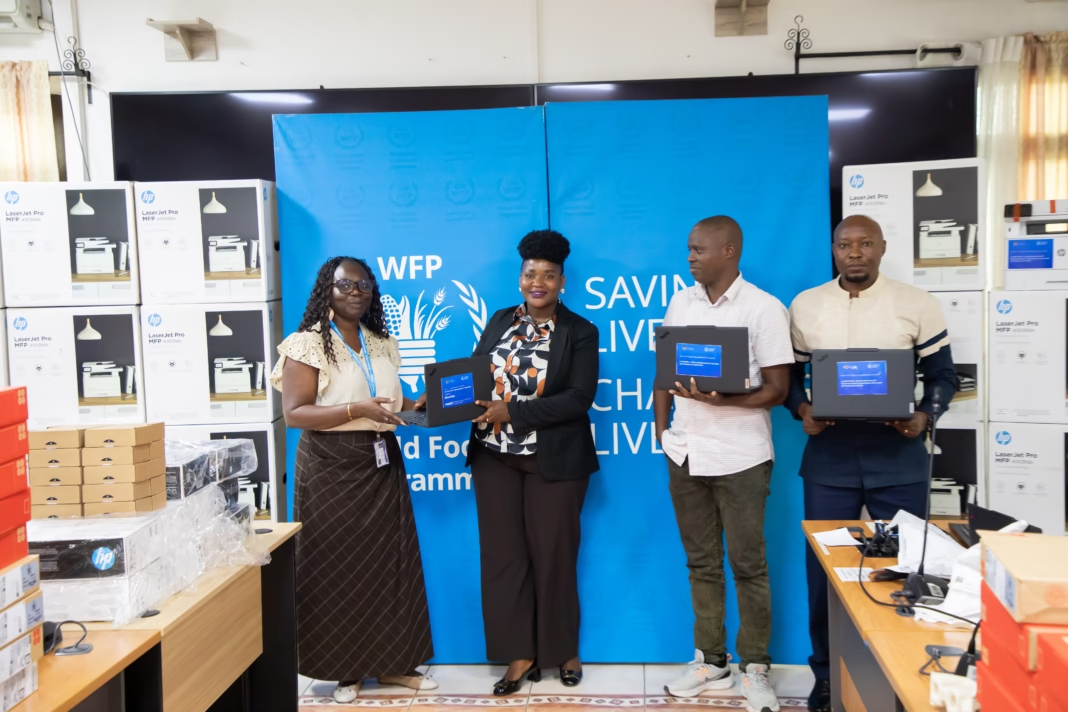
WFP said it has established multi-sectoral committees in 27 communes, with designated officials responsible for monitoring school canteens. The agency gave education services in those communes 27 laptop computers and 27 printer-scanners to support program management, procurement monitoring and information-sharing between schools and local authorities.
The equipment was part of a donation of 74 devices to Burundian public institutions, which also included 14 computers and six printer-scanners for social protection institutions.
Local farmers linked to school meals
The decentralized model is also meant to create markets for domestic producers by connecting schools directly with cooperatives that aggregate farmers’ produce. Schools can buy locally grown food from the cooperatives and from local processing units.
A WFP evaluation published in May 2026 found improvements under the decentralized procurement model, which was piloted with the government in 2022. Schools using it increased feeding days from an average of 7.4 to 13 per month. The model cost $40.61 per child annually, compared with $46.85 under the previous centralized system.
By the 2025-2026 school year, about 90% of WFP-supported schools had moved to the decentralized commodity-voucher model, according to the evaluation team. The model involved 90 smallholder farmer cooperatives supplying schools, with local authorities helping organize procurement.
Financing remains central to expansion
The Burundi government aims to extend school feeding to all preschool and primary pupils by 2032, a target estimated at nearly 2.8 million children.
In April 2026, the Education Ministry and WFP held a workshop to validate a revised national school-feeding policy and a sustainable financing strategy before submitting them to the government for formal adoption. The strategy seeks to clarify institutional responsibilities, strengthen coordination and identify ways to finance wider coverage.
A U.N. report published in September 2026 said the program reached nearly 1 million children and involved about 90 cooperatives representing 5,400 farmers during the 2025-2026 school year. It also said nearly four in five schools needed additional resources to sustain meals through the end of the academic year.
The question is particularly pressing as communes take on more of the procurement and delivery work. To reach the 2032 target, the government will need to expand coverage while ensuring local authorities have the resources and administrative capacity to sustain the program.
The latest support is part of WFP’s wider cooperation with the government to strengthen national ownership of school feeding and connect education, nutrition and local agriculture.