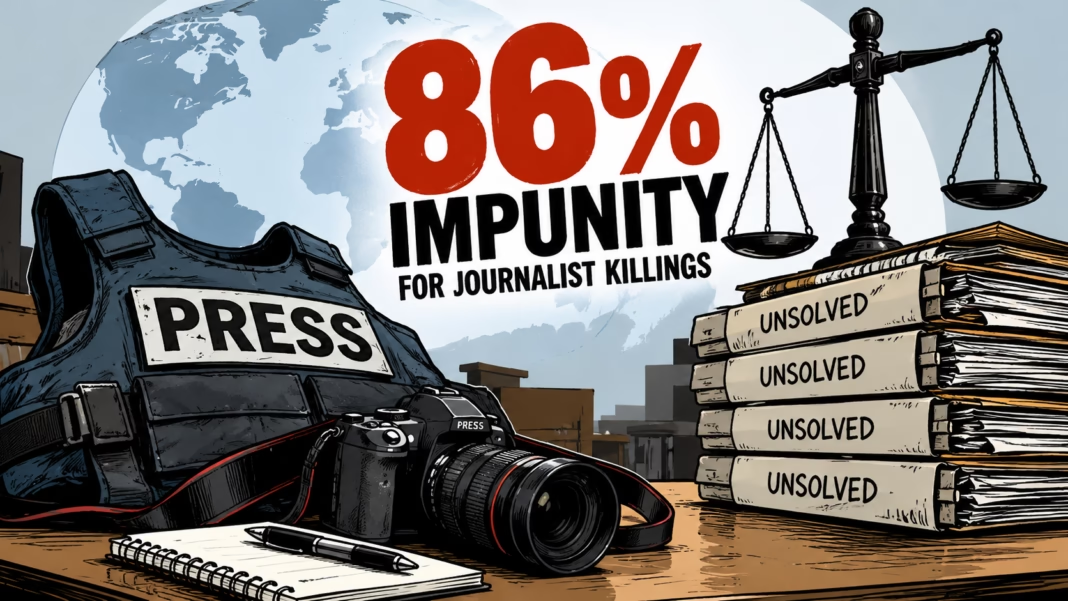

Nearly nine out of 10 killings of journalists worldwide remain judicially unresolved, with the global impunity rate rising to 86% for the first time since UNESCO began tracking the cases in 2012.
The increase, reported Monday in UNESCO’s latest findings on the safety of journalists, comes amid continued violence against media workers, particularly in conflict zones, where new technologies such as drones are creating additional threats.
A total of 189 journalists were killed in violent attacks worldwide in 2024 and 2025, with 67% of the deaths occurring in conflict zones, according to UNESCO. Fifty journalists were killed by unmanned aerial vehicles, or drones, across six conflict zones during the two-year period.
“New technologies and weapons are changing the ways attacks against journalists are carried out. Yet one thing remains unchanged: those who kill are rarely held accountable,” UNESCO said in a statement marking the International Day to End Impunity for Crimes against Journalists.
The global impunity rate increased by one percentage point, reversing the progress recorded since UNESCO began measuring the rate in 2012. The latest figures mean that only a small proportion of journalist killings have resulted in judicial resolution.
The findings point to contrasting trends between countries experiencing armed conflict and those without active conflicts.
In countries not experiencing armed conflict, the number of journalists killed fell to 62 in 2024 and 2025, the lowest level in 18 years. The impunity rate in those countries also declined by 17 percentage points since 2012, reaching 77%.
Despite that progress, the global picture remains bleak, with conflict zones accounting for more than two-thirds of journalist killings during the reporting period.
More than 1,600 journalists killed since 2006
The latest figures add to a broader record of violence against journalists. More than 1,600 journalists were killed worldwide between 2006 and 2025, with close to six out of every seven cases remaining judicially unresolved, according to UNESCO’s Observatory of Killed Journalists.
The agency warned that failure to prosecute those responsible for attacks on journalists has consequences beyond the media industry.
“Impunity leads to more killings and is often a symptom of worsening conflict and the breakdown of law and judicial systems,” UNESCO said.
It added that unresolved crimes against journalists can conceal serious human rights abuses, corruption and other criminal activities, weakening public accountability and the rule of law.
Women journalists face additional threats, including gender-based violence, online abuse and targeted attacks, UNESCO said.
UNESCO calls for stronger accountability
The findings were released Monday as UNESCO marked the International Day to End Impunity for Crimes against Journalists under the theme “Threats Evolve. Impunity Endures.”
The United Nations General Assembly established the annual observance in 2013 through Resolution A/RES/68/163, calling on member states to take concrete measures to combat impunity for crimes against journalists.
Nov. 2 was chosen to commemorate the killing of French journalists Ghislaine Dupont and Claude Verlon in Mali on Nov. 2, 2013.
UNESCO called on governments, media organizations and civil society to strengthen efforts to prevent attacks, protect journalists at risk and prosecute those responsible.
The agency said its 2026 Director-General’s Report on the Safety of Journalists and the Danger of Impunity provides new evidence to guide efforts to strengthen accountability and advance implementation of the United Nations Plan of Action on the Safety of Journalists and the Issue of Impunity.
The report is published every two years and examines the global situation of journalist safety, killings and judicial accountability.