
Burundi recorded no new planned investment from other East African Community countries in 2024, according to the bloc’s latest trade and investment report, as regional business leaders promote a pipeline of projects worth nearly $3.95 billion.
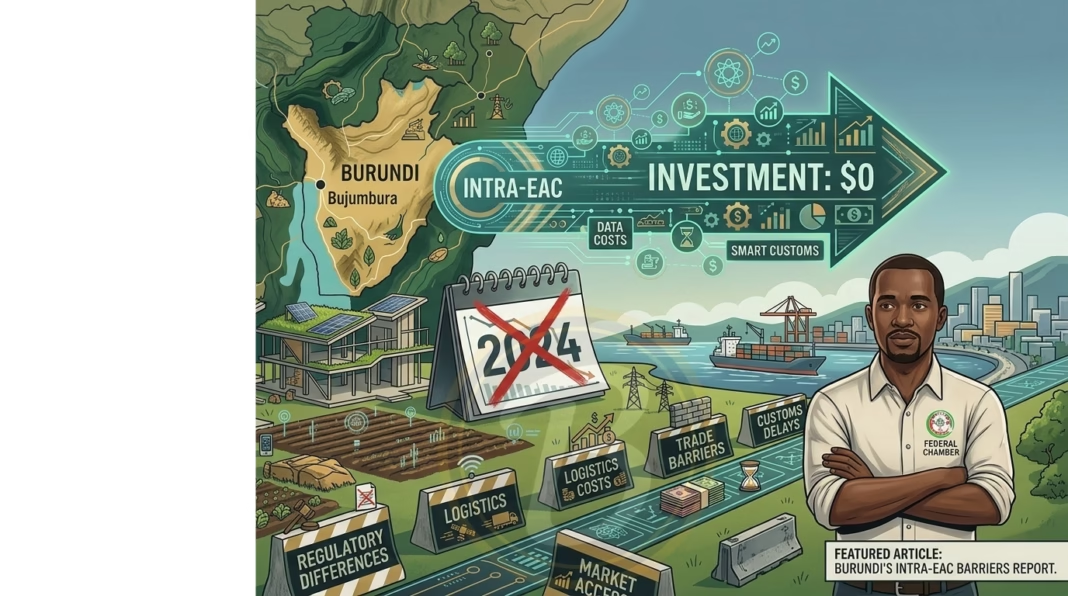
The EAC Trade and Investment Report 2024 shows Burundi had no intra-EAC investment projects that year, down from four projects worth $155.18 million in 2023. The report attributed the absence to Burundi’s risk profile and a broader regional slowdown in cross-border greenfield investment.
Burundi’s total planned foreign direct investment from all sources fell 99% to $10.61 million in 2024 from $1.32 billion in 2023, the report shows. It was the only EAC member to record a decline, while the bloc’s total rose 46.8% to a record $20.18 billion.
India was the only significant foreign investor in Burundi, with $10.6 million across two projects in pharmaceuticals and light engineering, the report says. The rest of the $260.1 million in total investment it recorded was domestic: 57 projects worth $249.5 million, expected to create 3,230 direct jobs.
The East African Business Council said in a statement that the East Africa CEO & Investment Forum, which ended Friday in Nairobi, brought together businesses, investors and development finance institutions around 95 pre-screened investment opportunities. The projects span agribusiness, manufacturing, digital infrastructure, energy, logistics, tourism, health and other sectors. They are not committed funding. The council said the forum’s deal room was meant to advance them toward partnerships, financing and potential deals.
The statement did not say how many of the projects are in Burundi. Burundian businesses were eligible to submit projects to a new East Africa Investment Projects Catalogue, and a regional call for agribusiness proposals named Burundi among the eligible countries. The catalogue and the council’s EAC Trade and Investment Climate Report 2026 were both launched at the forum.
“Without adequate capital, investment opportunities remain just opportunities,” Benard Paul Mono, acting director general of the East African Development Bank, said at the forum. The bank co-convened the event with the business council and the EAC Secretariat.
Barriers cited
At a Sept. 4 roundtable in Bujumbura organised by the council and the Federal Burundi Chamber of Commerce and Industry, business leaders and officials discussed trade barriers ahead of the Nairobi forum. Participants cited non-tariff barriers, regulatory differences, infrastructure gaps, logistics costs, limited access to finance and inadequate market information as obstacles to trade and investment.
Ahmed Farah, the council’s executive director, said competitiveness depends on reliable electricity, shorter transit times, access to foreign exchange and credit, quality suppliers and faster regulatory approvals. He linked Burundi’s Vision 2040-2060 development goals to the need to reduce reliance on a narrow export base.
“A day saved in transit is working capital returned to business,” Farah said, according to Burundi Times.
Olivier Suguru, the council’s vice chair, called for harmonised standards and taxes, stronger implementation of regional commitments and faster adoption of pending trade and investment measures. He said trade barriers persist despite a March 2026 EAC Summit directive that they be resolved by June 30. Africa Intelligence reported that the deadline lapsed with little progress, citing a count of 28 outstanding barriers, one of them attributed to Burundi.
Severin Mbarubukeye, permanent secretary in Burundi’s Ministry of Foreign Affairs, Regional Integration and Development Cooperation, said the private sector should have a central role in shaping economic policy.
“The private sector is not just a stakeholder it is the engine of our economy, and your voice must be at the centre of our policy-making processes,” he said. He urged Burundian businesses to treat the EAC as their home market.
Alice Irakoze, director of registration at the Burundi Development Agency, said the country had made progress in facilitating the movement of goods, services and capital but still faces constraints that limit regional investment.
Regional picture
The EAC recorded $156.7 billion in total trade in 2025, including $19.7 billion among partner states, according to a statement from its secretary general. That puts intra-EAC trade at roughly 12.5% of the total. The EAC’s 2024 report put the share at 11.8%, down from 15% in 2023.
EAC Secretary-General Stephen Mbundi told the forum the bloc aims to raise intra-EAC trade to at least 50% of the total over the next five years.
“We must move decisively from volumes to value,” Mbundi said. Manufactured goods account for less than 30% of EAC exports, he said.
Rebecca Kadaga, Uganda’s first deputy prime minister and chair of the EAC Council of Ministers, represented President Yoweri Museveni at the forum. She said regional growth is projected at 6% in 2026 and that East Africa “must move beyond being a consumer market.” She added that “we must ensure that growth translates into investment, exports, jobs and shared prosperity.”
What Burundi offers
Burundi’s investment authorities have identified agriculture and agro-processing, livestock, mining, energy, infrastructure, tourism, information technology, manufacturing and services as areas with potential.
The EAC report said the government enacted a new Mining Code in August 2023 that reopened access to gold, nickel and rare-earth deposits under transparent, royalty-based terms. According to EAC investment information, incentives include exemptions on some investment goods, reduced corporate tax rates tied to the employment of Burundian nationals and free repatriation of after-tax profits. The EAC says business registration is online and can be completed within a working day.
Power supply remains a constraint. The Jiji and Mulembwe hydropower project has a combined capacity of 49.5 megawatts. The Jiji plant was inaugurated in 2025, with the Mulembwe plant due to follow. The World Bank put Burundi’s electricity access rate at 26%, against a sub-Saharan Africa average of 51%. The regional Rusumo Falls plant was designed to generate 80 megawatts shared equally among Burundi, Rwanda and Tanzania.
Bruce Mpamizo, a council board director, said the forum’s success would be judged by what follows.
“The success of the East Africa CEO & Investment Forum will not be measured by the conversations held here, but by what happens after we leave this room, the partnerships we sustain, the projects we finance, the deals we convert, the businesses we expand and the jobs we create,” he said.