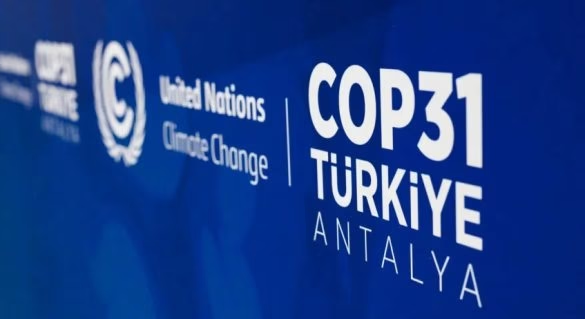

East African countries are converging on a common climate position ahead of COP31, the UN’s 31st climate conference, with farmers and regional experts calling for adaptation, climate finance and smallholder resilience to anchor the region’s global climate agenda.
The push comes as the East African Community (EAC) develops its Climate Change Strategy and Action Plan 2026–2036 and finalises regional priorities for COP31 in Antalya, Türkiye.
In March 2026, the EAC said Partner States had agreed on a common approach to upcoming negotiations, including COP31, as part of the new 10-year regional climate strategy, a move meant to give East Africa a stronger, more coordinated voice internationally.
Speaking during earlier preparations for COP30, EAC Deputy Secretary General Andrea Ariik Malueth said a coordinated regional position would ensure East African communities’ concerns are heard on the global stage. “A coordinated and well-articulated message will amplify our voice and ensure that the needs of our communities are heard and addressed,” she said, adding that regional engagement needed to be “strategic, evidence-based, and future-oriented.”
The stakes are high: more than half the region’s population depends on rain-fed agriculture and other climate-sensitive livelihoods, and the EAC estimates climate-related losses could reach 2 to 4 percent of regional GDP annually by 2040.
Farmers demand a seat at the table
The proposed regional position is now being discussed with farmers, civil society and other stakeholders. Opening the Regional Dialogue on the New EAC Climate Change Strategy 2026–2036, ESAFF Chairperson Diane Sibanda said the consultations were a chance to ensure smallholder farmers’ experiences shape both the regional strategy and the COP31 agenda.
“For our farmers, climate change is already a daily reality,” Sibanda said, citing unpredictable rainfall, prolonged droughts, floods, rising temperatures, pests and disease. She said a common regional position must go beyond describing vulnerability and clearly identify the investments and policy changes communities need.
Farmers’ organisations are proposing several priorities:
- Policy coherence — aligning the EAC climate strategy with the CAADP Kampala Declaration and the EAC Regional Agri-food Systems Investment Plan (RASIP), so climate and agricultural policy reinforce each other.
- Institutionalised farmer participation, giving farmers’ organisations, including women, youth and vulnerable groups, a formal role in planning, implementing, monitoring and evaluating the regional strategy.
- Agroecology and sustainable land management, backed by dedicated budgets and practical programmes supporting locally driven solutions, food security and farmer-managed seed systems.
The finance gap
Climate finance remains the most contentious issue. ESAFF wants adaptation finance to reach farmers through simplified, accessible mechanisms for farmer organisations.
Chriss Buss of Farmers Organizations and Restorative Action (FFORA) said small-scale farms sustain the livelihoods of more than 2.5 billion people worldwide, yet receive a fraction of climate finance. He cited estimates that roughly $443 billion a year is needed to help small-scale family farmers adapt — while they currently receive less than 1 percent of climate finance flows.
FFORA and the Family Farmers for Climate Action Campaign are working with farmer organisations across Africa and Asia to push for a Dedicated Farmers Resiliency Fund and greater farmer representation in the governing bodies of global climate funds, the UNFCCC and other Rio Conventions. The underlying question, Buss suggested, is not how much finance is pledged, but whether it reaches the farmers most exposed to climate impacts.
“Not merely beneficiaries”
Magreth Masudio, a woman farmer from Uganda, said COP31 should shift the agriculture agenda from recognising vulnerability to financing practical solutions. Progress, she said, should be measured by whether finance, technology, knowledge and decision-making power actually reach farmers and enable farmer-led solutions.
That view reflects a broader push among farmer organisations against being treated as passive recipients of climate programmes. Sibanda said COP31 recommendations should call for climate finance to reach farmers directly, alongside investment in agroecology, farmer-managed seed systems, and the operationalisation of Loss and Damage support. She also called for farmer-led social accountability — using tools such as community scorecards and participatory monitoring to track climate budgets and commitments — to ensure pledges translate into visible action.
“Farmers remain committed to working with the EAC, Partner States and development partners to ensure that smallholder farmers are not merely beneficiaries of climate action, but active partners in shaping, implementing, monitoring and evaluating climate policies and actions,” Sibanda said.
A common voice, grounded locally
The emerging position pairs regional diplomatic unity with grassroots participation. For EAC policymakers, a common voice is meant to strengthen East Africa’s hand in international negotiations. For farmer organisations, that voice must reflect the realities of communities whose livelihoods depend on climate-sensitive agriculture.
Their message for COP31: a coordinated regional position built on farmer-led adaptation, accessible climate finance, agroecology, farmer-managed seed systems, accountability, and practical support for communities facing climate losses.
The challenge now facing the EAC is translating that consensus into a negotiating agenda and, as Sibanda put it, into “concrete actions within the new Strategy.” For East Africa’s farmers, a unified COP31 voice will ultimately be judged by one measure: whether it delivers real resources, stronger resilience, and greater influence for the people adapting to climate change on the ground.