
Officials from the Democratic Republic of Congo and Rwanda reported progress on key security commitments during a meeting in Geneva this week, as the United States and other international mediators sought to maintain momentum behind a peace agreement aimed at ending years of conflict in eastern Congo.
The fifth meeting of the Joint Security Coordination Mechanism brought together representatives of the United States, the Democratic Republic of Congo, Rwanda, Qatar, Togo and the African Union to review implementation of the Washington Accords, the U.S.-brokered agreement signed in 2025.
According to the U.S. Bureau of African Affairs, Congolese officials updated participants on efforts to neutralize the Democratic Forces for the Liberation of Rwanda (FDLR), while Rwanda reported progress toward lifting what it describes as its defensive measures in eastern Congo.
“The DRC and Rwanda reported progress on neutralizing the FDLR and lifting Rwanda’s defensive measures in eastern DRC, key steps toward lasting peace in the region,” the bureau said in a statement posted on X, adding that the United States “remains committed to seeing this through.”
The Joint Security Coordination Mechanism is one of the central pillars of the Washington peace process. It is designed to coordinate intelligence-sharing, monitor implementation of agreed security measures and verify commitments by both governments as they work to reduce tensions in eastern Congo.
The peace process involves multiple tracks. Alongside the Washington Accord between Kinshasa and Kigali, Qatar has facilitated separate negotiations involving the Congolese government and the AFC/M23 rebel movement, while Togo and the African Union continue serving as key mediators. International partners have described the two tracks as complementary efforts to stabilize the Great Lakes region.
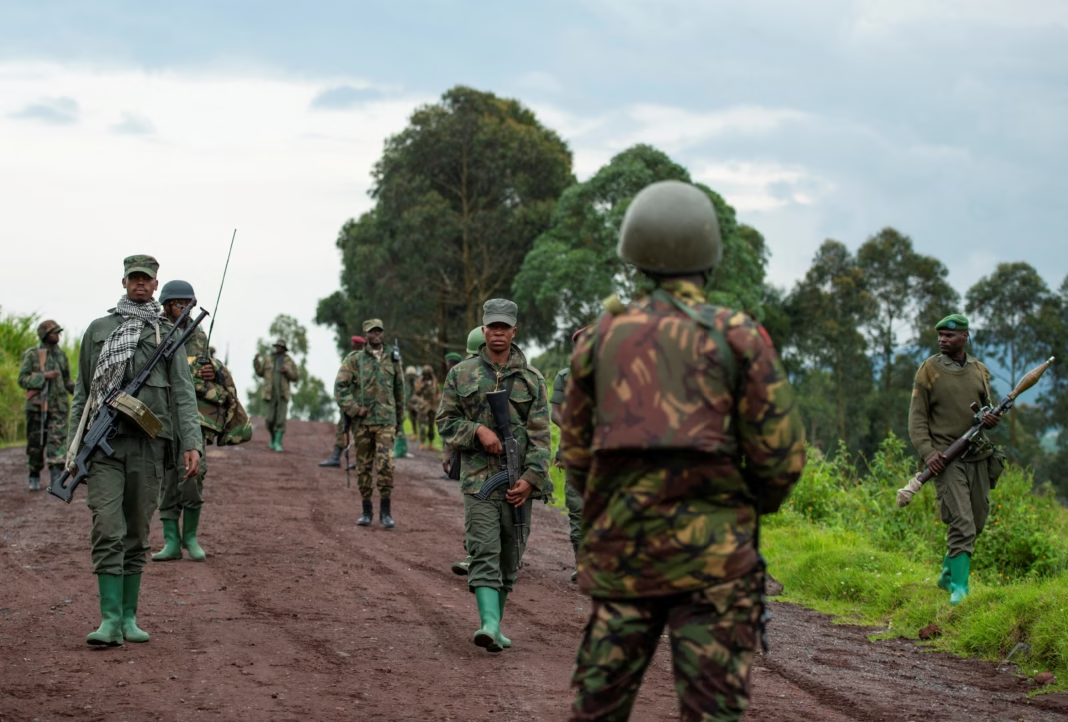
Relations between Congo and Rwanda have remained strained over allegations that Rwanda supports the M23 rebel group operating in eastern Congo. Rwanda denies backing M23 and says its security concerns stem largely from the continued presence of the FDLR, an armed group founded by individuals linked to the perpetrators of Rwanda’s 1994 genocide. Kinshasa has repeatedly accused Rwanda of military involvement inside Congolese territory, allegations Kigali rejects.
Previous meetings under the peace agreement have focused on establishing a timetable for dismantling the FDLR, exchanging intelligence, and defining the conditions under which Rwanda would withdraw forces or end what it calls defensive measures. Although implementation has faced delays, participants have continued to describe the overall peace framework as remaining on course.
The latest Geneva meeting did not announce new deadlines or specific operational milestones. Instead, participants emphasized continuing implementation of existing commitments, suggesting that the focus has shifted from negotiating the agreement to carrying out its provisions.
For the United States, which has played a leading diplomatic role in brokering the agreement alongside Qatar, the African Union and Togo, sustained implementation is seen as critical to reducing violence that has displaced millions across eastern Congo and undermined regional stability for decades.
- The Washington peace agreement was signed in June 2025 between the Democratic Republic of Congo and Rwanda with U.S. mediation.
- The agreement commits Congo to address the threat posed by the FDLR while Rwanda is expected to end its defensive military measures as security conditions improve.
- Qatar is facilitating parallel talks involving the Congolese government and AFC/M23, while Togo serves as the African Union mediator.
- The Joint Security Coordination Mechanism meets regularly to monitor implementation and verify progress on security commitments.