
The disarmament and demobilisation of the Democratic Forces for the Liberation of Rwanda is emerging as a key test of whether the U.S.-brokered peace process between Rwanda and the Democratic Republic of Congo can move from signed commitments to implementation.
The International Contact Group for the Great Lakes, comprising the United States, Belgium, Canada, Denmark, the European Union, France, Germany, the Netherlands, Sweden, Switzerland and the United Kingdom, has urged Kinshasa to act on a protocol accepted by a faction of the FDLR on July 28.
The group said the Congolese government should “promptly develop an operational plan and a realistic timeline” to implement an effective FDLR neutralization, in line with commitments made under the Washington Accords and related security arrangements.
The intervention puts renewed international focus on one of the central security commitments underpinning the Rwanda-DRC peace process.
The Washington peace agreement, signed by Rwanda and the DRC on June 27, 2025, requires Kinshasa to neutralize the FDLR, while Rwanda committed to the disengagement of its forces and the lifting of defensive measures. The two countries reaffirmed those commitments when Presidents Paul Kagame and Félix Tshisekedi established the Washington Accords for Peace and Prosperity in December 2025.
The agreement was designed to address the security concerns at the heart of the conflict in eastern Congo, with the FDLR issue representing a longstanding concern for Kigali and the presence of Rwandan forces and alleged support for M23 remaining major concerns for Kinshasa.
But implementation has remained contested.
At a June meeting of the Joint Oversight Committee for the Rwanda-DRC peace agreement, both countries reaffirmed their commitment to fully implement the June 2025 agreement. The DRC reported on its work to neutralize the FDLR, while Rwanda provided an update on the disengagement of its forces and lifting of defensive measures.
The July protocol now provides a new opportunity to advance the FDLR component of the agreement, but the International Contact Group made clear that the signing itself does not constitute completion of the obligation.
The group also called on Kinshasa to clarify how the protocol will address impunity and urged the government to work with MONUSCO, the U.N. peacekeeping mission in Congo, during implementation.
It further issued a warning against any military relationship between the Congolese government and FDLR elements.
“Any collocation or operational collaboration with elements of the FDLR is fundamentally at odds with the commitments made in the Washington Accords,” the group said.
That warning goes directly to one of Rwanda’s longstanding concerns about the FDLR.
Rwanda maintains that the group remains a security threat and has accused the DRC of supporting FDLR elements operating in eastern Congo. Kigali has repeatedly said the Washington Accords cannot be implemented selectively and that the DRC must fulfill its obligation to neutralize the group. In June, Rwanda said the DRC remained in violation of its commitments because of what it described as continued state support for the FDLR.
The DRC has rejected accusations that it backs the FDLR and has increasingly emphasized its commitment to addressing the group under the Washington framework.
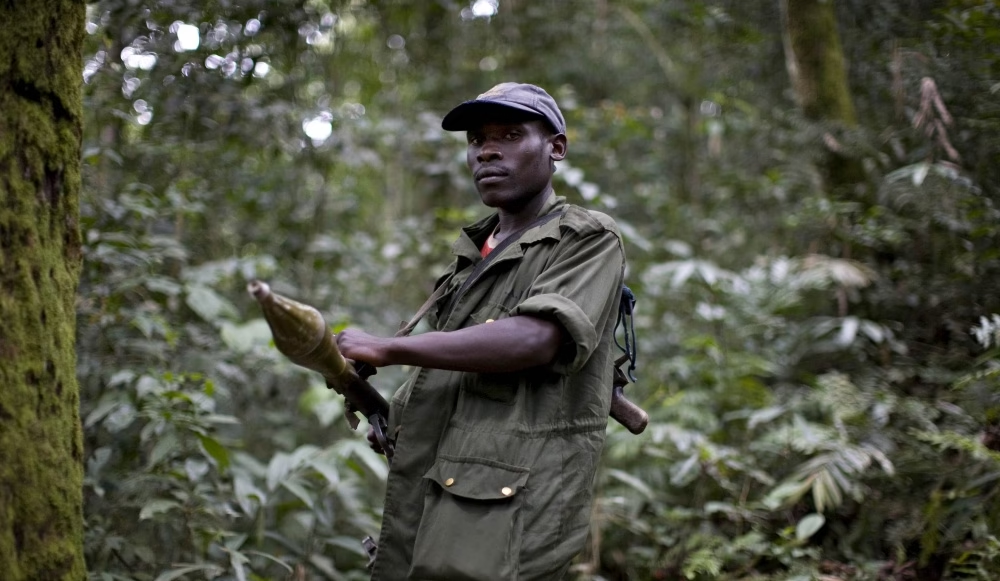
The FDLR’s roots extend to the aftermath of the 1994 genocide against Tutsi in Rwanda. The armed group has operated in eastern Congo for decades and has been accused of serious abuses against civilians.
The accountability question is therefore likely to remain central to the implementation process.
The International Contact Group specifically urged Kinshasa to clarify the “mechanisms for combating impunity” referenced in the protocol, indicating that disarmament cannot be separated from questions of justice and accountability.
The protocol itself reportedly provides for disarmament, demobilization and cantonment, while also addressing security guarantees, the return of Rwandan refugees and international monitoring.
The development comes as the broader peace process faces continued pressure.
The Washington Accords have been presented as a framework for ending decades of instability in eastern Congo, but fighting and mutual accusations have continued despite the agreement. The United States has previously accused Rwanda of violating the accord through its support for M23, while Rwanda has maintained that the DRC must first address the FDLR threat.
The International Contact Group is now urging both sides to maintain momentum across the wider peace process.
It called on all parties to the Washington Accords and the Doha Framework, as well as African Union-led mediation efforts, to continue implementing their commitments. It also reminded the parties of their obligation to protect civilians, respect international humanitarian law and immediately de-escalate tensions.
The group welcomed a separate prisoner exchange between the DRC government and the AFC/M23, describing it as a “vital confidence-building measure” and praising a recent transfer facilitated by the International Committee of the Red Cross.
The latest statement therefore places the FDLR protocol within a broader push to turn the Rwanda-DRC peace process into concrete actions on the ground.
For Kinshasa, the next stage is the development of the operational plan and timeline demanded by its international partners. For Kigali, the implementation of FDLR neutralization remains a central security commitment under the Washington framework.
The FDLR disarmament process has consequently become one of the clearest measures of progress in the implementation of the Washington Accords.