

American scientist Karl Deisseroth and German scientists Peter Hegemann and Georg Nagel have won the 2026 Nobel Prize in Physiology or Medicine for discoveries that enabled researchers to control nerve cells with light, opening a powerful new way to study the brain and neurological disease.
The Nobel Assembly at Karolinska Institutet announced the award Monday, honoring the three scientists for their “discoveries concerning light-gated ion channels and optogenetics.”
Their work helped establish optogenetics, a technique that allows researchers to use light to activate or inhibit specific neurons in living organisms.
The Nobel committee said the method is now used in laboratories around the world to investigate the brain.
Deisseroth, a professor at Stanford University in the United States, and Hegemann and Nagel, both based in Germany, made discoveries that revealed how certain proteins can respond to light and influence the electrical activity of cells.
Those discoveries eventually allowed scientists to introduce light-sensitive proteins into nerve cells and then use pulses of light to control their activity.
The technique has become an important tool in neuroscience because it allows researchers to study particular groups of neurons with a degree of precision that was previously difficult to achieve.
Rather than observing the brain only after a process has occurred, researchers can manipulate selected neurons and examine how that changes behavior, movement and other biological functions.
The work could also contribute to a better understanding of neurological and psychiatric disorders, although the Nobel award recognizes the underlying scientific discoveries rather than a specific new treatment.
The Nobel Prize carries an award of 12 million Swedish kronor, to be shared equally among the three laureates, according to Reuters.
The medicine prize traditionally opens the annual Nobel announcements. Prizes in physics, chemistry, literature, peace and economics will follow during Nobel week.
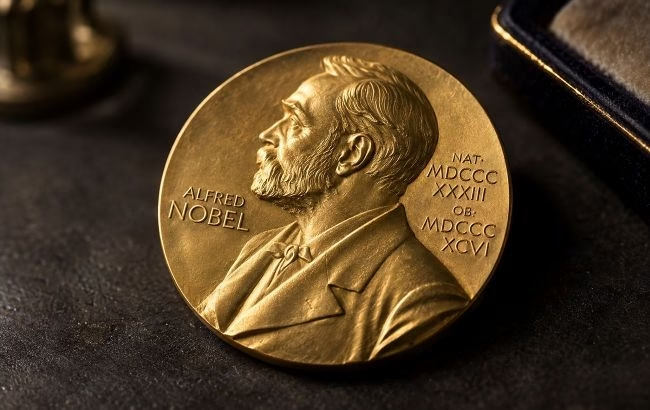
The Nobel awards were established through the will of Swedish industrialist and inventor Alfred Nobel and have been presented since 1901.
The 2026 medicine prize follows last year’s award to Mary Brunkow, Fred Ramsdell and Shimon Sakaguchi for discoveries concerning peripheral immune tolerance and the regulatory mechanisms that prevent the immune system from attacking the body’s own tissues.