
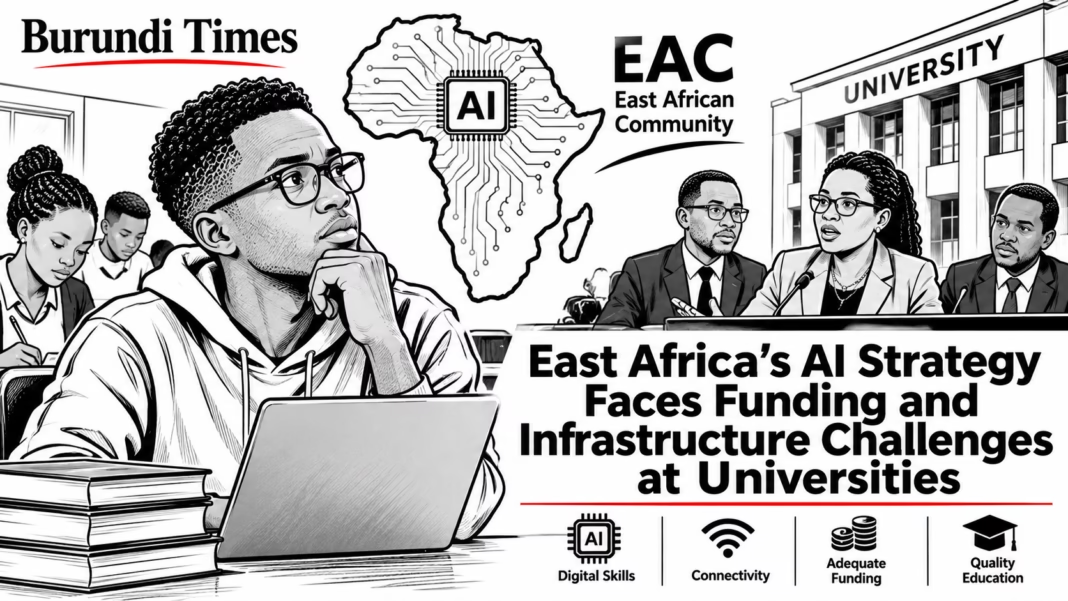

East Africa’s plans to introduce artificial intelligence education across its universities could face significant implementation challenges, including inadequate digital infrastructure, limited funding and shortages of qualified lecturers, raising questions about whether the region is prepared to deliver on its technological ambitions.
Ministers responsible for education, science and technology from the East African Community (EAC) adopted regional artificial intelligence and digital transformation strategies on Oct. 31 and approved an AI foundational module for undergraduate students across the region.
The decisions establish a framework for integrating artificial intelligence into higher education and other sectors, including agriculture, health care, industry and public services. However, the ministers also acknowledged financial and institutional capacity constraints that could complicate implementation.
Addressing the ministerial session, EAC Deputy Secretary-General Andrea Ariik Malueth called for clear implementation plans backed by adequate resources and institutional accountability.
“As we consider outstanding decisions and new proposals, I urge that our directives identify responsible institutions, achievable timelines and the resources required,” Malueth said.
His remarks highlight a broader challenge facing the regional bloc: translating policy commitments into practical programmes, particularly in countries where universities may lack adequate computer facilities, reliable internet connectivity and specialist teaching capacity.
Infrastructure and funding remain key challenges
Introducing artificial intelligence into university curricula requires more than approving a common academic module. Universities need reliable electricity, internet connectivity, computers, appropriate software and lecturers equipped to teach students how to use AI tools effectively and responsibly.
These requirements could prove difficult for institutions operating with limited resources, particularly in countries where access to digital infrastructure remains uneven.
A World Bank analysis of digital infrastructure in sub-Saharan African higher education institutions found significant connectivity gaps, including institutions without internet access in lecture rooms and information technology laboratories.
Although the findings cover a broader regional sample rather than EAC universities alone, they illustrate the infrastructure challenges facing African higher education institutions seeking to expand digital learning.
For East African universities, the gaps raise questions about whether students will have equal opportunities to benefit from the proposed AI curriculum or whether institutions with stronger technological resources will move ahead faster than others.
The EAC has not specified the overall cost of implementing its newly adopted AI and digital transformation strategies, the financial contributions expected from individual Partner States or a timetable for introducing the AI module across universities.
Regional cooperation and implementation
Under the approved framework, Partner States were directed to consider adopting the AI foundational module across their undergraduate degree programmes, while the Inter-University Council for East Africa (IUCEA) will develop a regional implementation framework.
The module is designed to provide students across different academic disciplines with basic AI knowledge, practical applications and guidance on responsible use.
Ministers also approved the establishment and operationalization of a Regional Artificial Intelligence Network of Universities to strengthen collaboration in AI education, research and innovation.
Three additional instruments addressing teacher competencies, institutional policies and codes of conduct were approved to guide the integration of AI into teacher education and university systems.
The initiatives are intended to support regional cooperation and develop skills needed in an increasingly technology-driven economy.
However, their effectiveness will depend on the capacity of individual universities and governments to translate the regional decisions into funded programmes.
Governments face financing questions
The funding challenge was acknowledged during the ministerial meeting, with the EAC calling for stronger national financing and private-sector partnerships.
The regional bloc also recognized support from development partners, including Germany, the European Union and the World Bank, particularly through initiatives such as the EAC AI Alliance.
“Sustained national financing, stronger private-sector partnerships and adequate institutional capacity are essential to carry these programmes forward,” Malueth said.
The emphasis on national financing raises questions about how governments will prioritize AI education alongside other demands on public education budgets.
For universities, implementation could require investment in digital infrastructure, staff training, research facilities and access to AI technologies.
Without sustained funding, the regional initiative risks creating a common policy framework without ensuring that universities have the resources to deliver it.
East Africa’s AI strategy sets an ambitious direction for higher education and regional technological development. But its success will ultimately depend on whether governments can bridge existing infrastructure and skills gaps and make the proposed opportunities accessible to students across the region.