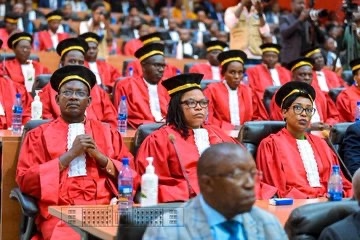

Burundi’s president, who also chairs the Supreme Council of the Judiciary, officially opened the 2025-2026 judicial year on July 26 with a call for judges to strengthen national unity and deliver impartial justice.
Speaking at a ceremony held at the Kigobe Congress Palace, the head of state urged magistrates to remember their mission of reconciliation. “A judge must always remember that he delivers justice to reconcile brothers, not to divide them,” he said.
The president praised the work of judicial professionals but urged them to intensify their efforts, warning that no solid future could be built without an effective justice system. He criticized lengthy court procedures, saying they force citizens to spend valuable time in tribunals instead of focusing on development.
As guarantor of judicial independence, the president called for neutrality, stressing that “a judge has neither ethnicity nor province, but acts with the heart and in accordance with the principles of the profession.” He also urged that the judiciary be treated as a fully independent branch of state, not simply as an administrative sector.
On ongoing governance reforms, he pledged that the judiciary would be strengthened and given greater recognition. He encouraged legal professionals to draft legislation that responds to current realities and helps address systemic dysfunctions.
Burundi’s judiciary is rooted in the civil law tradition inherited from Belgium, with customary law still applied in local disputes. The system is composed of residence tribunals, higher instance courts, courts of appeal, and at the top, the Supreme Court and Constitutional Court, which can jointly sit as a High Court of Justice. While the Constitution guarantees independence, rights groups say the judiciary faces political pressure, slow proceedings and limited resources, leaving many citizens with little confidence in fair and timely justice.