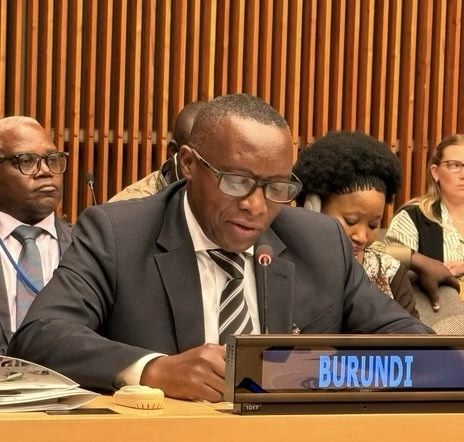

Burundi’s Foreign Minister Edouard Bizimana on Tuesday urged the international community to formally recognize the 1972 genocide against Hutu people in his country, saying the acknowledgment is essential for justice and reconciliation.
Speaking before the U.N. General Assembly, Bizimana said Burundi has turned a painful chapter in its history and now stands as “a living example of resilience and the restoration of peace.” He emphasized that the memory of the atrocities committed in 1972 remains a central part of the nation’s healing process.
“The recognition of the genocide against the Hutu people of Burundi in 1972 is of vital importance,” he said, stressing that international acknowledgment would help strengthen reconciliation and prevent a repetition of violence.
Historians say the 1972 massacres began after a Hutu insurgency in southern Burundi in late April. What followed was a broad military campaign by the Tutsi-dominated government targeting Hutu elites — including intellectuals, students, teachers, and civil servants. Estimates of the death toll vary widely; many put it between 100,000 and 300,000, with some sources around 200,000. In addition, hundreds of thousands of Hutu fled into exile.
In 2021, Burundi’s Truth and Reconciliation Commission officially classified the 1972–73 killings as genocide against Hutus, citing mass graves across the country and tens of thousands of identified victims. The body called for both national remembrance and international recognition of the atrocities.
Bizimana also criticized what he described as the “politicization of human rights,” denouncing the mandate of the U.N. special rapporteur on Burundi, which has monitored the country for more than a decade. He called the reports “biased and subjective,” arguing they no longer reflect the country’s progress.
Beyond Burundi, the minister urged world leaders not to overlook global crises, pointing to the war in Gaza, instability in the Democratic Republic of the Congo, Sudan, and violence in the Sahel. He said peace must be rooted in international law, dialogue and respect for state sovereignty.
He further pressed for reforms at the United Nations to give Africa stronger representation in global decision-making, particularly on the Security Council. “It is essential that this reform be Member States-led, in a spirit of geographical equity, transparency, multilingualism and respect for regional priorities,” he said.
Burundi, once plagued by years of conflict, has contributed troops to peacekeeping missions and sought to reposition itself as an active partner in international diplomacy. But Bizimana said the U.N. should not reduce itself to “a technocratic or budgetary logic,” warning that doing so would weaken its legitimacy.