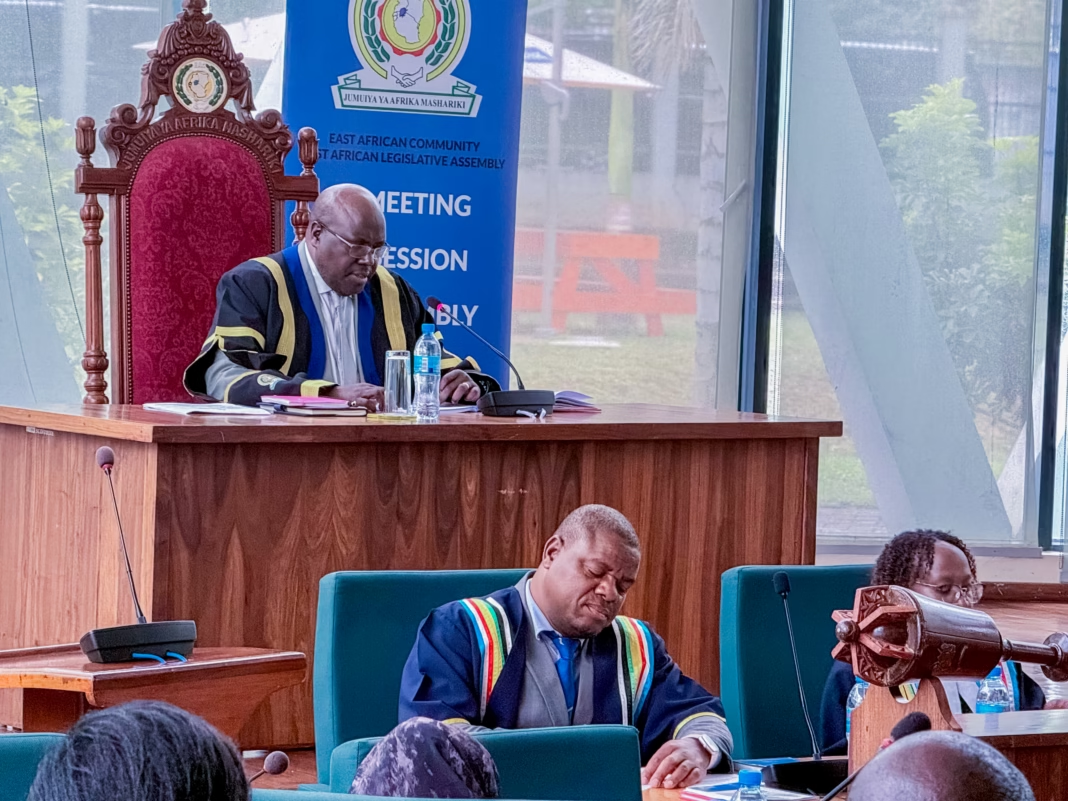

East African Legislative Assembly Speaker Joseph Ntakirutimana criticized the absence of ministers responsible for East African Community affairs during a plenary sitting in Arusha on Thursday 8th, questioning how the bloc’s executive leadership could account for its work while failing to engage with regional lawmakers.
“It is sad and not understandable,” Ntakirutimana said on Thursday after lawmakers raised concerns about the absence of the ministers and other ex-officio members expected to participate in the Assembly’s proceedings.
“We have ex-officio members and no one is there, and they are the executive of the Community,” he said. “We as members of parliament are the voices of the people.”
Ntakirutimana questioned how the executive could report to the EAC Summit of heads of state and government without participating in parliamentary proceedings.
“So what do they report to the Summit if they are not present during the sitting?” he asked, adding that the absences were not a new problem.
The Assembly proceeded with its business despite the absence of ministers from Burundi, the Democratic Republic of Congo, Kenya, Rwanda, Somalia, South Sudan, Tanzania and Uganda. EAC Secretary-General Stephen Patrick Mbundi attended briefly before leaving. The reason for his departure was not confirmed.
We are having a front bench, which is empty. And this front bench is meant to coordinate whatever is going to be submitted to the house, now…We don’t have any member of the council present, and neither we have ex-officio members,” said Abdullah Hasnuu Makame regional law maker from Tanzania .
The sitting included reports on oversight of the EAC Payment and Settlement System, public financial management and accountability, and implementation of the African Continental Free Trade Area.
The Assembly’s Accounts Committee presented a report examining implementation of the regional payment and settlement system and public financial management and accountability. The Committee on Communication, Trade and Investment presented a report on the African Continental Free Trade Area.
The absence of the ministers raised questions about the Assembly’s ability to obtain direct explanations from national officials responsible for coordinating their countries’ participation in regional integration initiatives.
Rules and responsibilities
Article 48 of the Treaty for the Establishment of the East African Community provides for ministers responsible for EAC affairs from partner states, the secretary-general and the counsel to the Community to serve as ex-officio members of the Assembly.
Although ex-officio members do not have voting rights, their participation provides a channel for engagement between the executive and legislative arms of the regional bloc.
The Treaty’s membership provisions do not, by themselves, establish that every absence constitutes a breach of the rules. However, repeated nonattendance can limit opportunities for lawmakers to question executive officials and seek explanations about the implementation of regional policies.
No explanation was available at the sitting for the ministers’ absence.
A recurring problem
The latest criticism follows previous incidents in which ministers’ absences disrupted or threatened to delay EALA proceedings.
In June 2024, the Assembly adjourned a sitting for 24 hours after ministers failed to attend proceedings scheduled to consider the Community’s main and supplementary budgets.
Ntakirutimana criticized the absence at the time, saying the Assembly could not proceed with its business without the secretary-general or members of the Council of Ministers.
In February 2022, the Assembly also suspended a sitting after ministers failed to attend proceedings expected to consider proposed legislation, including the East African Community Financial Services Commission Bill.
The repeated incidents have raised concerns about cooperation between the EAC’s executive and legislative institutions, particularly when lawmakers require officials to explain decisions affecting regional budgets, legislation and integration programmes.
Unlike some previous incidents, Thursday’s sitting continued despite the ministers’ absence. But Ntakirutimana’s remarks underscored the speaker’s concern that the problem persists.
The episode raises questions about how effectively EALA can scrutinize the implementation of regional policies when ministers responsible for coordinating their countries’ engagement with the Community are absent from parliamentary proceedings.