
KIGALI — A US$404 million infrastructure project intended to reshape Kigali’s road network is facing renewed scrutiny as Rwanda’s latest public finance reviews highlight continuing challenges in procurement, compliance and management of public resources.
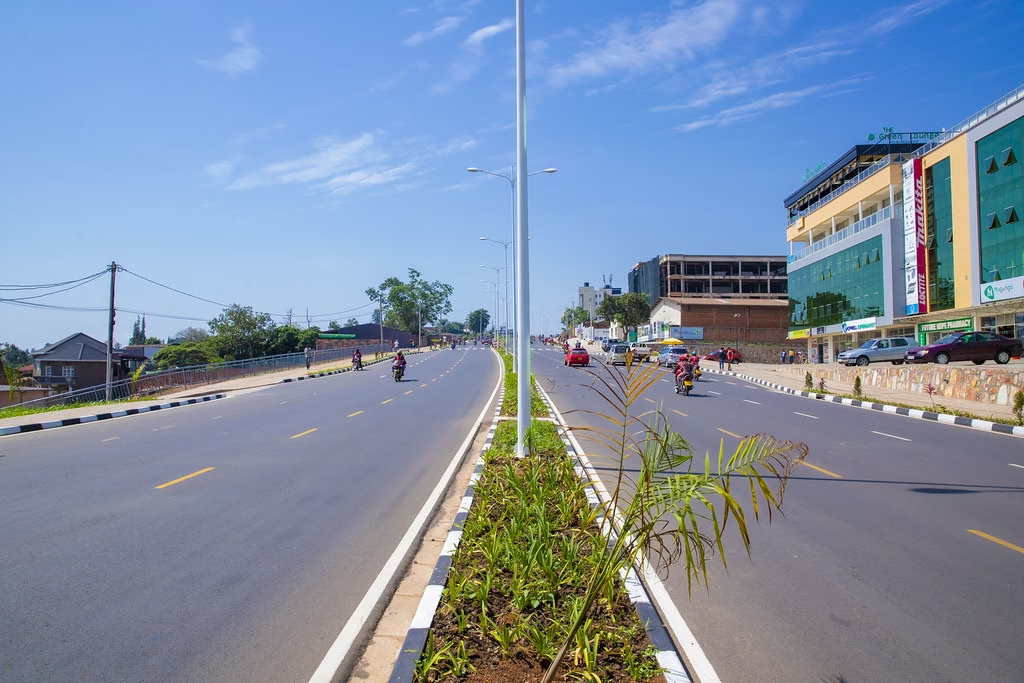
The Kigali Infrastructure Project (KIP), launched through an agreement between the City of Kigali and Crystal Ventures Ltd in 2020, was designed to deliver more than 215 kilometres of roads through a pre-financing model aimed at accelerating infrastructure development.
But years after the agreement was signed, questions remain over implementation delays, financing challenges and whether the oversight mechanisms surrounding large public projects have been effective.
The renewed scrutiny comes after Transparency International Rwanda’s 2026 analysis of Auditor General reports covering decentralised entities and the City of Kigali for the financial year ending June 30, 2024.
The report highlighted continued weaknesses in public financial management, including challenges related to public procurement, asset management, compliance with laws and procedures, and management of public resources.
While the 2026 analysis does not specifically accuse Crystal Ventures Ltd of wrongdoing or identify corruption in relation to the Kigali Infrastructure Project, it provides a broader governance context for examining how major public investments are planned, financed and implemented.
The Kigali Infrastructure Project has become a key example of the challenges that can arise when governments pursue large infrastructure commitments through complex financing arrangements.
According to Transparency International Rwanda’s earlier analysis of Rwanda’s Auditor General findings, the City of Kigali signed a 10-year Memorandum of Understanding with Crystal Ventures Ltd on Oct. 5, 2020, for a pre-financing arrangement valued at approximately US$404.7 million excluding VAT.
The project was expected to construct approximately 215.5 kilometres of roads across Kigali.
The financing model was designed to address a common challenge facing rapidly growing cities: infrastructure needs often outpace available government budgets.
By involving private-sector financing, Kigali sought to accelerate road construction without relying exclusively on annual public allocations.
However, such arrangements also require strong transparency and accountability measures because they involve significant public financial commitments.
Rwanda’s Office of the Auditor General later identified implementation challenges affecting the project.
In its audit covering the financial year ending June 30, 2023, the Auditor General found that the project had experienced financing constraints and slow progress.
The audit reported that approximately US$150 million of the planned financing had been mobilized at the time of review, representing about 37 percent of the expected project financing.
It also found that only 13.3 kilometres of roads had been completed, while significant sections of the planned works remained unfinished.
Rwanda Office of the Auditor General — Annual Audit Report 2022/2023
The Auditor General’s findings raised concerns over whether the project would meet its original objectives within the planned timeframe.
The audit did not accuse Crystal Ventures Ltd of corruption or financial misconduct.
Instead, the findings focused on financing challenges, implementation delays and project management issues.
The 2026 Transparency International Rwanda analysis places these project-level concerns within a wider public accountability picture.
The organization’s review of Auditor General findings from decentralized entities and the City of Kigali found persistent weaknesses affecting public financial management systems.
TI-Rwanda highlighted areas including procurement processes, asset management and compliance with existing regulations.
The organization’s findings do not automatically indicate financial losses or wrongdoing.
Rather, they point to institutional areas where stronger controls and oversight may be needed to improve management of public resources.
Earlier, Transparency International Rwanda examined the Kigali Infrastructure Project specifically through its analysis of Auditor General findings for the 2022/2023 fiscal year.
The organization raised questions about aspects of the procurement process, including approval timelines, compliance with procurement guidance and contract management procedures.
However, the organization did not accuse Crystal Ventures Ltd of corruption, nor did it conclude that funds were misappropriated.
The concerns focused on whether public institutions followed appropriate procedures when structuring and approving a major infrastructure commitment.
One of the remaining questions surrounding the project is whether the US$404.7 million cost represented value for money.
Publicly available documents reviewed by Burundi Times do not provide a complete breakdown of the project’s cost structure, including detailed engineering estimates, alternative proposals or independent comparisons with similar infrastructure projects.
Without those records, it is not possible to determine whether Kigali paid more than necessary.
Infrastructure costs vary depending on technical requirements, including road design, drainage systems, utilities, land acquisition and urban construction conditions.
A high project cost alone does not prove overpayment.
However, transparency around cost calculations remains important for citizens seeking to understand whether major public investments deliver value.
The project has continued to attract attention as Rwanda’s oversight institutions examine public spending and implementation performance.
The Office of the Auditor General’s latest reporting has highlighted broader challenges affecting government projects, including delays, procurement concerns and contract management weaknesses.
Office of the Auditor General of Rwanda
Officials have previously attributed implementation challenges affecting major projects to factors including financing constraints and the complexity of infrastructure delivery.
However, publicly available government responses reviewed by Burundi Times do not address every concern raised by independent oversight bodies regarding procurement procedures and project management.
Crystal Ventures Ltd remains the private-sector partner associated with the Kigali Infrastructure Project.
The company has not been accused by Rwanda’s Auditor General or Transparency International Rwanda of corruption, fraud or misuse of public funds in relation to the project.
The accountability questions surrounding the project relate primarily to procurement processes, financing structures, implementation performance and institutional oversight.
Four years after the agreement was signed, the Kigali Infrastructure Project represents a broader challenge facing governments across Africa: how to deliver urgent infrastructure needs while maintaining transparency and accountability.
Kigali’s demand for expanded roads is not disputed. The city has experienced rapid growth and increasing pressure on its transport infrastructure.
But the project now serves as a test of whether innovative financing models can deliver public infrastructure while maintaining strong oversight.
For taxpayers, the final measure of success will not only be the kilometres of roads completed.
It will also be whether one of Kigali’s largest infrastructure commitments demonstrates responsible management of public resources and public confidence in the institutions responsible for delivering it.