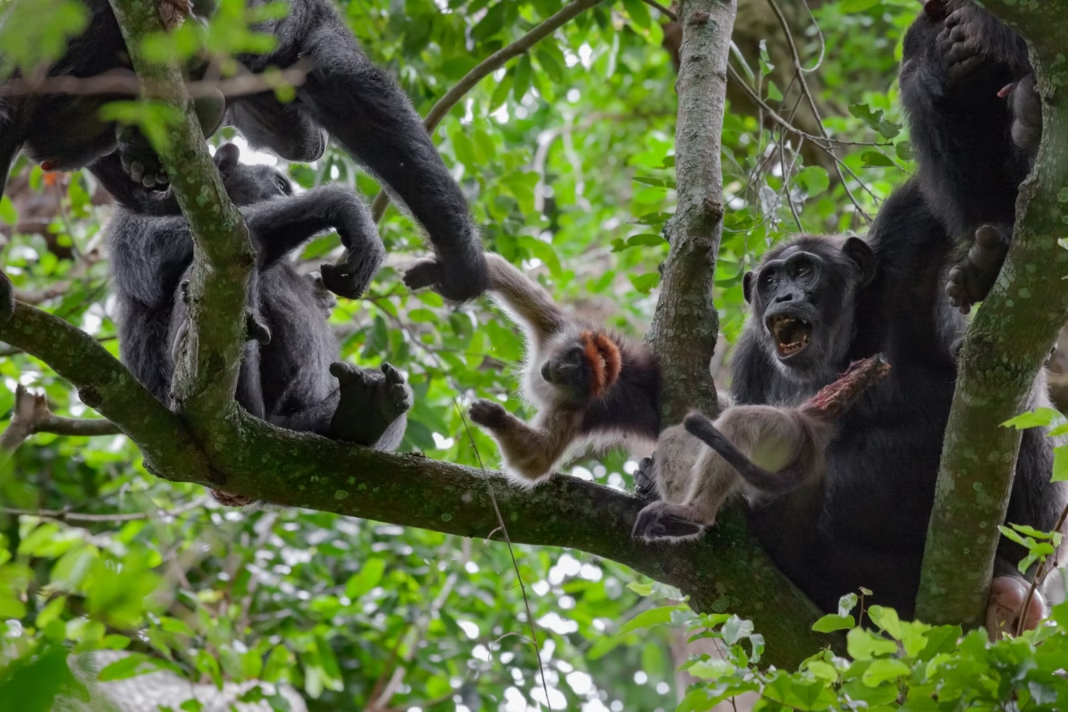

KIBALE NATIONAL PARK, Uganda — For two decades, they were the undisputed rulers of their forest. A chimpanzee community numbering around 200 individuals dominated rival groups, expanded their territory, and grew into one of the largest such societies ever documented by researchers. Then, within a few years of losing the social bonds that had held them together, they began killing each other.
What primatologists who have spent years studying the Ngogo chimpanzee community in Uganda’s Kibale National Park now describe as a tragedy of success had its roots not in weakness, but in the group’s extraordinary dominance. According to researchers familiar with the study, the community’s size was both its greatest strength and, ultimately, the condition that made its collapse catastrophic.
“They were victims of their own success,” researchers concluded, a phrase that has echoed through the scientific community since the group’s fracture became impossible to ignore.
“They were victims of their own success.” Researchers studying the Ngogo chimpanzee community, Kibale National Park
The community, long monitored by primatologists from American and Ugandan institutions, had maintained cohesion for roughly 20 years through a web of alliances anchored by key social figures — elder males and long-established alpha individuals whose relationships bridged competing factions within the group. When those individuals died, the connective tissue dissolved.
A new alpha rose to power. Within three years, the community had split into two rival factions. By 2018, former allies were engaged in lethal conflict.
The violence that followed was systematic. Attacks began with adult males targeted, lethal raids that researchers say mirror patterns seen in inter-community chimp warfare. But the aggression escalated. Infants, unable to defend themselves or flee, became targets as well. Confirmed fatalities have surpassed 24 and, according to ongoing field records, the toll continues to rise.
Chimpanzees share approximately 98 percent of their DNA with humans, a fact that primatologists are careful not to overstate but that has lent the Ngogo situation a particular resonance among researchers studying group behavior, resource competition, and political power in social animals.
The sequence of events prolonged dominance, resource abundance, population growth, the death of key unifying figures, a contested succession, faction formation, and ultimately fratricidal violence — is not, scholars note, without analog in the study of human societies. Whether those parallels carry meaningful lessons is a matter of ongoing academic and public debate.
What is not debated among the field researchers involved is the mechanism: the community grew large enough to strain the social infrastructure required to sustain it. Territory that had once been won through collective strength became the very prize that factions competed for once unity failed.
Long-term primate field studies of this kind are rare. The Ngogo research project, which has tracked the community for decades, represents one of the most sustained observational records of wild chimpanzee behaviour in existence. Researchers say the depth of that record is precisely what makes the fracture and the killing so legible.
The findings have yet to be published in a final consolidated form, but data from the project has informed a growing body of peer-reviewed literature on chimpanzee fission-fusion dynamics, coalition politics, and intergroup aggression.
For now, in the forest, the killing has not stopped.