
The United Nations’ top human rights official warned Thursday that the rule of law is steadily eroding in Uganda, citing growing military involvement in civilian institutions, shrinking civic space and an intensified crackdown on dissent following the country’s January general elections, allegations the Ugandan government has strongly rejected.
In a statement, U.N. High Commissioner for Human Rights Volker Türk said the developments were creating “a climate of fear” and undermining fundamental freedoms.
“I am appalled that the authorities are increasingly targeting any form of dissent, and deepening restrictions on the fundamental freedoms of all those living in Uganda,” Türk said. “Those who dare to speak out are silenced.”
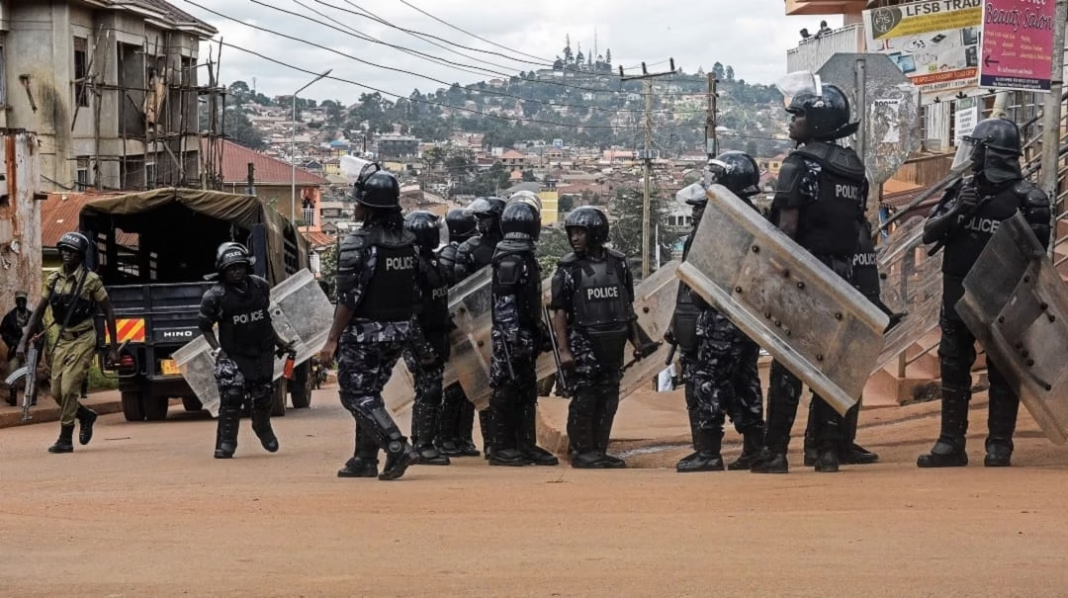
According to the U.N. Human Rights Office, repression has intensified since Uganda’s Jan. 15, 2026, general elections. The office said it had received information indicating that at least 50 opposition leaders and supporters, five human rights defenders and five journalists have been subjected to alleged human rights violations, including enforced disappearances, torture and ill-treatment, and arbitrary arrest or detention. The U.N. attributed the detentions in part to legal provisions it says do not comply with international human rights law.
The U.N. also expressed concern over what it described as increasing military involvement in functions traditionally carried out by civilian institutions, saying the trend risks undermining the separation of powers and democratic governance.
“The actions of the authorities are creating a climate of fear that is increasing self-censorship, further stifling public debate and deepening polarisation,” Türk said.
The U.N. Human Rights Office said at least 10 leading civil society organizations have been suspended since January, while others have faced increased scrutiny and harassment. It also said some media outlets had been forced to suspend operations temporarily amid mounting pressure.
Türk urged Ugandan authorities to uphold their obligations under international human rights law, the African Charter on Human and Peoples’ Rights and the country’s Constitution.
“I call on the Government to abide by its obligations under international human rights law, the African Charter and the Ugandan Constitution to ensure a vibrant civil society where everyone can freely express their views and participate in public affairs,” he said.
The U.N. rights chief also called on the government to uphold the separation of powers by preventing military interference in civilian institutions.
In addition, Türk expressed concern over Uganda’s Protection of Sovereignty Act, enacted in May, which places broad restrictions on international funding and foreign engagement with civil society organizations. According to the U.N., the law provides for prison sentences of up to 10 years for violations.
Responding on X, Uganda’s incoming substantive Minister of Foreign Affairs, Adonia Ayebare, dismissed the U.N.’s findings and accused the human rights body of misrepresenting the situation in the country.
“Discredited Volker Türk and his outfit are at it again misrepresenting the situation in Uganda,” Ayebare wrote. “The Ugandan government will be responding to these falsehoods in detail in addition to working with like minded nations around the world to expose this dangerous UN body.”
Ayebare’s post did not address the specific allegations raised by the U.N. Human Rights Office, including claims of enforced disappearances, arbitrary arrests and increased military involvement in civilian institutions.
Despite its criticism, the U.N. said it remained committed to supporting Uganda in strengthening respect for human rights. Türk also encouraged the government to leverage the country’s economic opportunities and renewed international financial support to address structural challenges while promoting what he described as a human rights-centered economy.