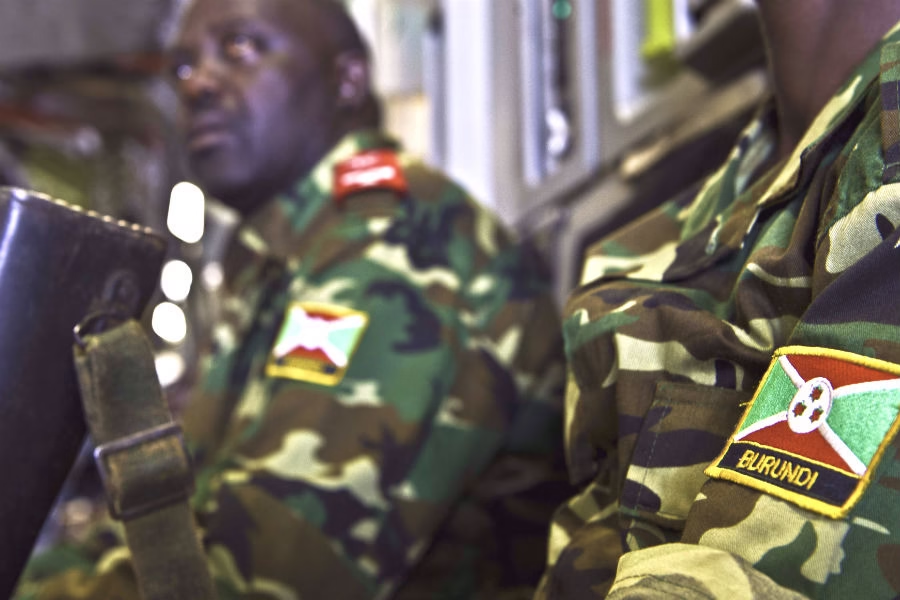

Burundi’s military has publicly rejected claims circulating on social media about the state of the country’s armed forces, prompting a response from rights activist Pacifique Nininahazwe, who defended his criticism as legitimate public scrutiny rather than an attack on the country.
The exchange took place on X (formerly Twitter) after the spokesperson for the Burundi National Defence Force (FDNB) responded to a series of online commentaries that he said had been published since Burundi celebrated the 64th anniversary of its independence on July 1.
Without referring to a specific post, the spokesperson accused Nininahazwe and a group of people he said were using social media to present themselves as military experts while criticizing the FDNB and its leadership based on what he described as information they claimed was credible.
Seeking to reassure the public, the military spokesperson said the armed forces remained fully operational and continued to carry out their constitutional responsibilities.
“We wish to inform Burundians and the international community that the FDNB remains strong and that its members continue to faithfully carry out the duties entrusted to them. No one should give credence to statements made by individuals whose only objective is to undermine the country,” the spokesperson wrote.
The statement did not address any specific allegations that had been circulating online.
Nininahazwe, president of the rights organisation Forum pour la Conscience et le Développement (FOCODE), rejected the suggestion that criticising the military amounted to attacking Burundi.
“The country belongs to me just as it belongs to you. Pointing out what is not working in the army is not insulting Burundi,” he wrote on X.
He went on to argue that the priority should instead be to hold accountable those he alleged were harming the institution, claiming that some soldiers had not received the full compensation they had been promised.
Burundi Times has not independently verified those allegations, and no supporting evidence was provided in the social media exchange.
Social media becomes a battleground for public debate
The exchange reflects a broader shift in Burundi’s public discourse, where debates over governance, security and state institutions increasingly play out on digital platforms.
Government institutions including the Presidency, ministries and the military have expanded their presence on social media in recent years, using official accounts to communicate policy decisions, respond to criticism and engage directly with the public.
At the same time, opposition figures, civil society organizations and Burundian activists living abroad have increasingly relied on those same platforms to raise concerns about governance, human rights and public institutions.
The result has been a growing online contest of narratives, particularly on issues related to national security and public accountability.
A military under greater public attention
The latest exchange comes as Burundi’s armed forces continue to play an expanded regional role.
The FDNB remains deployed in eastern Democratic Republic of Congo under bilateral security cooperation with Kinshasa and has participated in regional peace support operations under the East African Community and the African Union.
Those deployments have increased public interest in the military’s operations and welfare while also drawing greater scrutiny from commentators both inside and outside the country.
The Burundian government has consistently described the FDNB as a professional institution fulfilling its constitutional mandate and contributing to regional peace and stability.
Critics, meanwhile, have periodically called for greater transparency regarding military governance and the welfare of personnel.
Separating opinion from verified fact
Public exchanges on social media often combine opinion, allegation and verified information, making independent verification essential.
In this case, the military has publicly maintained that the FDNB remains fully operational and dismissed the online claims as attempts to undermine the institution.
Nininahazwe, for his part, maintains that raising concerns about the military is a legitimate exercise of public accountability rather than an attack on Burundi.
Neither side, however, presented documentary evidence in the exchange to substantiate its broader assertions.