

JUBA, South Sudan— A top United Nations official on Tuesday warned that South Sudan is edging dangerously close to full-scale conflict amid rising tensions between the country’s rival leaders.
Nicholas Haysom, the UN Secretary-General’s Special Representative for South Sudan, told the UN Security Council that the fragile peace between President Salva Kiir and former First Vice President Riek Machar has deteriorated into direct military confrontation.
“This situation is darkly reminiscent of the conflicts of 2013 and 2016, which cost over 400,000 lives,” Haysom said, urging the international community to help de-escalate tensions and preserve the 2018 Revitalized Peace Agreement.
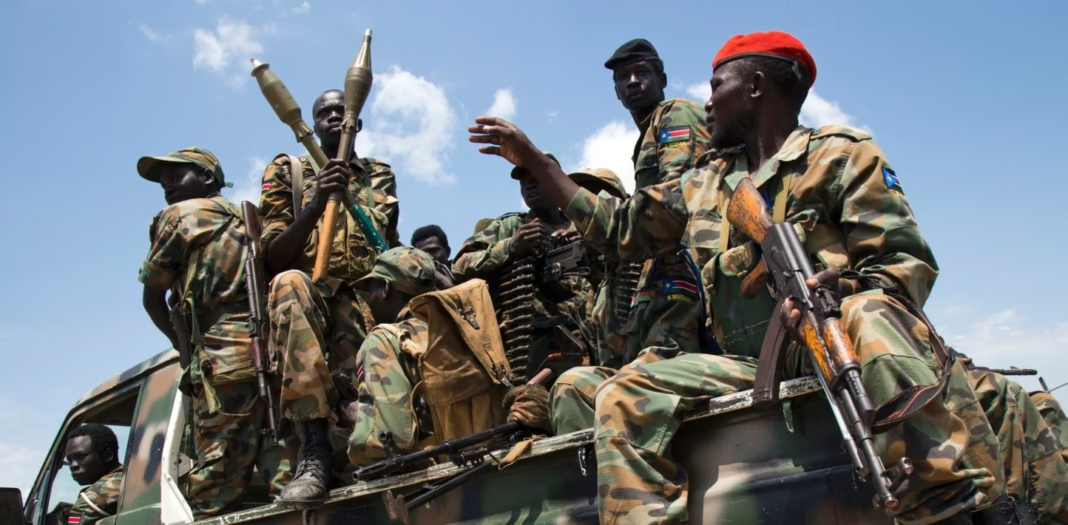
The warning comes amid reports of renewed mobilization by the White Army militia and South Sudan People’s Defence Forces (SSPDF) in Upper Nile state, the recruitment of child soldiers, and the deployment of Ugandan troops at the request of South Sudan’s government.
Haysom said misinformation, disinformation and hate speech are inflaming political and ethnic divisions, threatening to unravel years of fragile peacebuilding efforts.
“We need look no further than across the northern border to Sudan for a stark reminder of how quickly a country can descend into catastrophic conflict,” he said. “This region cannot afford another crisis that could further destabilize an already fragile landscape.”
Haysom, who also heads the UN Mission in South Sudan (UNMISS), highlighted ongoing diplomatic efforts with the African Union, regional bloc IGAD, Pope Francis, and others to restore dialogue and urge restraint.
He called on the Security Council to support initiatives that promote respect for the ceasefire, ease tensions in hotspots such as the Nasir region of Upper Nile state, and ensure the release of detained officials. The parties, he emphasized, must recommit to dialogue, consensus-based decision-making, and nonviolence.
“UNMISS is a peacekeeping mission — not an army — and cannot be everywhere, all at once,” Haysom noted, warning that the mission’s ability to respond remains limited by access denials and operational constraints.
The political crisis is unfolding against what the UN Office for the Coordination of Humanitarian Affairs (OCHA) described as a “humanitarian nightmare in the making.”
OCHA Director of Operations Edem Wosornu told ambassadors that conditions have dramatically worsened over the past eight months. Over 9.3 million people — about three-quarters of the population — now require humanitarian assistance, with nearly half of them children.
Since February, insecurity in Upper Nile state has displaced more than 130,000 people, forcing thousands to flee into Ethiopia. Attacks on medical facilities have forced hospitals to close, while nearly 7.7 million people face acute food insecurity.
“The humanitarian situation is deteriorating rapidly,” Wosornu said.
Haysom stressed that while humanitarian efforts continue, they cannot replace political will.
“What is needed is urgent, sustained, and coordinated action from national leaders, regional guarantors and the international community,” he said. “Another war is a risk South Sudan simply cannot afford — nor can the wider region.”
As the rainy season begins, aid agencies fear the crisis could worsen. Last year, floods displaced 1.4 million people, disrupted agriculture and triggered local violence — a scenario that could repeat itself in the coming months.
“The Revitalised Peace Agreement remains the only viable framework to break this cycle of violence in South Sudan,” Haysom said.


