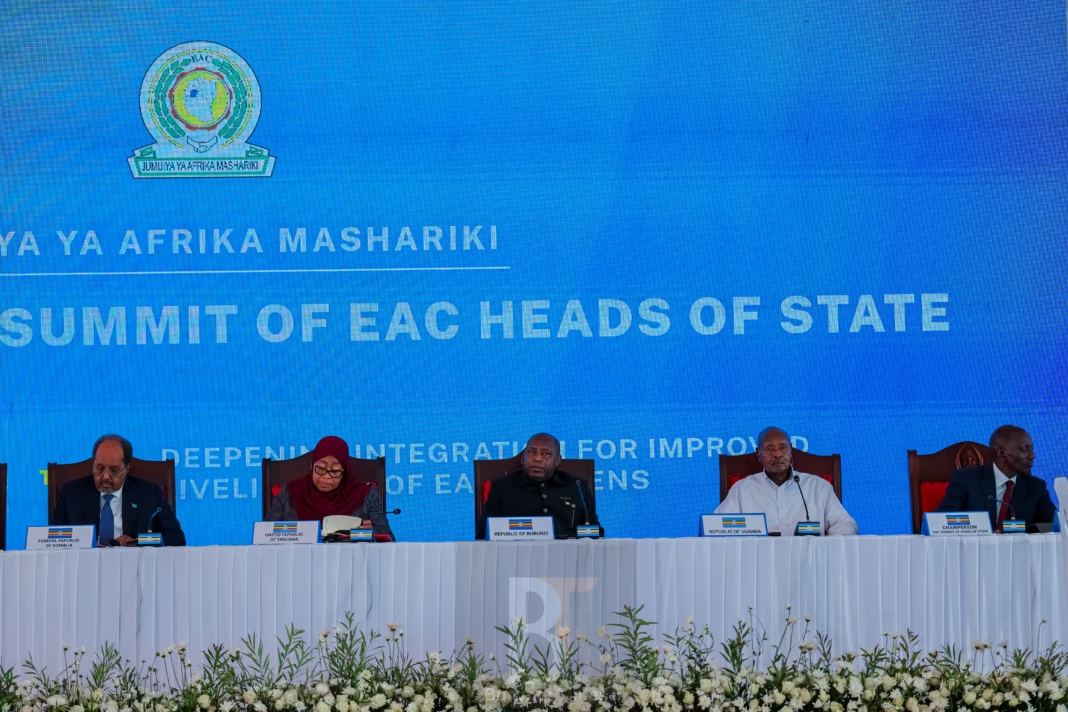

Somalia and South Sudan have missed out on securing top leadership positions within the East African Community (EAC) following decisions taken during the bloc’s 25th Ordinary Summit in Arusha.
The development came as regional leaders adopted stricter governance and financial compliance expectations for member states seeking to occupy senior roles within the Community’s institutions.
During the summit, Uganda assumed the rotating chairmanship of the regional bloc while Rwanda was appointed rapporteur.
However, diplomatic discussions during the meeting revealed growing concern among partner states over treaty compliance and financial obligations among some members.
Financial obligations under scrutiny
Outgoing EAC Summit chairperson and Kenya’s President William Ruto used his final address to highlight the persistent challenge of delayed contributions by partner states.
“Delayed and non-remittance of statutory contributions to the EAC budget continue to hamper our ability to implement development projects and fulfil our collective commitments,” he said.
The issue has become particularly sensitive as the Community expands and attempts to implement ambitious regional programmes.
Ruto warned that failure by member states to meet their financial obligations undermines the credibility of the bloc.
“This challenge heavily undermines our financial sustainability, viability, and credibility as a regional organisation capable of delivering on our promises to our citizens,” he said.
Leadership implications
According to regional officials, the issue of arrears and compliance played a role in the outcome of leadership deliberations during the summit.
Somalia — the newest member of the EAC — is still in the early stages of aligning its institutions with the bloc’s frameworks following its admission in 2023.
South Sudan, which joined the Community in 2016, has also faced challenges in meeting some of its obligations to the regional organisation.
As a result, the two countries were unable to secure the top institutional roles that were under consideration during the summit.
The decisions reflect a growing push within the EAC to link leadership opportunities with treaty compliance and financial responsibility.
Growing pains of expansion
The EAC has undergone rapid expansion in recent years, growing from its traditional core members to include the Democratic Republic of Congo and Somalia.
While enlargement has strengthened the bloc’s geopolitical influence and market size, it has also introduced governance and financial challenges.
Observers say the decisions taken during the summit signal a shift toward stricter institutional discipline as the Community attempts to consolidate its integration agenda.
Ruto emphasised that regional cooperation will depend on collective responsibility from all partner states.
“It is therefore our noble duty to honour our respective financial obligations to the Community promptly,” he said.
Despite the tensions surrounding compliance issues, regional leaders reaffirmed their commitment to strengthening the EAC as a driver of economic integration and stability in East Africa.
The bloc continues to pursue major initiatives in infrastructure, trade facilitation, digital integration and peacebuilding across the region.
But analysts say the outcome of the summit sends a clear message: membership alone will not guarantee influence within the Community unless countries meet their institutional and financial commitments.