
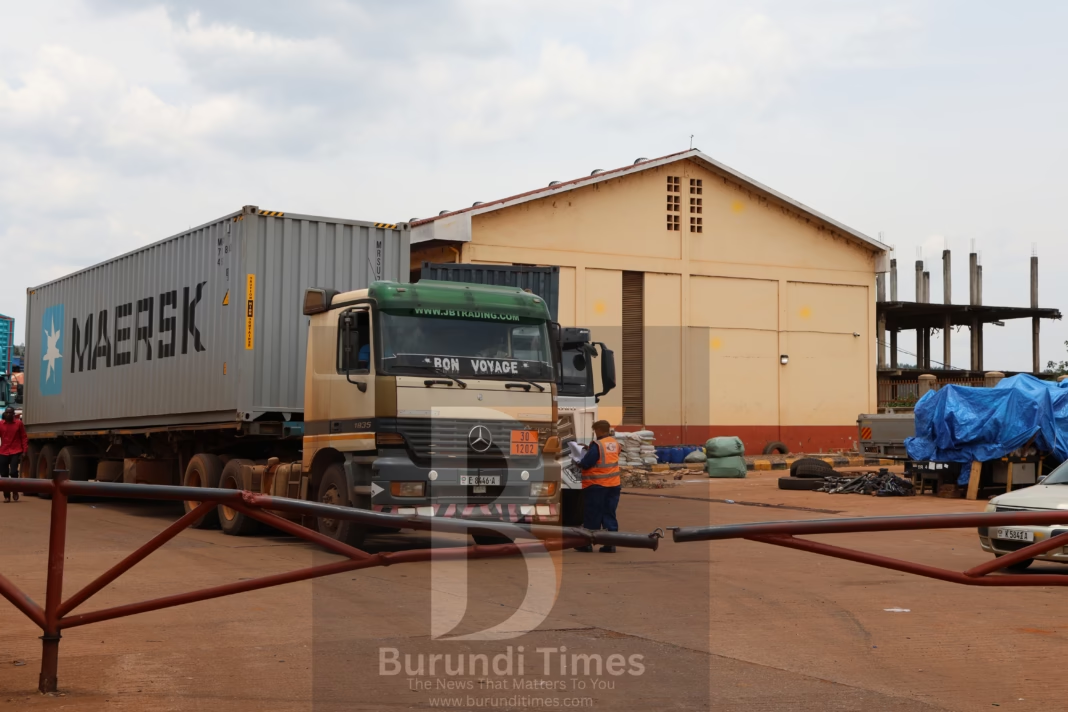

By the time the truck was taken, there was little left to salvage.
A Tanzanian trader watched as her pickup loaded with yams, her livelihood, was impounded at the Kobero–Kabanga One Stop Border Post. The yams were later auctioned by the Burundian authorities according to the Tanzanian customs officials. The vehicle, too, nearly gone.
For small traders who move goods across the border each day, the loss of a single shipment can mean more than a bad day’s business. It can mean starting over.
“The yams were impounded and even the car — a border official had to pay for it to be released,” a customs official familiar with the case said. “There is a lack of harmonised border procedures.”
The case, now cited by lawmakers as they scrutinize operations at the crossing, has become a stark example of how bureaucratic gaps and inconsistent rules can translate into real financial hardship.
The trader is widely known by the border community as Mama Ali, her experience is far from isolated.
Along the corridor linking Burundi and Tanzania, thousands of small-scale traders — many of them women — cross daily with perishable goods, working on thin margins and tight timelines. Delays, paperwork disputes or shifting enforcement can quickly turn profit into loss.
At Kobero–Kabanga, one of the region’s key gateways for goods moving inland from Dar es Salaam, such risks are compounded by uneven procedures on either side of the border.
A Tanzanian customs official, identified as Abdul B. Shemzigwa, said the treatment of small traders differs significantly between the two countries.
“We facilitate small traders — they almost pay nothing at our end but Burundi still treats them like formal business people,” he said.
For traders dealing in perishables like yams, time is as valuable as the goods themselves. A delay of hours can reduce quality. A delay of days can erase value entirely.
Lawmakers from the East African Legislative Assembly, who visited the border this week, pointed to the case as a sign of deeper structural problems — from a lack of harmonized procedures to operational inefficiencies that undermine the One-Stop Border Post model.
Designed to simplify trade by bringing officials from both countries under one roof, the system is meant to reduce clearance times and costs. But in practice, traders say, uncertainty still defines the crossing.
At stake is more than individual livelihoods. The Kobero–Kabanga post handles a significant share of trade flowing into Burundi, making it a critical artery for the economy.
Yet for the trader who lost her yams, the impact is immediate and personal — a business interrupted, capital wiped out, and a return to the border now far more uncertain.
Lawmakers say such cases highlight the urgency of reform.
“If small traders continue to face these kinds of losses, it will undermine the very objective of regional integration,” one legislator said during the visit.
For now, the trucks keep coming, the traders keep crossing — and for many, the risk remains part of the journey.