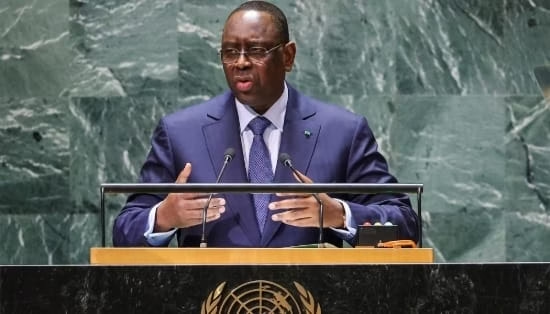

The African Union Commission confirmed Friday that a draft decision to endorse former Senegalese President Macky Sall’s candidacy for U.N. Secretary-General has formally failed, after 20 member states broke a contentious 24-hour silence procedure imposed by the AU’s current chair, Burundian President Évariste Ndayishimiye.
The AU Commission, in an official communiqué dated March 27, 2026 stated that by close of business that day the deadline set for the silence procedure the threshold of objecting states had been met. “Therefore, the circulated draft decision on UN Secretary General candidacy of H.E Macky Sall, former President of the Republic of Senegal, has not been adopted,” the Commission said.
The collapse of the procedural gambit caps three weeks of diplomatic turbulence that began March 2, when Burundi’s permanent representative in New York formally notified the U.N. General Assembly president that his government identifying itself as the current AU chair was nominating Sall for the world body’s top post.
According to several media outlets, the March 2 letter from Bujumbura to the U.N. General Assembly president stated that “my government, current Chair of the African Union, nominates His Excellency Macky Sall, former President of the Republic of Senegal, for the position of Secretary-General of the United Nations.” The submission formally entered Sall into a field that includes former Chilean President Michelle Bachelet and Argentine diplomat Rafael Grossi, director general of the International Atomic Energy Agency.
According to Rwanda’s minister of foreign affairs Olivier Nduhungirehe whose country’s relation with Burundi continues to deteriorate said that the nomination came as a surprise to all African heads of state and government none of whom, the minister said, had been consulted by Ndayishimiye before he submitted Sall’s name. Analysts at Amani Africa, a continental policy research organization based in Addis Ababa, noted separately that Sall’s name was conspicuously absent from the report of the AU’s Ministerial Committee on Candidatures, presented to the AU Assembly just weeks before the New York letter was filed.
Sall, who led Senegal from 2012 to 2024 and briefly chaired the AU in 2022, left office after his preferred successor was defeated by current leader Bassirou Diomaye Faye. Dakar’s new government has not formally endorsed the candidacy, and domestic political divisions over the bid persist.
A 24-Hour Ultimatum and a Continental Revolt
The draft decision circulated to member states called on the AU to express “firm support” for Ndayishimiye “for having presented the candidacy” of Sall. Member states were given until close of business March 27 to register an objection by breaking the silence or to acquiesce through inaction. Twenty member states chose to object. Under AU procedure, that was sufficient to block adoption of the draft. The Commission notified member governments of the outcome the same evening.
Why Rwanda that active
Ties between Rwanda and Burundi have deteriorated sharply in recent years. Burundi has long accused Rwanda of supporting opposition groups operating across its borders, charges Kigali denies. The two countries have at various points recalled ambassadors, restricted cross-border movement, and engaged in public recriminations at regional forums. Against that backdrop, Rwanda’s unusually blunt public rebuke of Ndayishimiye by name, and in detail was not lost on diplomatic observers who track Great Lakes politics.
Africa Without a Unified Candidate
The failed procedure leaves Africa without a formally AU-endorsed candidate for the U.N.’s top position less than a year before Secretary-General António Guterres’s second term expires Dec. 31, 2026. The U.N. Security Council is expected to begin formal consideration of candidates by the end of July, giving the AU a narrow window to reconstitute a unified position.
The AU maintains an established Ministerial Committee on Candidatures precisely to prevent ad hoc, uncoordinated nominations. That committee’s most recent report, presented at the 39th AU Assembly in February when Burundi assumed the chairmanship, made no mention of Sall’s candidacy.
Whether Sall continues his bid without continental backing and whether the AU moves to formally endorse an alternative African candidate through proper channels remained unclear by Friday.