
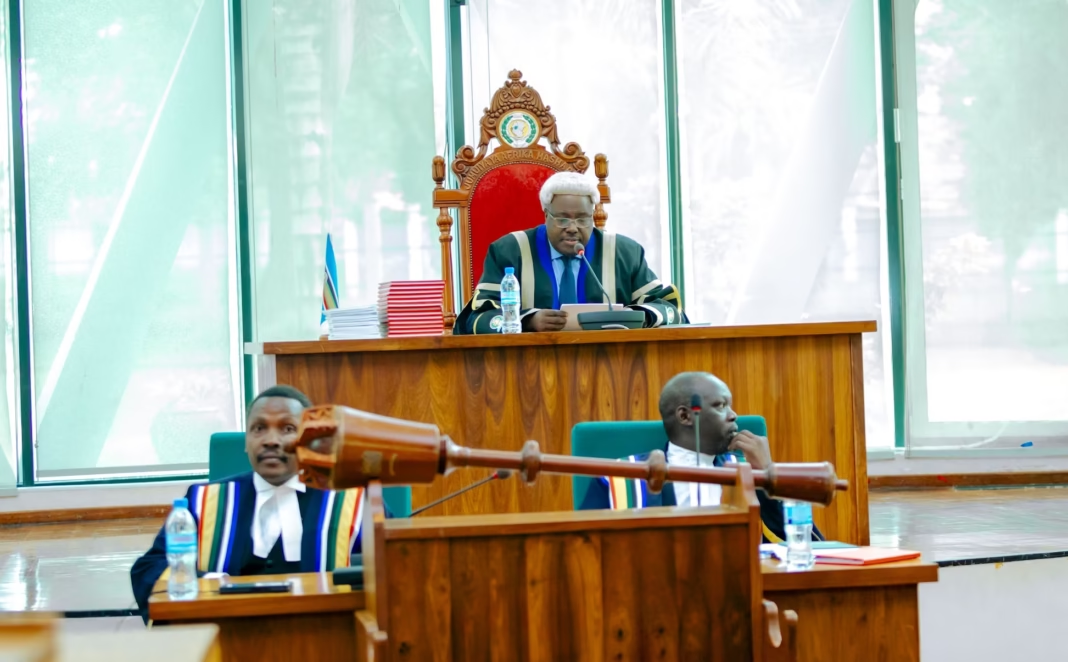

The East African Legislative Assembly has called for urgent intervention after months of unpaid salaries for its members and staff, highlighting a deepening financial crisis within the East African Community driven by delayed remittances from member states.
In a resolution passed this week, lawmakers urged the Council of Ministers to “urgently address the non-payment of salaries,” warning that the situation is undermining the functioning of the regional parliament.
They also called on the Council to direct the EAC Secretary General to return funds deducted from the Assembly’s budget for the 2025/2026 financial year.
The salary delays come against the backdrop of mounting arrears across the bloc. According to figures Burundi Times obtained early this year, partner states collectively owe the EAC about $89 million in outstanding contributions, severely constraining operations.
Burundi itself has accumulated more than $22.7 million in outstanding obligations, including arrears exceeding $15.7 million, although it recently made a partial payment of $1.5 million, according to EAC Secretary General Veronica Nduva.
Other member states also remain in arrears, with the Democratic Republic of Congo owing roughly $27.7 million and South Sudan more than $21.8 million, underscoring the scale of the funding gap.
Only a few countries including Kenya and Tanzania have fully met their financial obligations for the current fiscal year, while Uganda has paid most of its dues and Rwanda only partially complied, according to regional financial data.
EAC officials say delayed remittances are directly affecting the bloc’s ability to function.
The funding shortfall has already forced some EAC organs to scale down activities, delayed programs and triggered institutional tensions now spilling into the legislative arm.
The crisis has also reignited debate over the bloc’s financing model, which has historically required equal contributions from member states despite wide economic disparities. Leaders recently approved reforms introducing a hybrid system that partly reflects countries’ economic capacity.
Within the Assembly, lawmakers warned that continued salary delays risk eroding morale and institutional credibility at a time when the body is expected to drive key regional legislation.
The Assembly’s appeal signals growing frustration within the institution as the broader financial strain threatens to disrupt governance and the project of the community.
The East African Legislative Assembly is currently struggling to conduct its plenary meetings due to the financial constraints hence piling up the region parliament’s backlog.