
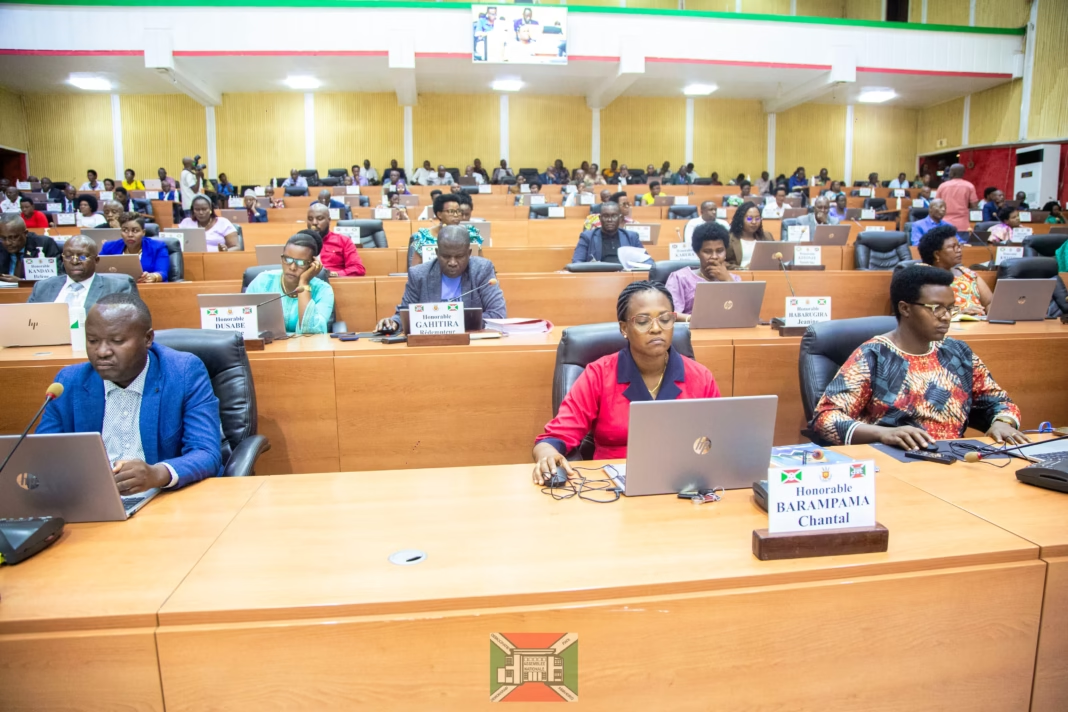

Burundi parliament has unanimously adopted a bill reforming the missions, organisation and functioning of the country’s Court of Audit, in a move authorities say is aimed at strengthening oversight of public finances and improving accountability in state institutions.
Lawmakers approved the legislation during a plenary session held Thursday at the Kigobe in Bujumbura.
The bill also establishes procedures governing cases brought before the Court of Audit, Burundi’s supreme public finance oversight institution.
Speaking before parliament, Justice Minister Alfred Ahingejeje said the reform expands the court’s mandate by giving it authority to adjudicate cases linked to the management and use of public funds within state services.
“The Court of Audit has been entrusted with an additional mission consisting of judging cases related to the management and use of public finances in state services,” Ahingejeje told lawmakers.
He said the reform seeks to align Burundi’s financial oversight system with international standards and practices adopted in other countries where courts of accounts play a central role in safeguarding public resources.
Parliamentary debates focused on the independence of the institution, its control mechanisms and its ability to ensure stricter management of state finances.
Ahingejeje defended the court’s autonomy, saying the institution “remains independent” and is intended to assist the state in control, evaluation and transparency in the use of public resources.
Several lawmakers argued that reinforcing the jurisdiction would contribute to improved governance and stronger accountability in the management of public assets.
The legislation was adopted unanimously after lawmakers reviewed amendments proposed by the relevant parliamentary committee.
The reform comes as Burundi continues broader efforts to modernise public financial management and tighten budgetary oversight. In recent months, the government has introduced measures aimed at improving budget execution, digitising financial management systems and strengthening anti-corruption mechanisms.
Burundi’s Court of Audit serves as the country’s supreme institution for auditing public finances and overseeing the use of state resources. The government has increasingly presented financial governance reforms as part of its wider economic modernisation agenda and long-term development strategy.
Burundi continues to rank among the world’s lowest-performing countries on corruption perception indicators. According to the 2025 Corruption Perceptions Index (CPI), Burundi scored 17 out of 100 and ranked 167th globally, reflecting persistent concerns over public sector corruption, weak oversight mechanisms and governance challenges. The CPI, widely used as a global benchmark on perceived public sector corruption, rates countries on a scale from 0, considered highly corrupt, to 100, considered very clean.