
Burundi is expected to benefit from a new East African Community regional virology hub launched in Uganda on Wednesday, a move aimed at strengthening the region’s ability to detect and respond to infectious disease outbreaks more quickly as East Africa continues to face recurring threats from Ebola, Marburg and other emerging viruses.
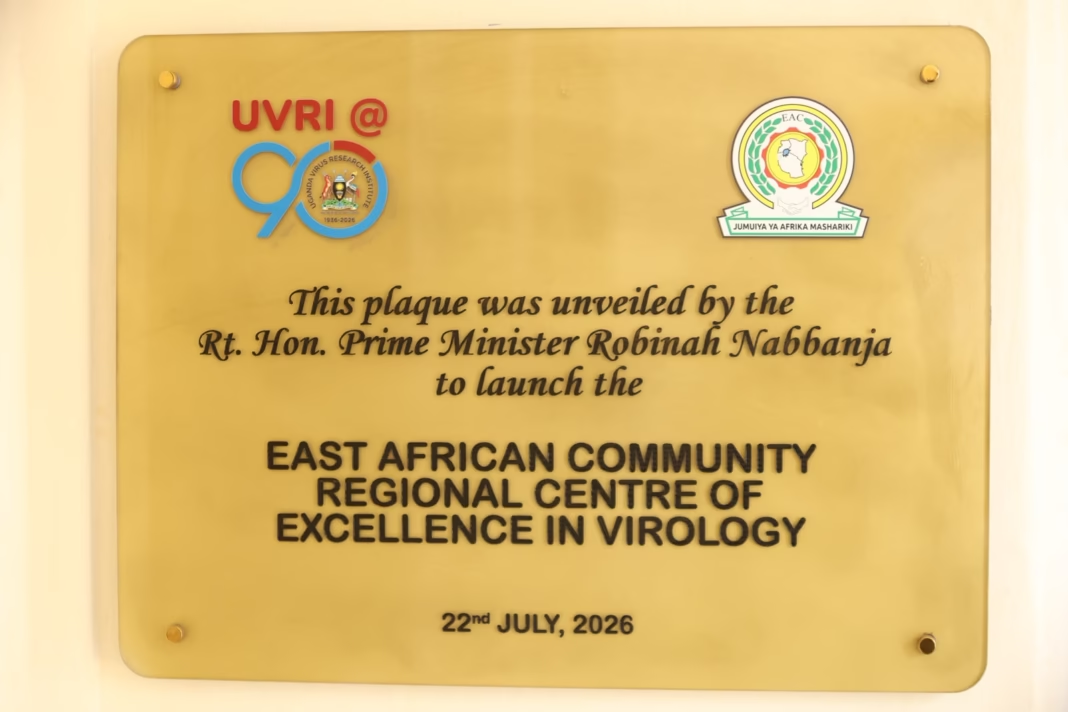
The East African Community (EAC) officially designated the Uganda Virus Research Institute (UVRI) in Entebbe as its Regional Centre of Excellence in Virology, making it the bloc’s specialized hub for advanced virus research, laboratory training, disease surveillance, diagnostics and scientific collaboration.
The launch comes as East African countries continue to invest in regional health security following lessons learned during the COVID-19 pandemic and repeated outbreaks of Ebola virus disease, Marburg virus disease and mpox in several parts of the region.
“The COVID-19 pandemic demonstrated that diseases do not respect borders, and an outbreak emerging in one Partner State can quickly become a regional concern,” Rebecca Alitwala Kadaga, Uganda’s First Deputy Prime Minister and the current chairperson of the EAC Council of Ministers, said during the launch ceremony.
Health experts have long argued that no single East African country has the resources to independently maintain every advanced laboratory capability required for rapid detection of highly infectious diseases. Regional centres are intended to bridge those gaps by allowing countries to share specialized expertise and laboratory capacity.
According to the EAC Secretariat, the new centre will support Partner States through advanced virology research, specialized laboratory training, diagnostics, disease surveillance and knowledge sharing.
Representing EAC Secretary-General Veronica Nduva, Deputy Secretary-General Ariik Aguer Malueth described the centre as a shared regional asset.
“These Centres ensure that scientific knowledge and specialised capabilities developed in one Partner State become a shared regional resource benefiting all East Africans,” he said.
One of the most significant gains highlighted during the launch is the region’s improved laboratory response time.
The EAC said its Mobile Laboratory Network, established in 2017, has reduced the turnaround time for testing samples linked to high-risk viral diseases from about 72 hours to roughly eight hours, allowing health authorities to confirm outbreaks more quickly and implement public health measures sooner.
The new virology centre is expected to further strengthen that network by supporting laboratory confirmation, training scientists and expanding collaboration among national public health laboratories.
UVRI already plays a regional role by confirming samples referred from Partner States before disease outbreaks are officially declared, helping ensure that public health decisions are based on laboratory evidence.
Implications for Burundi
For Burundi, the regional hub could provide additional technical support in surveillance, diagnostics and laboratory training at a time when the country remains vulnerable to cross-border disease threats because of its proximity to neighboring countries that have experienced outbreaks in recent years.
Burundi has strengthened surveillance along its borders during regional Ebola outbreaks and has participated in EAC-led preparedness initiatives aimed at improving detection and response capacities.
The World Health Organization has repeatedly warned that increasing population movement and cross-border trade in the Great Lakes region make regional cooperation essential for controlling infectious diseases that can spread rapidly across national boundaries.
The new centre is also expected to advance the EAC’s One Health approach, which recognizes the links between human, animal and environmental health in preventing emerging diseases.
The virology centre is one of seven Regional Medical Diagnostic Centres of Excellence identified under the EAC Health Investment Priority Framework 2018–2028, adopted by the bloc’s Heads of State to strengthen regional laboratory capacity.
Uganda was selected to host the virology centre in recognition of UVRI’s decades of research on viral diseases and its internationally recognized expertise in outbreak surveillance and laboratory science.
Speaking during the launch, Uganda’s Prime Minister Robinah Nabbanja, representing President Yoweri Museveni, said the facility reflected the importance of investing in scientific research.
“Through this journey, we have seen and learnt that a nation that studies its own pathogens is a self-reliant nation. We commit to increasing funding for research,” Nabbanja said.
The centre’s operationalization has been supported through the EAC Regional Network of Reference Laboratories for Communicable Diseases Project with financial support from Germany through KfW Development Bank and technical assistance from the Bernhard Nocht Institute for Tropical Medicine.
Germany also announced that six container-based laboratories are being procured to strengthen diagnosis of infectious diseases and antimicrobial resistance surveillance across the region.
While the launch marks another step in East Africa’s efforts to improve collective preparedness, public health experts note that sustaining regional laboratory networks will require continued investment by Partner States beyond donor support, as infectious disease threats continue to evolve.