
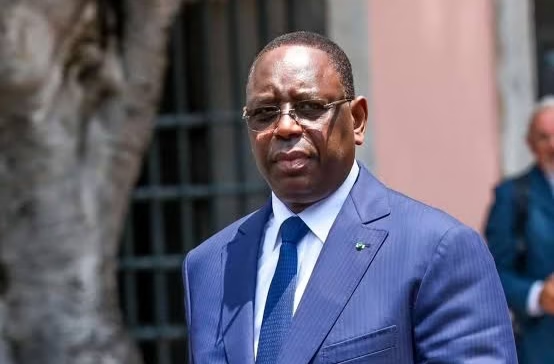

Former Senegalese President Macky Sall withdrew his candidacy for United Nations secretary-general on Saturday, a day after an informal Security Council vote indicated that no candidate had secured the support needed to advance without opposition from a permanent member.
Sall said he made the decision after consultations with Burundi President Évariste Ndayishimiye, the African Union’s current chair, and Senegalese President Bassirou Diomaye Faye, who also chairs the Economic Community of West African States.
“Following the informal vote of Oct. 16, 2026, for the election of the secretary-general of the United Nations, and after consultations … I have decided to withdraw my candidacy for this position,” Sall said in a statement dated Oct. 17 and issued from Marrakech.
Sall said he hoped his withdrawal would help produce a candidate acceptable to a broader range of Security Council members.
“I made this decision with a deep sense of responsibility, hoping thereby to contribute to the emergence of a consensus candidacy within the Security Council,” he said.
He added that the voting results since the beginning of the selection process indicated a preference for a candidate from Latin America and the Caribbean, potentially a woman.
The Security Council held its sixth informal straw poll on Friday as member states weighed seven candidates seeking to succeed Secretary-General António Guterres, whose second term ends Dec. 31.
Rebeca Grynspan, a former vice president of Costa Rica, emerged as the leading candidate in the latest poll, receiving nine votes of encouragement, five votes of discouragement and one member expressing no opinion, according to Reuters. However, she also faced opposition from permanent council members, underscoring the obstacles confronting candidates in the race.
The council has 15 members, including five permanent members, China, France, Russia, the United Kingdom and the United States whose veto power can block a recommendation for secretary-general.
Under Article 97 of the U.N. Charter, the General Assembly appoints the secretary-general on the recommendation of the Security Council. The informal ballots help members assess candidates before the council makes a formal recommendation.
Burundi nominated Sall for the position on March 2, according to the United Nations’ official selection process records. In his withdrawal statement, Sall thanked Ndayishimiye for sponsoring his candidacy and Faye for supporting it.
He also thanked Security Council members who had voted for him, his campaign team and the Senegalese people, as well as religious and traditional leaders, political organizations and civil society groups that had backed his bid.
Sall, who served as Senegal’s president from 2012 to 2024, said his candidacy had been motivated by a desire to put nearly four decades of public service to work for the United Nations.
As he withdrew, Sall renewed his call for reform of the global body, citing conflicts, geopolitical rivalries, divisions in the international order and economic and financial pressures.
“I remain convinced that the United Nations must undertake a profound transformation of its methods of work and functioning,” he said.
He also urged African countries to continue pressing for a stronger role in global governance.
“I withdraw my candidacy, but remain fully committed to the ideals that inspired it: peace, security, economic and social development, international cooperation and dialogue among nations,” Sall said.
His withdrawal leaves Uganda’s Olara Otunnu as the remaining African candidate in the race. The selection process is continuing, with the Security Council expected to identify a candidate for submission to the General Assembly.