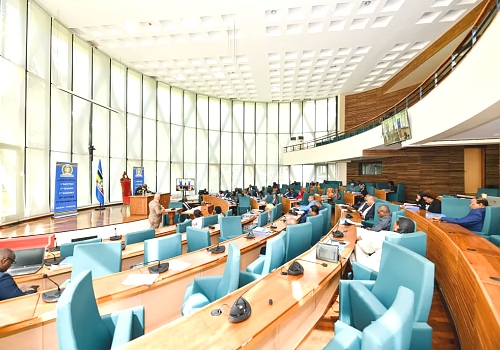
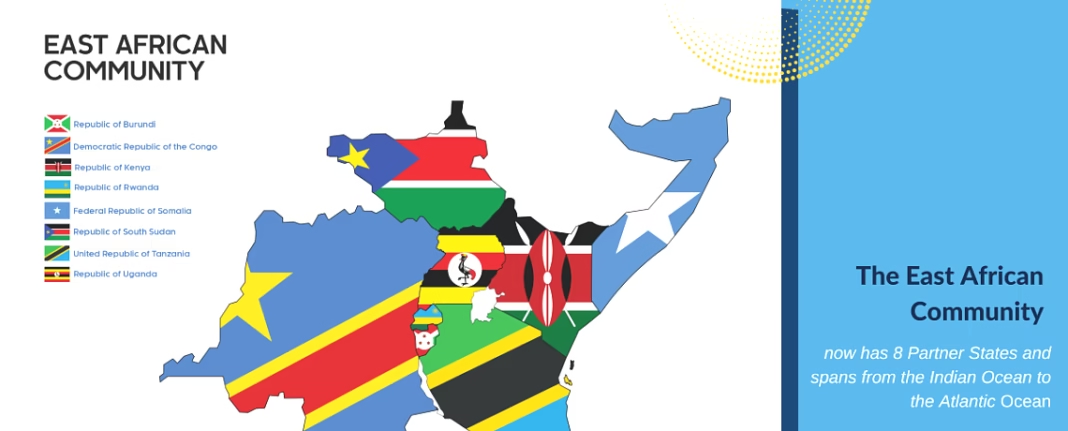

The East African Community’s push toward a political confederation is facing gaps in public consultation, with an East African Legislative Assembly committee warning that limited funding and delays are preventing citizens in some member states from meaningfully participating in the process.
In a report on the implementation of the political confederation roadmap, EALA’s Committee on Regional Affairs and Conflict Resolution said consultations had been limited and insufficiently inclusive, raising concerns about public participation in a process intended to deepen political integration across East Africa.
“The public consultations process at the Partner States level has not been people-centered,” said Maina Karobia Chairperson of the Committee on Regional Affairs and Conflict Resolution at EALA , describing the exercise as “limited and elitist.”
The committee also warned of an “information blackout for most East Africans,” citing inadequate resources and limited public awareness of the proposed political arrangement.
The findings raise questions about how the regional bloc can advance its political integration agenda while ensuring that citizens understand the proposed changes and have opportunities to contribute to the process.
EAC heads of state adopted the political confederation model in May 2017 as a transitional step toward a political federation. The roadmap originally envisaged the adoption of a constitution by 2027-28, but progress has been delayed.
Tanzania and Somalia face consultation delays
The committee identified delays in Tanzania and Somalia, where national consultations had not been completed at the time of its oversight.
Tanzanian officials told the committee that public sensitization had begun but was interrupted by parliamentary and presidential election activities. The government expected the exercise to conclude by November 2026, according to the report.
Somalia, which ratified the EAC Treaty on Feb. 10, 2024, had not begun national consultations on the proposed confederation constitution despite a June 30, 2026, deadline set by the EAC Summit, the report says.
The delays raise questions about how the two countries will gather public views and incorporate them into the wider constitutional process.
The report does not suggest that consultations have been absent across the entire bloc. It notes that Burundi, Kenya, Uganda and Rwanda had conducted consultations, while identifying gaps in public engagement in other partner states.
Funding shortfall threatens wider consultations
The committee said inadequate funding was undermining efforts to extend consultations across the region.
“The Committee was informed that Council was obligated to finance the pillar with the funding sourced from the general reserve. However, since 2022, no funds have been allocated to this process,” the report states.
It adds: “At the moment no funds are available to undertake consultations in the remaining Partner States.”
The funding gap threatens to constrain further public engagement in a process that requires consultations across countries with different political systems and institutional arrangements.
The committee also highlighted delays in developing an EAC Good Governance Protocol intended to promote accountability, transparency, the rule of law, social justice, equal opportunities, gender equality and human rights.
The proposal has been stalled amid disagreements dating to 2012, and the report says there is “no clear timeline for finalization.”
Good governance and public participation are already among the principles set out in the EAC Treaty. Article 6 identifies good governance, democracy, the rule of law, accountability and human rights as fundamental principles of the Community, while Article 7 establishes people-centered cooperation as a guiding principle.
The committee’s findings highlight the difficulty of translating those commitments into meaningful public participation in the political confederation process, particularly where consultations remain incomplete and funding is unavailable.