
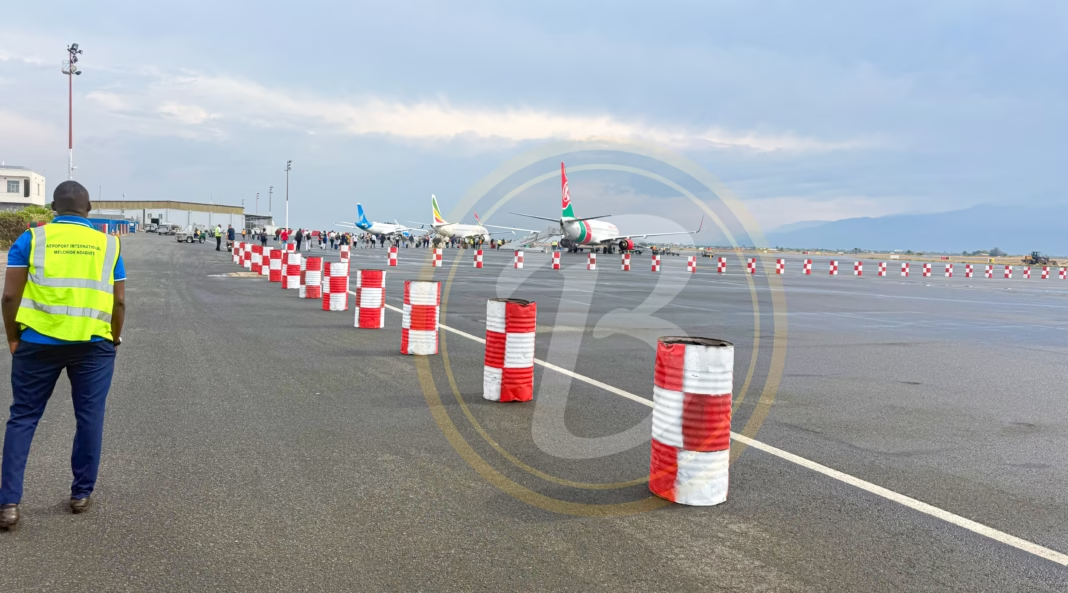

An East African regional lawmaker is seeking parliamentary approval to introduce a bill that would classify qualifying flights between partner states as domestic services, in a proposed overhaul of regional aviation aimed at reducing travel costs ahead of the 2027 Africa Cup of Nations.
The Domestication of Airspace and Liberalisation of Air Traffic Rights Bill, 2026, proposed by East African Legislative Assembly (EALA) member Kennedy Musyoka Kalonzo, seeks to establish a common East African Community airspace, liberalise airline access to regional routes and harmonise aviation charges.
Uganda’s First Deputy Prime Minister and Minister for East African Affairs, Rebecca Kadaga, backed the proposal, saying the difficulties of travelling between neighbouring countries also affect government officials.
“Something we have been talking about, even us are inconvenienced, the amount of connection you make to a very near country making so many stops,” Kadaga said.
She said the Council of Ministers would support efforts to advance the proposal once it is formally tabled.
“So we support Musyoka’s bill,” she said. “When the bill is tabled, we will take it over as the Council of Ministers so that it can move faster, ahead of AFCON.”
Kadaga’s remarks signal support for accelerating consideration of the proposal, but do not establish that the Council has formally taken it up.

AFCON 2027 adds urgency
EALA member George Odongo said the tournament, which Kenya, Tanzania and Uganda will co-host from June 19 to July 17, 2027, presents an opportunity to address barriers to regional air travel.
He argued that fragmented airspaces contribute to the cost of tickets by treating journeys between neighbouring countries as international travel rather than part of an integrated regional market.
“A big part of our air tickets, the cost of our air tickets, is coming from fragmented airspaces,” Odongo said. “So, we are not traveling as a one airspace. We are traveling like we are going from one country to another.”
He said a common airspace could reduce travel costs by allowing qualifying regional flights to be treated as domestic services.
“So if we consider this as a single airspace, then there will be considered domestic air flights. And that reduces significantly the cost of travel,” Odongo said.
He also called for governments to pursue interim measures while working toward longer-term harmonisation of aviation systems and regulations before the tournament.
The proposal would require the EAC to coordinate technical arrangements and develop a common framework for regional air transport. However, the bill has not yet completed the legislative process, and no implementation timetable has been established through its adoption.
Bill targets charges and airline access
The draft proposes that qualifying EAC-registered airlines be allowed to operate routes across the common airspace without seeking additional route authorisation, subject to licensing and eligibility requirements.
It would also classify flights operated by qualifying regional carriers within the common airspace as domestic and require the harmonisation of airport charges, navigation fees and other user charges.
To qualify, an airline would need to be registered and licensed by a partner state, maintain its headquarters and primary operational base within the Community, conduct at least 60% of its operational activities within or between partner states, and include partner-state nationals in key senior operational roles.
The draft also proposes a unified air traffic control system and coordination of airline schedules.
Under the proposed framework, the EAC Council of Ministers would develop regulations governing eligibility and licensing, while the EAC Summit would declare the common airspace on the Council’s recommendation.
The potential impact on ticket prices remains uncertain. Although the proposal aims to reduce costs and improve connectivity, it provides no estimate of passenger savings or guarantee that airlines would pass on any reductions in operating charges.