
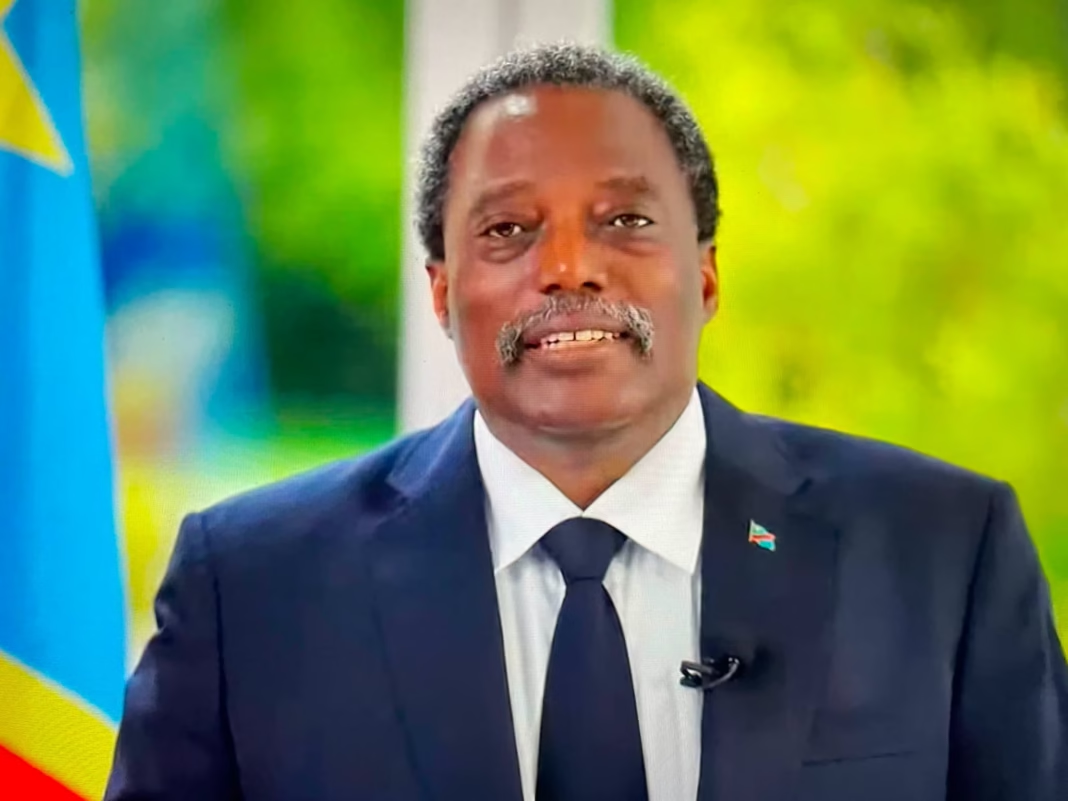

Former Congolese President Joseph Kabila has been named leader of a new political-military coalition that includes figures from the M23 rebel movement, deepening his confrontation with President Félix Tshisekedi and potentially complicating efforts to end the conflict in eastern Congo.
The Front for the Refoundation of the Nation, known by its French acronym FRN, was announced Monday in Goma, a city under M23 control since January 2025. The new coalition brings together political and armed opposition figures challenging Tshisekedi’s government.
The coalition’s formation places Kabila, who governed Congo from 2001 to 2019, at the head of a movement that includes senior figures associated with the insurgency in the country’s mineral-rich east.
Claude Ibalanky, an adviser to the coalition, said its mission was to restore the foundations of a functioning republic.
The group aims to “unite and coordinate all resistance forces in order to put an end to tyranny by any means necessary, including the use of force,” Ibalanky said at a news conference in Goma, according to The Associated Press.
“The signatories have decided to pool their forces, resources, and means to create a framework for action through which all Congolese people, acting in unison, will undertake the task of liberating their country,” he said.
The coalition named Corneille Nangaa and Bertrand Bisimwa as vice presidents. Nangaa previously headed Congo’s electoral commission, while Bisimwa is a senior political leader of M23. Sultani Makenga, a senior M23 military commander, was named chief of staff of the Congolese Revolutionary Army, with the rank of vice president.
The founding declaration, dated Oct. 12, states that the FRN succeeds the Alliance Fleuve Congo (AFC) and formally ends the AFC’s existence. It does not separately declare M23 dissolved.
Kabila’s confrontation with Tshisekedi
Kabila’s move comes amid years of deteriorating relations with Tshisekedi, who succeeded him in 2019 following elections held the previous December.
Congolese authorities have accused Kabila of supporting the rebellion in eastern Congo. Kabila had initially denied links to M23 and Rwanda and has described legal proceedings against him as politically motivated.
Last year, a Congolese military court sentenced Kabila to death in absentia after convicting him of treason, war crimes and crimes against humanity over his alleged links to the rebellion. The court said he had collaborated with Rwanda and M23.
The United States imposed sanctions on Kabila earlier this year over his alleged role in supporting armed groups operating in eastern Congo.
Congo, the United States and United Nations experts have accused Rwanda of backing M23, allegations Kigali denies.
M23 seized Goma in January 2025 and subsequently took control of other key areas in eastern Congo, displacing civilians and intensifying a conflict that has persisted for decades.
Peace negotiations face fresh uncertainty
The coalition’s launch comes as the Congolese government and AFC-M23 have pursued negotiations in Doha, Qatar, alongside other diplomatic initiatives seeking to end the fighting.
The inclusion of a former head of state in the leadership of a coalition with armed opposition figures could complicate those efforts by broadening the political challenge facing Tshisekedi’s government.
The FRN says it intends to unite opposition forces and restore governance in Congo. Its formation, however, leaves open questions about how the new political structure will relate to M23’s military command and whether it will alter the course of the conflict or ongoing peace negotiations.

