
African leaders have committed to accelerating local production of medicines and vaccines as the continent faces declining international health assistance, placing greater emphasis on domestic investment and pharmaceutical manufacturing to strengthen health security.
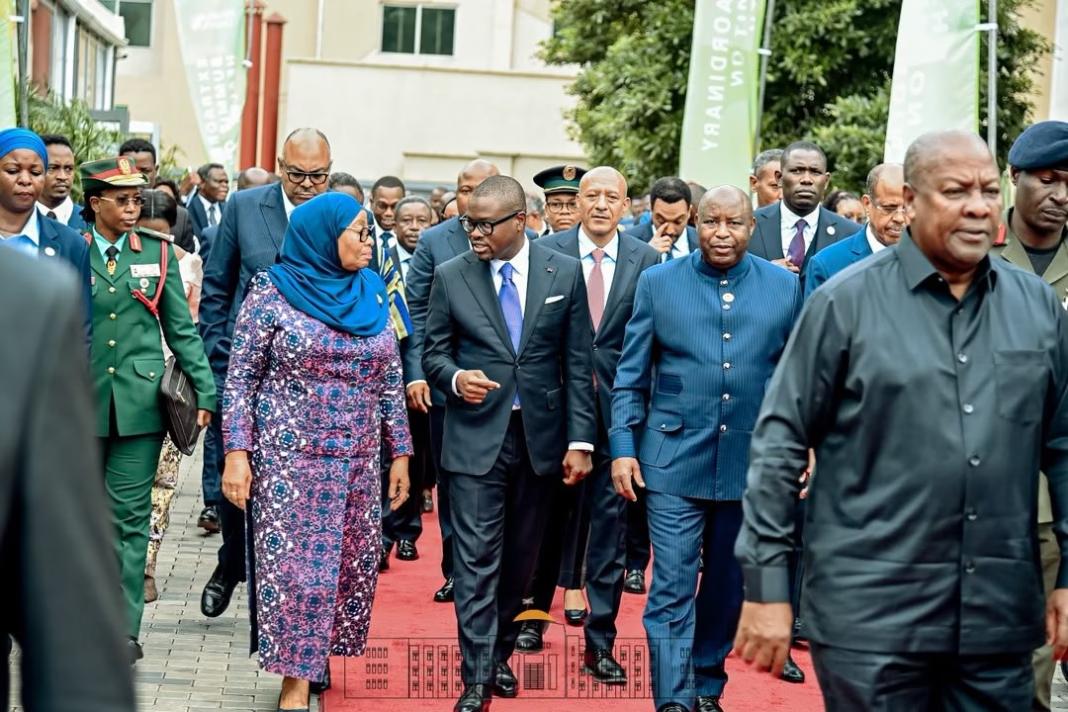
The commitment came Wednesday at the 20th Extraordinary Session of the African Union Assembly in Accra, Ghana, where heads of state adopted the Accra Declaration, a roadmap aimed at advancing universal health coverage while reducing Africa’s dependence on imported medical products and external funding. The summit was chaired by Burundi President Évariste Ndayishimiye in his capacity as chairperson of the African Union.
The declaration reflects a growing shift in Africa’s health strategy following lessons from the COVID-19 pandemic, which exposed the continent’s heavy reliance on imported medicines, vaccines and medical supplies. It also comes as many African countries confront uncertainty over international health financing, prompting governments to seek more sustainable domestic solutions.
Among the summit’s key priorities were expanding local pharmaceutical manufacturing, increasing domestic health financing, strengthening political accountability and improving access to essential medicines.
“The future of Africa’s health depends on our ability to produce our own solutions,” Ndayishimiye said in closing remarks, according to the Burundian presidency. He urged African governments to build what he described as “an Africa that heals itself, that produces its own responses, and that no longer endures but anticipates.”
The African Union has increasingly framed pharmaceutical manufacturing as both a public health and economic priority. During the summit, leaders reaffirmed that strengthening regional production of medicines, vaccines and diagnostics would improve preparedness for future health emergencies while reducing dependence on global supply chains.
The summit also highlighted the challenge of financing Africa’s health systems as external assistance becomes less predictable.
Addressing the assembly, African Union Commission Chairperson Mahmoud Ali Youssouf called for a transition from political declarations to measurable implementation.
“Africa’s health sovereignty depends on stronger domestic financing, local manufacturing of medicines and vaccines, robust regulatory systems, research and innovation, and sustained political leadership,” Youssouf said, urging member states to translate the Accra Declaration into concrete national action.
The emphasis on self-financing was echoed by World Health Organization Director-General Tedros Adhanom Ghebreyesus, who warned that declining external funding threatens decades of progress against HIV, tuberculosis and other diseases.
“But Africa still carries the heaviest burden, and as external funding declines, we risk losing ground,” Tedros told the summit, urging governments to increase domestic investment in primary healthcare and local manufacturing.
The AU meeting was convened to review progress toward ending AIDS and tuberculosis by 2030, reducing preventable maternal and child deaths, tackling non-communicable and neglected tropical diseases, and strengthening health systems across the continent.
According to the African Union, Africa has reduced AIDS-related deaths by approximately 74% since 2004, but those gains are increasingly at risk because of uncertain donor financing. The organization is encouraging member states to honor the 2001 Abuja Declaration, under which governments pledged to allocate at least 15% of national budgets to health, a target many countries have yet to achieve.
For Burundi, the declaration aligns with broader regional efforts within the East African Community to strengthen pharmaceutical production and improve preparedness for infectious disease outbreaks. While the country imports most of its medicines, increased regional manufacturing could improve access to essential medical products and reduce vulnerability to global supply disruptions.
The Accra Declaration also calls for stronger governance, improved accountability and regular monitoring of commitments made by African governments, signalling a shift from donor-driven health responses toward greater continental ownership of healthcare financing and delivery.